
Cambridge C1 Advanced Reading practice test 6
- Engineered to the real Cambridge format
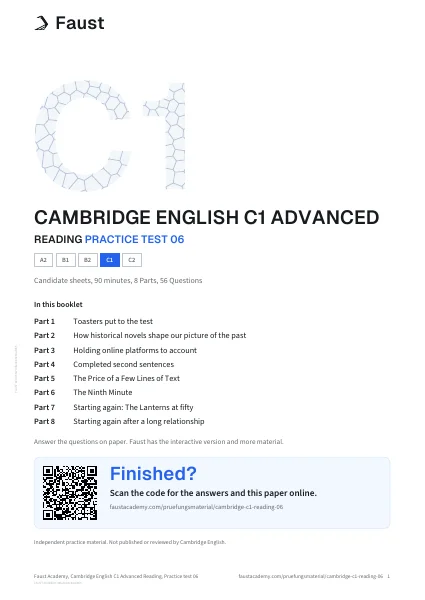
Cambridge C1 Advanced Reading practice test 6 is a reading paper for the Cambridge C1 Advanced exam. It takes 90 minutes. The PDF has 20 pages and 8 sections. You can download the PDF for free, with no account. You can also practise it online.
Updated 17 November 2026, Faust Academy team
In this paper
- Toasters put to the test
- How historical novels shape our picture of the past
- Holding online platforms to account
- Completed second sentences
- The Price of a Few Lines of Text
Exam material is in English.
Every PDF is free. How Faust marks
Independent Faust practice material. Not published or endorsed by the Cambridge University Press and Assessment.
Inside the paper
Part 1
For questions 1-8, read the text below and decide which answer (A, B, C or D) best fits each gap. There is an example at the beginning (0). Mark your answers on the separate answer sheet.
Toasters put to the test
Most of us simply take it for (0) granted that a toaster will do its job. Yet many models (1) ........ to produce an evenly browned slice, so the results of recent comparative tests make uncomfortable reading. Reviewers who put a range of toasters through their (2) ........ concluded that price was a poor guide to quality. The cheaper models had a (3) ........ to scorch the edges of the bread while leaving the middle pale. Yet testers were (4) ........ by how little separated the best performers from those in the middle of the field. A toaster that looks elegant on the worktop may still (5) ........ short once the bread goes in, and several handsome, expensive machines did precisely that. Slot width proved a (6) ........ factor for thick, crusty loaves, which jammed in the narrower models. Anyone who favours sourdough or farmhouse bread would be wise to check the dimensions before buying. (7) ........ the best performers cost little more than the worst, buyers have scant reason to pay a premium. Few of the manufacturers' claims about energy saving (8) ........ up to scrutiny in the tests, which suggests that the figures printed on the box deserve a healthy dose of scepticism. In short, independent results are a safer guide than the packaging.
Example
0. Most of us simply take it for (0) ........ that a toaster will do its job.
A) given
B) certain
C) sure
D) granted
Answer: D
1. Yet many models (1) ........ to produce an evenly browned slice, so the results of recent comparative tests make uncomfortable reading.
A) neglect
B) lack
C) fail
D) miss
2. Reviewers who put a range of toasters through their (2) ........ concluded that price was a poor guide to quality.
A) tests
B) steps
C) rounds
D) paces
3. The cheaper models had a (3) ........ to scorch the edges of the bread while leaving the middle pale.
A) tendency
B) habit
C) trend
D) custom
4. Yet testers were (4) ........ by how little separated the best performers from those in the middle of the field.
A) hit
B) caught
C) struck
D) marked
5. A toaster that looks elegant on the worktop may still (5) ........ short once the bread goes in, and several handsome, expensive machines did precisely that.
A) come
B) fall
C) run
D) stand
6. Slot width proved a (6) ........ factor for thick, crusty loaves, which jammed in the narrower models.
A) conclusive
B) definite
C) determined
D) decisive
7. (7) ........ the best performers cost little more than the worst, buyers have scant reason to pay a premium.
A) Provided that
B) Given that
C) Even if
D) In case
8. Few of the manufacturers' claims about energy saving (8) ........ up to scrutiny in the tests, which suggests that the figures printed on the box deserve a healthy dose of scepticism.
A) came
B) lay
C) stood
D) kept
How historical novels shape our picture of the past
For questions 9 to 16, read the text below and think of the word which best fits each gap. Use only one word in each gap. There is an example at the beginning (0). Write your answers IN CAPITAL LETTERS on the separate answer sheet.
How historical novels shape our picture of the past
It is a curious fact that many people's ideas about medieval medicine come not from textbooks but from novels. Few of us could name a single medieval physician, yet most of us feel we know how one worked. Such is the power of a good story that readers rarely stop to ask which details were invented and which were recorded. Historians may protest, but no matter how carefully they correct the record, the fictional version tends to linger in the public imagination. A reader who has followed a fictional healer through a year of plague is unlikely to be persuaded by a footnote that the scene never took place. Some scholars, many of whom have advised film and television productions, have therefore learnt to work with storytellers rather than against them. They would sooner embrace the genre than condemn it, since it draws people towards a subject they might otherwise never have considered. The real danger lies not in fiction itself but in the assumption that everything in it is accurate. As long as readers remember they are holding a story, little harm is done. A good novel can even send them to the archives themselves, which is surely a welcome outcome. Indeed, the most thoughtful authors add an afterword in which they separate fact from invention.
Example
How historical novels shape our picture of the past
It is a curious fact that many people's ideas about medieval medicine come not from textbooks but from novels.
9. It is a curious fact (0) ........ many people's ideas about medieval medicine come not from textbooks but from novels. Few of us could name a single medieval physician, yet most of us feel we know how one worked. Such is the power of a good story {{9}} readers rarely stop to ask which details were invented and which were recorded. Historians may protest, but {{10}} matter how carefully they correct the record, the fictional version tends to linger in the public imagination.
10. It is a curious fact (0) ........ many people's ideas about medieval medicine come not from textbooks but from novels. Few of us could name a single medieval physician, yet most of us feel we know how one worked. Such is the power of a good story {{9}} readers rarely stop to ask which details were invented and which were recorded. Historians may protest, but {{10}} matter how carefully they correct the record, the fictional version tends to linger in the public imagination.
11. A reader who has followed a fictional healer through a year of plague is unlikely to be persuaded {{11}} a footnote that the scene never took place. Some scholars, many of {{12}} have advised film and television productions, have therefore learnt to work with storytellers rather than against them. They would sooner embrace the genre {{13}} condemn it, since it draws people towards a subject they might otherwise never have considered.
12. A reader who has followed a fictional healer through a year of plague is unlikely to be persuaded {{11}} a footnote that the scene never took place. Some scholars, many of {{12}} have advised film and television productions, have therefore learnt to work with storytellers rather than against them. They would sooner embrace the genre {{13}} condemn it, since it draws people towards a subject they might otherwise never have considered.
13. A reader who has followed a fictional healer through a year of plague is unlikely to be persuaded {{11}} a footnote that the scene never took place. Some scholars, many of {{12}} have advised film and television productions, have therefore learnt to work with storytellers rather than against them. They would sooner embrace the genre {{13}} condemn it, since it draws people towards a subject they might otherwise never have considered.
14. The real danger lies not in fiction itself but in the assumption that everything in it is accurate. {{14}} long as readers remember they are holding a story, little harm is done. A good novel can even send them to the archives themselves, {{15}} is surely a welcome outcome. Indeed, the most thoughtful authors add an afterword {{16}} which they separate fact from invention.
15. The real danger lies not in fiction itself but in the assumption that everything in it is accurate. {{14}} long as readers remember they are holding a story, little harm is done. A good novel can even send them to the archives themselves, {{15}} is surely a welcome outcome. Indeed, the most thoughtful authors add an afterword {{16}} which they separate fact from invention.
16. The real danger lies not in fiction itself but in the assumption that everything in it is accurate. {{14}} long as readers remember they are holding a story, little harm is done. A good novel can even send them to the archives themselves, {{15}} is surely a welcome outcome. Indeed, the most thoughtful authors add an afterword {{16}} which they separate fact from invention.
Holding online platforms to account
For questions 17 to 24, read the text below. Use the word given in capitals at the end of some of the lines to form a word that fits in the gap in the same line. There is an example at the beginning (0). Write your answers IN CAPITAL LETTERS on the separate answer sheet.
Holding online platforms to account
For years, the debate about harmful online content has been shaped by one dominant idea: that platforms are neutral carriers of information, not publishers, and therefore cannot be expected to answer for what individuals choose to post. That argument is now looking increasingly fragile. Social media companies design systems that decide what millions of people see, and they have remained largely unaccountable for the consequences of those decisions. Anyone who has tried to report abusive messages knows how the procedure can be a lengthy one, with no guarantee of a reply. Meanwhile, the content that provokes the strongest reactions tends to spread fastest, because outrage keeps people scrolling, which proves highly profitable for the platforms themselves. Companies have shown little willingness to alter this model, preferring to promise voluntary improvements rather than accept binding obligations. It is undeniable that the harm to those targeted is real; lawyers who represent victims describe lasting damage to careers and health. Campaigners argue that an effective intervention will require the law to treat platforms more like other industries whose products can cause harm. Yet governments must take care not to restrict legitimate speech unnecessarily since open debate remains the lifeblood of any democratic society. Ultimately, the effectiveness of any new rules will depend less on their wording than on whether regulators have the power to enforce them.
Example
Holding online platforms to account
For years, the debate about harmful online content has been shaped by one dominant idea: that platforms are neutral carriers of information.
17. millions of people see, and they have remained largely {{17}} ACCOUNT
18. abusive messages knows how the procedure can be a {{18}} one, LENGTH
19. scrolling, which proves highly {{19}} for the platforms themselves. PROFIT
20. Companies have shown little {{20}} to alter this model, preferring WILL
21. It is {{21}} that the harm to those targeted is real; DENY
22. Campaigners argue that an effective {{22}} will require the law to treat INTERVENE
23. Yet governments must take care not to restrict legitimate speech {{23}} NECESSARY
24. Ultimately, the {{24}} of any new rules will depend less on EFFECTIVE
Part 4
For questions 25 to 30, complete the second sentence so that it has a similar meaning to the first sentence, using the word given. Do not change the word given. You must use between three and six words, including the word given. Here is an example (0). Write only the missing words IN CAPITAL LETTERS on the separate answer sheet.
Completed second sentences
Researchers were not given access to the files until last year. No sooner had Mira sat down at her desk than the phone rang. I wish I had booked the earlier train. The new tram line has fallen far short of people's expectations. The café can't have been open when we passed, because the lights were off. Hugo apologised for forgetting about the deadline.
Example
Example
Lena said she would definitely not sign the contract. REFUSED Lena ............ the contract.
25. Researchers {{25}} the files until last year.
26. No {{26}} down at her desk than the phone rang.
27. I {{27}} the earlier train.
28. The new tram line has {{28}} people's expectations.
29. The café {{29}} open when we passed, because the lights were off.
30. Hugo {{30}} about the deadline.
Part 5
You are going to read the introduction to a book about how the aviation industry responds to hoax security threats. For questions 31-36, choose the answer (A, B, C or D) which you think fits best according to the text. Mark your answers on the separate answer sheet.
The Price of a Few Lines of Text
Every year, among the millions of flights that cross the world's airspace, a few hundred crews are told that a bomb has been placed on board. Almost without exception, nothing is found. Security specialists will say that a genuine plot announced in advance by a warning is vanishingly rare, since anyone seriously intending harm has little reason to give notice of it. Yet the rules governing the response leave no room for that reasoning. A reported threat must be treated as real until it has been shown otherwise, so the aircraft is diverted or held, passengers are taken off, the hold is searched item by item, and crews who have reached their permitted hours must be replaced. The bill bears no relation to how plausible the message was. A scribbled line from a bored teenager and a note apparently written by someone with inside knowledge set exactly the same machinery in motion. This book is about that machinery: why it exists, what it costs and whether it can be made to work better. Why, then, does so little happen to the people responsible? Anyone expecting a steady procession of offenders into the dock will be disappointed. Most threats arrive through online services built to conceal the sender's identity, and the messages are commonly routed through servers in several countries before they reach the airline. To follow such a trail, investigators in one country must ask agencies in others for help, and every request has to pass through its own legal channels. The process takes months. By the time the records are finally in hand, the accounts have usually been closed, the devices thrown away and the trail has gone cold. The few cases that do reach court tend to involve careless individuals, and they say little about the rest. The public, meanwhile, learns of these incidents mainly from news bulletins. A flight diverted to a distant airport is a gift to a producer: fire engines lined up beside the runway, a passenger's shaky footage of an evacuation slide, a presenter announcing in a grave voice that a plane has been 'forced down'. Rarely does the story reach the point, often hours later, at which the aircraft is declared safe, and when it does, it is a single sentence beneath the next headline. Viewers who have watched the pictures could be forgiven for thinking the sky a perilous place, though the likeliest outcome of any such alert is a late dinner and a hotel voucher. The officials who handle these cases know how seldom a threat is real. Standard procedure is a blunt instrument: to deal with a message that in nearly every case proves empty, it holds an entire aircraft for the best part of a day and lets the delay spread to every flight that aircraft was due to operate. How much does all this cost? Nobody can say with confidence. Airlines rarely publish what hoax threats cost them, partly for fear of encouraging imitators who would be delighted to learn how much a few lines of text can achieve. That reluctance leaves researchers and regulators without reliable figures, and discussion of the problem therefore rests on estimates assembled from fuel, landing fees, hotel rooms and compensation claims, none of which are recorded in a uniform way. A single diversion of a long-haul flight can run into six figures, according to some of those who have worked on such cases, but others count only direct expenses and ignore the knock-on delays to the flights the aircraft was due to operate later. Without a shared basis for comparison, it is hard to judge whether any proposed remedy is worth paying for. Because a message costs nothing to send and its author may be anywhere in the world, I do not believe that threats can realistically be stopped before they are written. The better prospect lies elsewhere: in shortening and organising the checks that follow, so that an aircraft is cleared in hours rather than half a day; in agreed arrangements for feeding and housing passengers who find themselves stranded in unplanned places; in crew rosters and spare aircraft that absorb a diversion without spreading it across the network. None of this means lowering the guard. The chance, however small, that a threat is real is the reason the procedure exists, and every search must remain thorough. The task is to make thoroughness cheaper, quicker and less miserable for everyone involved. The chapters that follow set out how some airports and airlines have begun to do so.
31. What point does the writer make about hoax bomb threats in the first paragraph?
A) They have become harder to tell apart from genuine warnings as hoaxers copy official language
B) Their chief cost to airlines is the damage they do to passengers' confidence in flying
C) Their disruptive effect does not depend on anyone actually believing them
D) They are far more frequent than the travelling public generally realises
32. According to the writer, why are few of those responsible for hoax threats ever brought to court?
A) Following a message back to its sender is slow and often leads beyond national borders
B) Airlines are reluctant to pursue cases that would attract further publicity
C) Prosecutors struggle to prove that the sender meant to cause real harm
D) The penalties available are too light to justify the expense of a trial
33. What is the writer's attitude to the way news coverage treats a diverted flight?
A) Appreciative of the pressure it puts on airlines to act quickly
B) Resigned to the fact that it will always exaggerate what has happened
C) Understanding of editors who feel obliged to report every incident
D) Concerned that it creates an impression of danger out of keeping with the evidence
34. What does the writer mean by describing standard procedure as 'a blunt instrument'?
A) It is unpopular with the staff who have to carry it out
B) It causes far more disruption than most cases actually require
C) It delays the response to the rare threat that is genuine
D) It is out of date because it was designed for a different kind of danger
35. In the fourth paragraph, what does 'that reluctance' refer to?
A) Security agencies' unwillingness to share intelligence with one another
B) Passengers' unwillingness to complain after a long diversion
C) Airlines' unwillingness to say how much hoax threats cost them
D) Governments' unwillingness to fund research into the problem
36. What does the writer conclude about where the industry should concentrate its efforts?
A) On bringing in the police at an earlier stage, so that airlines act on their advice
B) On developing better technology for identifying the senders of threats more quickly
C) On limiting the disruption each incident causes, since stopping threats being sent is unrealistic
D) On pressing governments for tougher sentences, so that deterrence reduces the number of threats
Part 6
You are going to read four reviews of a book about the habit of pressing the snooze button and what it does to our mornings. For questions 37-40, choose from the reviews A-D. The reviews may be chosen more than once.
The Ninth Minute
Four reviewers comment on Tomas Ellery's book about the snooze button A Reviewer A Tomas Ellery's The Ninth Minute is at its best when it stops asking what the snooze button does to our bodies and starts asking why we press it. The sleep research he draws on is summarised with care, and he is honest about where experts remain unsure, but the physiology is the less interesting half of the story. Far more telling are his accounts of dread before a difficult meeting, of parents stealing a few minutes of peace, of people who simply cannot face the day. The habit, he suggests, is a small window onto how we live. His humour, light but never cruel, makes these portraits easy company. My reservation concerns the advice at the end. It assumes a fixed working day, with a regular alarm and a predictable bedtime, and so offers little to readers whose shifts change from week to week. B Reviewer B Ellery has plainly read widely, and his handling of the laboratory evidence is scrupulous: he reports what the studies measured, notes how few people took part, and resists claiming more than the data allow. I wanted more of this, since the book's real interest lies in what repeated alarms do to alertness, mood and the hours before breakfast. Unfortunately, the practical programme in the closing chapters is designed for someone with a regular timetable, the same start every morning and a stable evening. Anyone working nights or rotating shifts will find it of little use. What troubled me most, though, was the tone. Ellery's jokes about the 'hopeless sleepers' among us may amuse the well rested, but they make light of those for whom waking is a genuine struggle, and the condescension grows wearisome. C Reviewer C A book about alarm clocks sounds a dry prospect, yet Ellery keeps the reader turning pages. His humour does the work that a lecture could not, drawing us into the subject and making technical material feel approachable. He is a careful guide to the research, separating firm results from guesswork, and his conclusions are measured. But the real value of the book lies elsewhere. What the snooze habit reveals about our lives, our worries, our relationships, our sense of being owed a little more time, seems to me far more worth reading about than any change in hormone levels. The suggestions for change are sensible and easy to try, even if few readers will follow all of them. I would have liked more of the author's own mornings, which are the funniest passages, but this is a minor complaint. D Reviewer D Ellery writes with infectious energy, and his comic set pieces about the snooze button are the book's chief pleasure. They never belittle the reader, and I read them with real gratitude. The trouble begins when the jokes give way to instruction. The author devotes his central chapters to what extra minutes in bed do to the body, and from a handful of small and tentative studies he draws confident rules: set one alarm, rise at once, never doze again. The findings are simply too slight to carry that weight, and a more cautious writer would have said so. The closing checklist is clear and brief, and many readers will find it easy to put into practice, but I could not shake the feeling that its authority had been borrowed from evidence that cannot lend it.
37. Which reviewer has a different opinion from the others on how carefully the author uses scientific research?
A) Reviewer A
B) Reviewer B
C) Reviewer C
D) Reviewer D
38. Which reviewer shares reviewer A's opinion on whether the reasons people snooze matter more than its physical effects?
A) Reviewer A
B) Reviewer B
C) Reviewer C
D) Reviewer D
39. Which reviewer expresses a similar view to reviewer B regarding how far the book helps readers whose working hours are irregular?
A) Reviewer A
B) Reviewer B
C) Reviewer C
D) Reviewer D
40. Which reviewer has a different view from reviewer C on the effect of the author's humorous tone?
A) Reviewer A
B) Reviewer B
C) Reviewer C
D) Reviewer D
Part 7
You are going to read an extract from a magazine article. Six paragraphs have been removed from the extract. Choose from the paragraphs A-G the one which fits each gap (41-46). There is one extra paragraph which you do not need to use. Mark your answers on the separate answer sheet.
Starting again: The Lanterns at fifty
Mairi Calder stops the song after a single verse. She does not explain herself; she simply raises one hand, and Ewan Rask lets his sticks drop onto the snare. It is a Tuesday afternoon in a rehearsal room above a carpet warehouse in Dundee, and The Lanterns, who this month mark fifty years together, are doing what they have always done: beginning again. Calder, Rask, bassist Callum Dey and guitarist Priya Nair met at school in 1976, and the line-up has never changed, a record few bands of their generation can match. Their anniversary tour opens in March, and a new album must be ready before it. Nobody in the room sighs or checks a phone. Nair retunes a string, Dey cracks his knuckles, and Rask counts them in once more. __(41)__ Such thrift was typical of the early years. The four friends rehearsed in Rask's grandmother's garage, shared a single amplifier, and bought new strings only when a broken one could no longer be knotted back together. Calder wrote most of the early lyrics on the backs of bus tickets, partly because paper was dear and partly, she admits, because it forced her to be brief. 'We were not ambitious,' Nair says. 'We were just very careful, because there was never any money to be careless with.' For the best part of seven years the four friends played pubs and church halls across the north-east, usually for a plate of sandwiches and the promise of another booking. __(42)__ That distance showed in the arguments of 1989. Success had brought money, and money had brought lawyers, managers and a new habit of asking who deserved what. Rehearsals became silent affairs in which each of them addressed the others through the drummer. Calder and Nair each remembered composing the opening melody of 'Salt Road'; Rask, who had never claimed a lyric in his life, was weary of being asked to take sides; and Dey, in his own words, 'stopped answering the phone'. By October the band came within a week of splitting over who had written the song. __(43)__ The arrangement has held for more than thirty years. It has spared them the bitterness that dogs so many successful groups, and it has meant that nobody has had to pretend, at an awards dinner or in an interview, that a hit belonged to one pair of hands. Royalties arrive in four equal parts, and arguments about them, Rask says, 'are now confined to who pays for lunch'. Friends in the business still ask whether the pact is a legal document; it is, in fact, a single sheet of paper kept in Nair's kitchen drawer. It has also, by common consent, made them very hard to dislike. __(44)__ The band's answer to that criticism was a decision rather than a defence. Instead of explaining why compromise had served them well, they looked again at the long, polished sessions that had produced their last three records and resolved to change the way they record. __(45)__ Which brings us back to the rehearsal room, where the chorus is still not right. Dey mouths the count, and Nair frowns at her fretboard as though it had let her down. Calder starts the song again, for the third time that afternoon. __(46)__
41. Gap 41
A) The decision was typical of a band that has learnt to treat its own caution as the enemy. The new album, recorded live in six days at a disused chapel near Arbroath, has no overdubs at all, and several tracks keep the false starts that earlier producers would have cut
B) It was Dey who found a way out. At a meeting in a Glasgow café he proposed that every song be credited to all four members, whatever its true origin, and that nobody should ever again discuss who had contributed what
C) When the song finally runs from first note to last, nobody applauds and nobody looks surprised. Calder lifts her guitar strap over her head and asks whether anyone would like tea
D) The habit is older than the band's success. In 1976, with only an hour of cheap studio time booked, they discovered that a song abandoned at the first mistake could be rescued by simply beginning again, which cost seconds rather than money
E) Not everyone admires the result. Some critics argue that a pact which shares every credit equally produces music that offends nobody and thrills nobody, and Nair concedes that the band had begun to agree to things too quickly
F) Tribute acts have long made a living from the band's songs, and the members say they enjoy the attention. Dey recalls watching one such group in Hull, whose bass player wore a wig in his honour
G) Recognition arrived slowly, then all at once. 'Salt Road' reached the top ten in 1983, and within two years the friends who had once shared a van were being driven to concerts in separate cars
42. Gap 42
A) The decision was typical of a band that has learnt to treat its own caution as the enemy. The new album, recorded live in six days at a disused chapel near Arbroath, has no overdubs at all, and several tracks keep the false starts that earlier producers would have cut
B) It was Dey who found a way out. At a meeting in a Glasgow café he proposed that every song be credited to all four members, whatever its true origin, and that nobody should ever again discuss who had contributed what
C) When the song finally runs from first note to last, nobody applauds and nobody looks surprised. Calder lifts her guitar strap over her head and asks whether anyone would like tea
D) The habit is older than the band's success. In 1976, with only an hour of cheap studio time booked, they discovered that a song abandoned at the first mistake could be rescued by simply beginning again, which cost seconds rather than money
E) Not everyone admires the result. Some critics argue that a pact which shares every credit equally produces music that offends nobody and thrills nobody, and Nair concedes that the band had begun to agree to things too quickly
F) Tribute acts have long made a living from the band's songs, and the members say they enjoy the attention. Dey recalls watching one such group in Hull, whose bass player wore a wig in his honour
G) Recognition arrived slowly, then all at once. 'Salt Road' reached the top ten in 1983, and within two years the friends who had once shared a van were being driven to concerts in separate cars
43. Gap 43
A) The decision was typical of a band that has learnt to treat its own caution as the enemy. The new album, recorded live in six days at a disused chapel near Arbroath, has no overdubs at all, and several tracks keep the false starts that earlier producers would have cut
B) It was Dey who found a way out. At a meeting in a Glasgow café he proposed that every song be credited to all four members, whatever its true origin, and that nobody should ever again discuss who had contributed what
C) When the song finally runs from first note to last, nobody applauds and nobody looks surprised. Calder lifts her guitar strap over her head and asks whether anyone would like tea
D) The habit is older than the band's success. In 1976, with only an hour of cheap studio time booked, they discovered that a song abandoned at the first mistake could be rescued by simply beginning again, which cost seconds rather than money
E) Not everyone admires the result. Some critics argue that a pact which shares every credit equally produces music that offends nobody and thrills nobody, and Nair concedes that the band had begun to agree to things too quickly
F) Tribute acts have long made a living from the band's songs, and the members say they enjoy the attention. Dey recalls watching one such group in Hull, whose bass player wore a wig in his honour
G) Recognition arrived slowly, then all at once. 'Salt Road' reached the top ten in 1983, and within two years the friends who had once shared a van were being driven to concerts in separate cars
44. Gap 44
A) The decision was typical of a band that has learnt to treat its own caution as the enemy. The new album, recorded live in six days at a disused chapel near Arbroath, has no overdubs at all, and several tracks keep the false starts that earlier producers would have cut
B) It was Dey who found a way out. At a meeting in a Glasgow café he proposed that every song be credited to all four members, whatever its true origin, and that nobody should ever again discuss who had contributed what
C) When the song finally runs from first note to last, nobody applauds and nobody looks surprised. Calder lifts her guitar strap over her head and asks whether anyone would like tea
D) The habit is older than the band's success. In 1976, with only an hour of cheap studio time booked, they discovered that a song abandoned at the first mistake could be rescued by simply beginning again, which cost seconds rather than money
E) Not everyone admires the result. Some critics argue that a pact which shares every credit equally produces music that offends nobody and thrills nobody, and Nair concedes that the band had begun to agree to things too quickly
F) Tribute acts have long made a living from the band's songs, and the members say they enjoy the attention. Dey recalls watching one such group in Hull, whose bass player wore a wig in his honour
G) Recognition arrived slowly, then all at once. 'Salt Road' reached the top ten in 1983, and within two years the friends who had once shared a van were being driven to concerts in separate cars
45. Gap 45
A) The decision was typical of a band that has learnt to treat its own caution as the enemy. The new album, recorded live in six days at a disused chapel near Arbroath, has no overdubs at all, and several tracks keep the false starts that earlier producers would have cut
B) It was Dey who found a way out. At a meeting in a Glasgow café he proposed that every song be credited to all four members, whatever its true origin, and that nobody should ever again discuss who had contributed what
C) When the song finally runs from first note to last, nobody applauds and nobody looks surprised. Calder lifts her guitar strap over her head and asks whether anyone would like tea
D) The habit is older than the band's success. In 1976, with only an hour of cheap studio time booked, they discovered that a song abandoned at the first mistake could be rescued by simply beginning again, which cost seconds rather than money
E) Not everyone admires the result. Some critics argue that a pact which shares every credit equally produces music that offends nobody and thrills nobody, and Nair concedes that the band had begun to agree to things too quickly
F) Tribute acts have long made a living from the band's songs, and the members say they enjoy the attention. Dey recalls watching one such group in Hull, whose bass player wore a wig in his honour
G) Recognition arrived slowly, then all at once. 'Salt Road' reached the top ten in 1983, and within two years the friends who had once shared a van were being driven to concerts in separate cars
46. Gap 46
A) The decision was typical of a band that has learnt to treat its own caution as the enemy. The new album, recorded live in six days at a disused chapel near Arbroath, has no overdubs at all, and several tracks keep the false starts that earlier producers would have cut
B) It was Dey who found a way out. At a meeting in a Glasgow café he proposed that every song be credited to all four members, whatever its true origin, and that nobody should ever again discuss who had contributed what
C) When the song finally runs from first note to last, nobody applauds and nobody looks surprised. Calder lifts her guitar strap over her head and asks whether anyone would like tea
D) The habit is older than the band's success. In 1976, with only an hour of cheap studio time booked, they discovered that a song abandoned at the first mistake could be rescued by simply beginning again, which cost seconds rather than money
E) Not everyone admires the result. Some critics argue that a pact which shares every credit equally produces music that offends nobody and thrills nobody, and Nair concedes that the band had begun to agree to things too quickly
F) Tribute acts have long made a living from the band's songs, and the members say they enjoy the attention. Dey recalls watching one such group in Hull, whose bass player wore a wig in his honour
G) Recognition arrived slowly, then all at once. 'Salt Road' reached the top ten in 1983, and within two years the friends who had once shared a van were being driven to concerts in separate cars
Starting again after a long relationship
You are going to read a magazine article in which five relationship counsellors give advice about making a fresh start after a long relationship ends. For questions 47-56, choose from the counsellors (A-E). The counsellors may be chosen more than once. Mark your answers on the separate answer sheet.
Starting again after a long relationship
Ending a partnership of many years can feel like stepping off a moving train. We asked five counsellors how to make a fresh start without storing up regrets. A Helen Marsh Many people who leave a long relationship are startled to find that their first sensation is not despair but a kind of lightness, and they promptly feel they ought to be ashamed of it. I would urge them to resist that reading. Feeling lighter does not mean you were cruel, or wrong; guilt and rightness are two separate questions, and only the second can be settled by thinking calmly about what the relationship had become. Be wary, too, of the chorus around you. Friends love you and will rally round, but they have heard only your version, so their certainty can mislead. A friend who declares that your ex was impossible all along is being loyal rather than accurate. Listen warmly, then form your own view of what went wrong, ideally including the part you played in it. B Dev Chaudhry People tend to brace themselves for the worst on the day they separate, and then feel oddly capable for weeks afterwards. There are keys to return, a lease to renegotiate, a sofa to be divided, and all that activity keeps the mind busy. The sense of loss often comes months later, when the boxes are unpacked and the evenings are suddenly quiet, so do not assume you have escaped it. I would also encourage couples to deal with the dull side early. However amicable the conversation, get financial arrangements down on paper: who pays what into the joint account, who keeps the deposit, how any loan will be cleared. Good intentions fade faster than a signed note, and clear terms spare both of you resentment at a time when you will have very little patience left. C Ingrid Larsen After eight or ten years together, the urge to tidy everything away at once is strong. Resist it. Leave irreversible choices, such as selling the flat or changing jobs, until the first storm has passed, because the person making those decisions in the first fortnight is rarely the person who will have to live with them. A period of distance can be sensible, and some couples find that it gives each of them room to think. But a pause works only if you both agree when it ends; otherwise one of you counts the days while the other quietly assumes it is permanent. Name a date, even a loose one such as the end of next month, and agree what happens then. You needn't fill every evening with plans in the meantime. Rest is part of the process. D Tomás Reyes Long partnerships shape us gently, and often we notice only afterwards what we gave up. Go back to the things you quietly dropped when you became a couple: the choir, the swimming, the dreadful but cheerful five-a-side football. They remind you who you were before you became half of a pair, and they bring you into contact with people who know you only as yourself. I understand the temptation to pack a rucksack and vanish for six months. But a long journey merely takes the same worries to a new place, and you will unpack them in a hostel instead of a flat. Travel by all means if you have always longed to, but do it because you want the trip, not because you want to avoid your own front door. E Priya Nandakumar The conversation in which you tell your partner is the one people rehearse most and handle least well. Think carefully about what you want to say, then build it around yourself. Talk about what you need, not about what they did wrong. 'I have been unhappy for a long time' invites a response; 'you never listened' invites a defence. And hold your script lightly. Their reaction may be nothing like the one you rehearsed: someone you expect to rage may sit in silence, while someone you expect to accept it calmly may plead or turn angry. Neither response is a verdict on your decision. Give them time to say what they feel, do not rush to fill the silences, and accept that you may need a second, calmer conversation later.
47. Major life decisions should wait until the first emotional upheaval has settled.
A) A Helen Marsh
B) B Dev Chaudhry
C) C Ingrid Larsen
D) D Tomás Reyes
E) E Priya Nandakumar
48. Feeling relieved about a separation is not proof that you have acted wrongly.
A) A Helen Marsh
B) B Dev Chaudhry
C) C Ingrid Larsen
D) D Tomás Reyes
E) E Priya Nandakumar
49. Take up again the interests you gave up while you were part of a couple.
A) A Helen Marsh
B) B Dev Chaudhry
C) C Ingrid Larsen
D) D Tomás Reyes
E) E Priya Nandakumar
50. Sadness may not arrive until well after the practical changes have been dealt with.
A) A Helen Marsh
B) B Dev Chaudhry
C) C Ingrid Larsen
D) D Tomás Reyes
E) E Priya Nandakumar
51. Give your reasons to the other person without laying blame.
A) A Helen Marsh
B) B Dev Chaudhry
C) C Ingrid Larsen
D) D Tomás Reyes
E) E Priya Nandakumar
52. Well-meaning friends may give you a one-sided picture of what went wrong.
A) A Helen Marsh
B) B Dev Chaudhry
C) C Ingrid Larsen
D) D Tomás Reyes
E) E Priya Nandakumar
53. Going away to escape a problem will not make it disappear.
A) A Helen Marsh
B) B Dev Chaudhry
C) C Ingrid Larsen
D) D Tomás Reyes
E) E Priya Nandakumar
54. A break from contact can help, provided both people know when it will finish.
A) A Helen Marsh
B) B Dev Chaudhry
C) C Ingrid Larsen
D) D Tomás Reyes
E) E Priya Nandakumar
55. Even if you part on friendly terms, shared money arrangements should be put in writing.
A) A Helen Marsh
B) B Dev Chaudhry
C) C Ingrid Larsen
D) D Tomás Reyes
E) E Priya Nandakumar
56. Be prepared for the other person to react differently from how you expect.
A) A Helen Marsh
B) B Dev Chaudhry
C) C Ingrid Larsen
D) D Tomás Reyes
E) E Priya Nandakumar
More papers
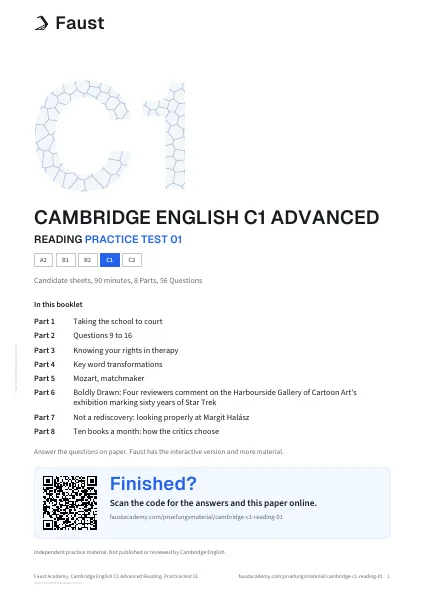
Paper 1
Taking the school to court
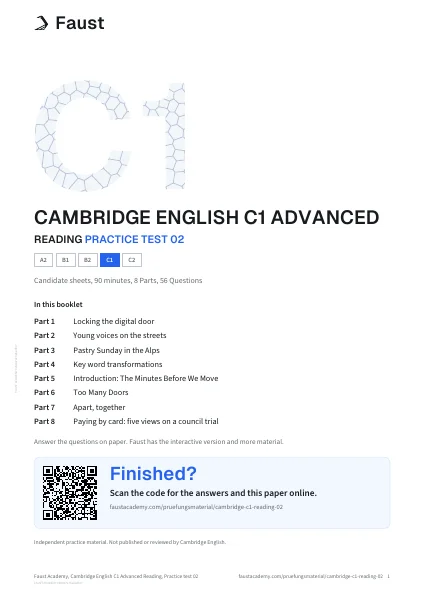
Paper 2
Locking the digital door

Paper 3
Recycling the metals behind modern technology
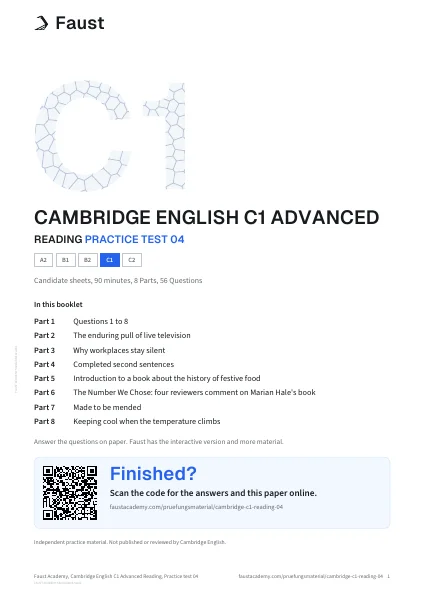
Paper 4
A new map of the heavens
Paper 5
The return of the dry-stone wall
Frequently asked questions
- How long is Cambridge C1 Advanced Reading practice test 6?
- The paper takes 90 minutes. The PDF has 20 pages, and the answer key is a separate PDF.
- Is Cambridge C1 Advanced Reading practice test 6 free?
- Yes. You can download the PDF for free, with no account. Online, one scored paper per part is free.