
Cambridge C1 Advanced Reading practice test 1
- Engineered to the real Cambridge format
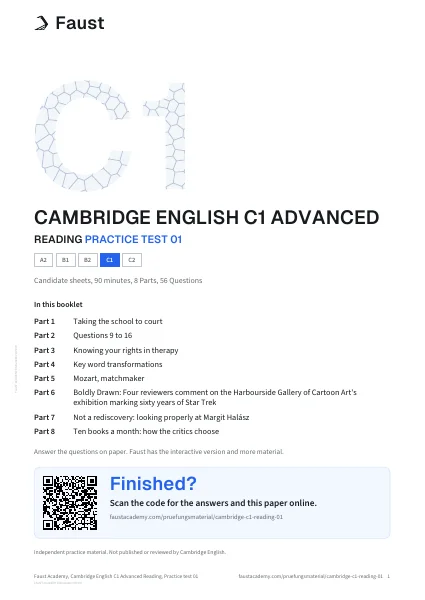
Cambridge C1 Advanced Reading practice test 1 is a reading paper for the Cambridge C1 Advanced exam. It takes 90 minutes. The PDF has 16 pages and 8 sections. You can download the PDF for free, with no account.
Updated 4 November 2026, Faust Academy team
In this paper
- Taking the school to court
- A second career in the shadows
- Knowing your rights in therapy
- Key word transformations
- Mozart, matchmaker
Exam material is in English.
Every PDF is free. How Faust marks
Independent Faust practice material. Not published or endorsed by the Cambridge University Press and Assessment.
Inside the paper
Part 1
For questions 1 to 8, read the text below and decide which answer (A, B, C or D) best fits each gap. There is an example at the beginning (0). Mark your answers on the separate answer sheet.
Taking the school to court
Cases in which former pupils take their schools to court are few and (0) far between, but one recent claim has caught the attention of teachers and parents alike. Over his last two years at a comprehensive school in the north of England, Daniel Hartley calculated that he had missed around 400 hours of lessons, a shortfall which, he argues, took its (1) ........ on his final grades. Now 20, Mr Hartley has (2) ........ a claim against the local authority responsible for the school. His case (3) ........ on the argument that the school failed in its duty to provide the education to which he was entitled. The problem, he says, was not the occasional absence of a teacher but a pattern that persisted for months. Many of the cancelled lessons were never (4) ........ up, and the gaps in the syllabus simply grew wider as the exams approached. Others were covered by supervisors who, through no (5) ........ of their own, had no expertise in the subject they were asked to teach. The local authority has (6) ........ any responsibility, pointing instead to a national shortage of qualified teachers that no single school could have resolved. Legal experts doubt that the claim will succeed, but it has already (7) ........ a wider debate about what schools owe their pupils. In particular, it raises the question of whether students whose education is seriously disrupted should have any (8) ........ when things go wrong.
Example
0. Cases in which former pupils take their schools to court are few and (0) ........ between, but one recent claim has caught the attention of teachers and parents alike.
A) far
B) wide
C) long
D) distant
Answer: A
1. Over his last two years at a comprehensive school in the north of England, Daniel Hartley calculated that he had missed around 400 hours of lessons, a shortfall which, he argues, took its (1) ........ on his final grades.
A) price
B) cost
C) toll
D) charge
2. Now 20, Mr Hartley has (2) ........ a claim against the local authority responsible for the school.
A) lodged
B) posted
C) placed
D) set
3. His case (3) ........ on the argument that the school failed in its duty to provide the education to which he was entitled.
A) lies
B) stands
C) sits
D) rests
4. Many of the cancelled lessons were never (4) ........ up, and the gaps in the syllabus simply grew wider as the exams approached.
A) caught
B) made
C) taken
D) brought
5. Others were covered by supervisors who, through no (5) ........ of their own, had no expertise in the subject they were asked to teach.
A) fault
B) blame
C) error
D) failing
6. The local authority has (6) ........ any responsibility, pointing instead to a national shortage of qualified teachers that no single school could have resolved.
A) refuted
B) rebutted
C) denied
D) disproved
7. Legal experts doubt that the claim will succeed, but it has already (7) ........ a wider debate about what schools owe their pupils.
A) fired
B) sparked
C) lit
D) struck
8. In particular, it raises the question of whether students whose education is seriously disrupted should have any (8) ........ when things go wrong.
A) resort
B) appeal
C) retreat
D) recourse
A second career in the shadows
For questions 9 to 16, read the text below and think of the word which best fits each gap. Use only one word in each gap. There is an example at the beginning (0). Write your answers IN CAPITAL LETTERS on the separate answer sheet.
A second career in the shadows
When Margaret Hale retired after four decades as an insurance claims assessor, her friends assumed she would take up gardening or perhaps join a choir. Far from slowing down, however, she set herself up as a private investigator at the age of sixty-four, and she has rarely had a quiet week since. Hale insists that her old career prepared her for the work better than any training course could have done. Spotting the gap between what people claim and what they actually do was, after all, the essence of assessing insurance claims. Rather than counting against her, her age, too, has proved to be an asset: a grey-haired woman lingering outside a café with a newspaper attracts almost no attention. Much of her work is far less glamorous than crime dramas would have us believe. Her clients are mostly employers who suspect staff of exaggerating injuries, or solicitors whose cases depend on tracing a missing witness. Long hours spent watching a doorway are the norm, and the law must never be broken, however tempting it may be to cut corners. Were she to start over, Hale says, she would make the change far sooner. Retirement, as she puts it, turned out to be not an ending but a promotion.
Example
9. When Margaret Hale retired after four decades as an insurance claims assessor, her friends assumed she would (0) ........ up gardening or perhaps join a choir. Far {{9}} slowing down, however, she set herself up as a private investigator at the age of sixty-four, and she has rarely had a quiet week since.
10. Hale insists that her old career prepared her for the work better {{10}} any training course could have done. Spotting the gap between {{11}} people claim and what they actually do was, after all, the essence of assessing insurance claims. {{12}} than counting against her, her age, too, has proved to be an asset: a grey-haired woman lingering outside a café with a newspaper attracts almost no attention.
11. Hale insists that her old career prepared her for the work better {{10}} any training course could have done. Spotting the gap between {{11}} people claim and what they actually do was, after all, the essence of assessing insurance claims. {{12}} than counting against her, her age, too, has proved to be an asset: a grey-haired woman lingering outside a café with a newspaper attracts almost no attention.
12. Hale insists that her old career prepared her for the work better {{10}} any training course could have done. Spotting the gap between {{11}} people claim and what they actually do was, after all, the essence of assessing insurance claims. {{12}} than counting against her, her age, too, has proved to be an asset: a grey-haired woman lingering outside a café with a newspaper attracts almost no attention.
13. Much of her work is far less glamorous than crime dramas would have us believe. Her clients are mostly employers who suspect staff of exaggerating injuries, or solicitors {{13}} cases depend on tracing a missing witness. Long hours spent watching a doorway are the norm, and the law must never be broken, {{14}} tempting it may be to cut corners.
14. Much of her work is far less glamorous than crime dramas would have us believe. Her clients are mostly employers who suspect staff of exaggerating injuries, or solicitors {{13}} cases depend on tracing a missing witness. Long hours spent watching a doorway are the norm, and the law must never be broken, {{14}} tempting it may be to cut corners.
15. {{15}} she to start over, Hale says, she would make the change far sooner. Retirement, {{16}} she puts it, turned out to be not an ending but a promotion.
16. {{15}} she to start over, Hale says, she would make the change far sooner. Retirement, {{16}} she puts it, turned out to be not an ending but a promotion.
Part 3
For questions 17 to 24, read the text below. Use the word given in capitals at the end of some of the lines to form a word that fits in the gap in the same line. There is an example at the beginning (0). Write your answers IN CAPITAL LETTERS on the separate answer sheet.
Knowing your rights in therapy
Most people beginning talking therapy assume that whatever they disclose will remain confidential. Many, though, remain unaware of the further rights they enjoy should the treatment itself begin to feel unhelpful. A client who is dissatisfied with the way sessions are going is not obliged to suffer in silence. After all, the quality of the therapeutic relationship is often described as central to whether treatment succeeds or fails, so persisting with a poor match makes little sense. Raising doubts need not be confrontational: a calm, honest conversation with the therapist is often the most sensible first step. Where this resolves nothing, clients may seek a second, entirely independent opinion, or ask to transfer to a different practitioner altogether. Such a request is entirely reasonable and should never be seen as a sign of weakness. Should something more serious occur, such as unethical behaviour or a breach of privacy, clients are entitled to lodge a formal complaint with the practitioner's professional body. Bringing such a complaint does not, in itself, mean that treatment must end, nor should it affect the respect with which a client is treated. Knowing all this from the outset offers considerable reassurance, especially to those who are seeking help for the very first time.
Example
17. Many, though, remain {{17}} of the further rights they enjoy AWARE
18. {{18}} with the way sessions are going is not obliged to suffer SATISFY
19. in silence. After all, the quality of the therapeutic {{19}} RELATE
20. need not be {{20}}: a calm, honest conversation CONFRONT
21. this resolves nothing, clients may seek a second, entirely {{21}} DEPEND
22. request is entirely {{22}} and should never be seen as REASON
23. {{23}} behaviour or a breach of privacy, clients are ETHIC
24. Knowing all this from the outset offers considerable {{24}}, especially to REASSURE
Part 4
For questions 25 to 30, complete the second sentence so that it has a similar meaning to the first sentence, using the word given. Do not change the word given. You must use between three and six words, including the word given. Here is an example (0). Write only the missing words IN CAPITAL LETTERS on the separate answer sheet.
Key word transformations
The director of the Harbourside Film Festival is generally believed to have treated junior staff unfairly. It was not until the builders sent me the final bill that I realised how much the renovation would cost. The decision on the new cycle lanes was put on hold by the planning committee until more data was available. I wish we had booked the cottage further in advance. The closure of the factory was mainly due to a fall in demand for its products. Sam apologised to Lucy for forgetting to send her the tickets for the rugby match.
Example
Example
You should not have left the meeting without telling anyone.
25. The director of the Harbourside Film Festival is generally {{25}} junior staff unfairly.
26. It was {{26}} me the final bill that I realised how much the renovation would cost.
27. The decision on the new cycle lanes was {{27}} the planning committee until more data was available.
28. I {{28}} the cottage further in advance.
29. The closure of the factory was {{29}} fall in demand for its products.
30. Sam {{30}} to send her the tickets for the rugby match.
Part 5
You are going to read an article about an opera company that arranges blind dates at its performances. For questions 31 to 36, choose the answer (A, B, C or D) which you think fits best according to the text. Mark your answers on the separate answer sheet.
Mozart, matchmaker
Anyone who has spent an evening swiping through dating apps will know the peculiar fatigue they induce: a parade of faces, a few half-hearted exchanges and the nagging sense that everyone would rather be elsewhere. Small wonder that many people are looking for alternatives. Few are as unexpected as the one offered by Ashcombe Opera, which this season has been pairing strangers for blind dates at its performances of Mozart's The Marriage of Figaro. When I told friends I had signed up, their reaction was almost uniformly baffled. Three hours, they pointed out, is a long time to spend beside someone you may not like, and in an opera house you cannot even talk your way out of the awkwardness. My own misgivings lay elsewhere. I could not shake off the suspicion that the whole thing was less about love than about ticket sales: a clever way of filling stubbornly empty seats on a Wednesday night, with a little romantic gloss for the press release. Nor was I reassured to learn that applicants range from season-ticket holders to people who have never set foot in an opera house; a wide net, I thought, is exactly what a marketing department would cast. Helen Marsh, the company's audience development manager, is unapologetic about how couples are paired. There is no algorithm and no tick-box form. Instead, each applicant writes a short handwritten account of a moment when a piece of music stirred them, and Marsh and two colleagues read every one. 'Ask people what they like and they'll give you a list,' she says. 'Ask them about a time music actually got to them and you learn how they feel, which tells you far more. Whether two people both love Puccini hardly matters to me. I'd happily seat a heavy-metal fan beside a choral singer if their stories suggested they'd understand each other.' The rules of the evening are simple, if slightly eccentric. Couples are given neighbouring seats for the first act but asked not to exchange a word until the interval. This is not simply a matter of theatre manners, though nobody would thank you for whispering through the overture. 'Normally a first date opens with the same old interview,' Marsh explains. 'What do you do, where are you from? Here, by the time you speak, you've just lived through an hour of music side by side. You've got something real to start from.' My own date was Daniel, a structural engineer attending his first opera. We nodded politely, sat down and the lights went out. For the next hour I was utterly absorbed; Cherubino's breathless little aria about being in love with every woman he meets left me grinning like a fool. When the curtain fell and we finally turned to each other, Daniel's verdict was brisk: he had found most of it tedious and could not see why it took a whole act for one man to hide behind a chair. I defended Mozart with more passion than I had intended, he held his ground cheerfully, and when the bell summoned us back we were still arguing and both laughing. Had we simply agreed that it was all very lovely, I suspect we would have run out of things to say before the ice creams were finished. Not everyone at Ashcombe is charmed. Some long-standing patrons have complained, in letters and in the foyer, that the scheme trivialises opera, reducing a serious art form to a backdrop for flirtation. It is an objection I struggle to take entirely seriously. The work these couples are watching is, after all, like so much of Mozart's comic output, built almost entirely on scheming lovers, disguises and a count trying to seduce his servant's fiancée. Mozart would surely not have been shocked to find his audience as preoccupied with courtship as his characters. The company hopes, naturally, that some of these first-timers will come back, and that the scheme might draw a younger crowd into a building whose audiences have been greying for years. Whether it does is a question for the box office. As for Daniel and me, we exchanged numbers, and we may or may not meet again; I find I mind rather less than I expected, and I suspect the same is true of many of the other couples. What stays with me is simpler. In an age when almost every encounter is mediated by a screen, two strangers sat in the dark and gave their undivided attention to the same thing for an hour. That, far more than any promise of romance, seems to me the real gift of the evening.
31. What was the writer's own reservation about the scheme before taking part?
A) An evening of opera seemed far too long for a first meeting between strangers
B) It appeared to be a commercial device dressed up as something romantic
C) Being matched on the basis of a questionnaire felt rather impersonal
D) People unfamiliar with opera were likely to feel out of place
32. According to Helen Marsh, the way participants are matched is intended to
A) bring together people who enjoy the same kind of music
B) ensure that newcomers are paired with experienced operagoers
C) reveal how people respond to music rather than what they say they like
D) keep the role of the company's staff as small as possible
33. Why are couples asked not to speak to each other before the interval?
A) so that other members of the audience are not disturbed
B) so that either person can leave discreetly if the match seems wrong
C) so that the evening keeps an element of mystery for as long as possible
D) so that they have a shared experience to discuss when they finally talk
34. What does the writer suggest about the conversation with Daniel during the interval?
A) It became more lively because they reacted so differently to the first act
B) It was hampered by Daniel's far greater knowledge of opera
C) It went well only once they stopped discussing the performance
D) It depended on the writer appearing to share Daniel's opinion
35. How does the writer respond to regular patrons who criticise the scheme?
A) by accepting that it risks treating serious art as entertainment
B) by pointing out that the opera itself revolves around courtship
C) by arguing that the income it brings in justifies the scheme
D) by claiming that most participants go on to become regular attendees
36. What is the writer's main conclusion about the scheme?
A) It has proved an effective way of attracting younger audiences
B) It offers a more dependable route to romance than dating apps
C) It works best for people who already have a love of opera
D) Its value lies less in any romance than in sharing a performance attentively
Part 6
You are going to read four reviews of an exhibition of cartoons marking sixty years of Star Trek. For questions 37 to 40, choose from the reviews A to D. The reviews may be chosen more than once.
Boldly Drawn: Four reviewers comment on the Harbourside Gallery of Cartoon Art's exhibition marking sixty years of Star Trek
A Reviewer one Boldly Drawn, the Harbourside Gallery of Cartoon Art's tribute to sixty years of Star Trek, occupies just two rooms, and is all the better for it. A tighter selection means that the curators have had to choose, and they have chosen well: the strongest artists are given room to breathe rather than being buried in a crowd of minor efforts. Nor do you need to be a devotee to enjoy yourself; much of the comedy springs from the universal absurdities of office life, transposed to the bridge of a starship, and my companion, who has never watched an episode, laughed as often as I did. Less persuasive are the cartoons that strain to equate the Federation with modern Westminster, where the analogy creaks audibly. And I wish the curators had trusted their material more, since a cartoon that needs a paragraph of explanation beside it has, almost by definition, been robbed of its punchline. B Reviewer two It is hard to escape the feeling that the Harbourside Gallery has stretched a modest idea rather thin. At twelve pounds a head, visitors might reasonably expect more than a couple of rooms that can be seen comfortably in under forty minutes, and too many of the pieces on display are slight variations on the same gag about doomed crew members. That said, the show is refreshingly welcoming: you need not know a warp drive from a tricorder to see the joke, as nearly every cartoon works on its own terms, and the wall texts helpfully sketch in the context of each era. But if anything justifies the trip, it is the room in which the starship becomes a vehicle for sharp comment on our own politics, from Cold War paranoia to recent quarrels over borders and migration. Here, at last, the laughter has teeth. C Reviewer three There is a good deal to admire in Boldly Drawn. The draughtsmanship is often superb, and the captions are a model of their kind, setting each cartoon against the decade that produced it so that one learns as much about the anxieties of the 1970s or the 1990s as about the series itself. The building does the work fewer favours: the rooms are so cramped that on a Saturday afternoon I spent more time peering past other visitors' shoulders than looking at the walls. More fundamentally, this is an exhibition made by enthusiasts for enthusiasts. The handful of pieces that tackle genuine social questions are outnumbered several times over by gags about tribbles, transporter mishaps and the precise wording of the Prime Directive, and anyone who cannot tell a Klingon from a Vulcan will spend much of the visit smiling politely at jokes aimed over their head. D Reviewer four Do we laugh at Star Trek, or with it? The cartoonists gathered in Boldly Drawn manage both, and the result is one of the most enjoyable shows of the year. Only around forty works are on display, and far from being a limitation, the gallery's restraint means that nothing on its walls is there merely to fill space. Clear, well-placed labels lead you from the series' early days to the present without fuss, and they assume no prior knowledge, which is just as well, because the show deserves an audience far beyond the convention crowd. Yet the real triumph lies in the cartoons that turn the Enterprise into a mirror for our own world: the bridge becomes a cabinet meeting, first contact a debate about refugees, and the Klingon Empire a stand-in for whichever superpower is currently in the headlines. It is here that the exhibition earns its place among serious satire.
37. Which reviewer has a different opinion from the others on how rewarding the exhibition is for visitors with little knowledge of Star Trek?
A) A Reviewer one
B) B Reviewer two
C) C Reviewer three
D) D Reviewer four
38. Which reviewer shares reviewer A's opinion on whether the modest size of the exhibition is a weakness?
A) A Reviewer one
B) B Reviewer two
C) C Reviewer three
D) D Reviewer four
39. Which reviewer expresses a similar view to reviewer D regarding how successfully the cartoons link the series to real political and social issues?
A) A Reviewer one
B) B Reviewer two
C) C Reviewer three
D) D Reviewer four
40. Which reviewer has a different view from reviewer C on the value of the explanatory texts that accompany the cartoons?
A) A Reviewer one
B) B Reviewer two
C) C Reviewer three
D) D Reviewer four
Part 7
You are going to read an extract from a magazine article. Six paragraphs have been removed from the extract. Choose from the paragraphs A to G the one which fits each gap (41 to 46). There is one extra paragraph which you do not need to use. Mark your answers on the separate answer sheet.
Not a rediscovery: looking properly at Margit Halász
The new exhibition at the Wexley Gallery in Bristol runs to four rooms, the third given over largely to letters, photographs and press cuttings. In the first room hangs The Afternoon Guests, painted by Margit Halász in 1949. A woman sits propped on pillows in an enormous bed, a man asleep on either side of her and a dozen cats across the coverlet. Visitors laugh, a little nervously. The wall text beside it introduces her as 'the great rediscovery of the season'. (41) ........ Consider the record. Throughout the 1950s Halász showed regularly in Paris, Milan and London. By 1975 she had almost disappeared from the survey books, reduced to a sentence and a reproduction. Reviews from the period, gathered in a reading room halfway through the show, make the reason plain: critics found it far easier to write about her than about her paintings. (42) ........ This, the curators contend, is precisely what did the damage. Once the persona had been established, viewers no longer felt obliged to look closely; each canvas could be treated as an anecdote rather than as a painting with its own construction. The argument is persuasive as far as it goes. Yet it would be too simple to cast her purely as the victim of a press that preferred gossip to criticism. (43) ........ That instinct for staging was not confined to her private life. For more than twenty years Halász designed costumes and sets for opera and ballet companies across Europe, work usually treated as a sideline to her real career. The exhibition gives it a whole room and, in what strikes me as the most intelligent decision in the show, places that room just before the route loops back to the large bedroom canvases. After an hour among her designs for masked balls and enchanted gardens, one returns to The Afternoon Guests with altered eyes. (44) ........ Not every room sustains this level of interest, however. The exhibition ends with a group of small, dark canvases from the last decade of her life, and they are hard going after the exuberance of what has come before. (45) ........ The curators nonetheless deserve credit for hanging them at all. Halász outlived both her companions and her fame, and exhibitions about forgotten artists are usually celebrations; the chance to end on a high note must have been tempting. By refusing it, they have treated Halász as a painter with an uneven career, which is to say as a painter like any other. (46) ........ Until then, the four rooms at the Wexley are the place to start. Come for the bed, the men and the cats; stay for the paintings. A She was, after all, a shrewd manager of her own image. Letters displayed in the third room show her instructing a photographer exactly where each cat should sit and which profile he was to favour, and a draft of one of her supposedly spontaneous interview answers survives with three crossings-out. The eccentricity was real enough, but it was also rehearsed. B Many of those reviewers dismissed her as a minor follower of the Surrealists, and the description has proved remarkably durable. Halász never joined the movement, however. She refused to sign its manifestos, declined invitations to its group exhibitions and, in a letter quoted in the catalogue, described its gatherings as 'parlour games for clever boys'. C Here the theatrical light has gone out. The interiors are empty, the beds unmade and unoccupied, and the cats have shrunk to shadows at the edge of the frame. It is tempting to read these pictures biographically, as the work of an old woman who had outlived both her companions and her reputation, but they are too carefully constructed for that. Whatever else they record, it is not a collapse of nerve. D It is a label I have come to distrust. To speak of rediscovering an artist implies that she was once found and then mislaid by accident, like an umbrella left on a train. In Halász's case the forgetting was neither accidental nor sudden. It was the cumulative result of choices made by dealers, critics and, to some degree, the artist herself. E That is why I hope this show will be remembered as something other than a rescue. Rescues are generous gestures, and they are soon forgotten. The real test will come when the next ambitious survey of twentieth-century painting is assembled. If Halász appears in it, not in a footnote on eccentric women but in the main argument, the exhibition will have done its job. F And there was a great deal to write about. She shared a flat in Trieste with two men, neither of whom she married, and as many as twenty cats. She arrived at her own openings in feathered masks and capes she had sewn herself. Photographers adored her; reviewers, with few exceptions, devoted more column inches to her wardrobe than to her brushwork. G The bed is no longer a scene of scandal but a stage. The two sleeping men turn out to be little more than props, as inert as the bolsters they lean against, while the woman between them, wide awake and lit as if by a spotlight, is the only figure directing events. Even the cats, ranged along the coverlet, watch her with the fixed attention of an audience waiting for the next line.
41. Gap 41
A) She was, after all, a shrewd manager of her own image. Letters displayed in the third room show her instructing a photographer exactly where each cat should sit and which profile he was to favour, and a draft of one of her supposedly spontaneous interview answers survives with three crossings-out. The eccentricity was real enough, but it was also rehearsed
B) Many of those reviewers dismissed her as a minor follower of the Surrealists, and the description has proved remarkably durable. Halász never joined the movement, however. She refused to sign its manifestos, declined invitations to its group exhibitions and, in a letter quoted in the catalogue, described its gatherings as 'parlour games for clever boys'
C) Here the theatrical light has gone out. The interiors are empty, the beds unmade and unoccupied, and the cats have shrunk to shadows at the edge of the frame. It is tempting to read these pictures biographically, as the work of an old woman who had outlived both her companions and her reputation, but they are too carefully constructed for that. Whatever else they record, it is not a collapse of nerve
D) It is a label I have come to distrust. To speak of rediscovering an artist implies that she was once found and then mislaid by accident, like an umbrella left on a train. In Halász's case the forgetting was neither accidental nor sudden. It was the cumulative result of choices made by dealers, critics and, to some degree, the artist herself
E) That is why I hope this show will be remembered as something other than a rescue. Rescues are generous gestures, and they are soon forgotten. The real test will come when the next ambitious survey of twentieth-century painting is assembled. If Halász appears in it, not in a footnote on eccentric women but in the main argument, the exhibition will have done its job
F) And there was a great deal to write about. She shared a flat in Trieste with two men, neither of whom she married, and as many as twenty cats. She arrived at her own openings in feathered masks and capes she had sewn herself. Photographers adored her; reviewers, with few exceptions, devoted more column inches to her wardrobe than to her brushwork
G) The bed is no longer a scene of scandal but a stage. The two sleeping men turn out to be little more than props, as inert as the bolsters they lean against, while the woman between them, wide awake and lit as if by a spotlight, is the only figure directing events. Even the cats, ranged along the coverlet, watch her with the fixed attention of an audience waiting for the next line
42. Gap 42
A) She was, after all, a shrewd manager of her own image. Letters displayed in the third room show her instructing a photographer exactly where each cat should sit and which profile he was to favour, and a draft of one of her supposedly spontaneous interview answers survives with three crossings-out. The eccentricity was real enough, but it was also rehearsed
B) Many of those reviewers dismissed her as a minor follower of the Surrealists, and the description has proved remarkably durable. Halász never joined the movement, however. She refused to sign its manifestos, declined invitations to its group exhibitions and, in a letter quoted in the catalogue, described its gatherings as 'parlour games for clever boys'
C) Here the theatrical light has gone out. The interiors are empty, the beds unmade and unoccupied, and the cats have shrunk to shadows at the edge of the frame. It is tempting to read these pictures biographically, as the work of an old woman who had outlived both her companions and her reputation, but they are too carefully constructed for that. Whatever else they record, it is not a collapse of nerve
D) It is a label I have come to distrust. To speak of rediscovering an artist implies that she was once found and then mislaid by accident, like an umbrella left on a train. In Halász's case the forgetting was neither accidental nor sudden. It was the cumulative result of choices made by dealers, critics and, to some degree, the artist herself
E) That is why I hope this show will be remembered as something other than a rescue. Rescues are generous gestures, and they are soon forgotten. The real test will come when the next ambitious survey of twentieth-century painting is assembled. If Halász appears in it, not in a footnote on eccentric women but in the main argument, the exhibition will have done its job
F) And there was a great deal to write about. She shared a flat in Trieste with two men, neither of whom she married, and as many as twenty cats. She arrived at her own openings in feathered masks and capes she had sewn herself. Photographers adored her; reviewers, with few exceptions, devoted more column inches to her wardrobe than to her brushwork
G) The bed is no longer a scene of scandal but a stage. The two sleeping men turn out to be little more than props, as inert as the bolsters they lean against, while the woman between them, wide awake and lit as if by a spotlight, is the only figure directing events. Even the cats, ranged along the coverlet, watch her with the fixed attention of an audience waiting for the next line
43. Gap 43
A) She was, after all, a shrewd manager of her own image. Letters displayed in the third room show her instructing a photographer exactly where each cat should sit and which profile he was to favour, and a draft of one of her supposedly spontaneous interview answers survives with three crossings-out. The eccentricity was real enough, but it was also rehearsed
B) Many of those reviewers dismissed her as a minor follower of the Surrealists, and the description has proved remarkably durable. Halász never joined the movement, however. She refused to sign its manifestos, declined invitations to its group exhibitions and, in a letter quoted in the catalogue, described its gatherings as 'parlour games for clever boys'
C) Here the theatrical light has gone out. The interiors are empty, the beds unmade and unoccupied, and the cats have shrunk to shadows at the edge of the frame. It is tempting to read these pictures biographically, as the work of an old woman who had outlived both her companions and her reputation, but they are too carefully constructed for that. Whatever else they record, it is not a collapse of nerve
D) It is a label I have come to distrust. To speak of rediscovering an artist implies that she was once found and then mislaid by accident, like an umbrella left on a train. In Halász's case the forgetting was neither accidental nor sudden. It was the cumulative result of choices made by dealers, critics and, to some degree, the artist herself
E) That is why I hope this show will be remembered as something other than a rescue. Rescues are generous gestures, and they are soon forgotten. The real test will come when the next ambitious survey of twentieth-century painting is assembled. If Halász appears in it, not in a footnote on eccentric women but in the main argument, the exhibition will have done its job
F) And there was a great deal to write about. She shared a flat in Trieste with two men, neither of whom she married, and as many as twenty cats. She arrived at her own openings in feathered masks and capes she had sewn herself. Photographers adored her; reviewers, with few exceptions, devoted more column inches to her wardrobe than to her brushwork
G) The bed is no longer a scene of scandal but a stage. The two sleeping men turn out to be little more than props, as inert as the bolsters they lean against, while the woman between them, wide awake and lit as if by a spotlight, is the only figure directing events. Even the cats, ranged along the coverlet, watch her with the fixed attention of an audience waiting for the next line
44. Gap 44
A) She was, after all, a shrewd manager of her own image. Letters displayed in the third room show her instructing a photographer exactly where each cat should sit and which profile he was to favour, and a draft of one of her supposedly spontaneous interview answers survives with three crossings-out. The eccentricity was real enough, but it was also rehearsed
B) Many of those reviewers dismissed her as a minor follower of the Surrealists, and the description has proved remarkably durable. Halász never joined the movement, however. She refused to sign its manifestos, declined invitations to its group exhibitions and, in a letter quoted in the catalogue, described its gatherings as 'parlour games for clever boys'
C) Here the theatrical light has gone out. The interiors are empty, the beds unmade and unoccupied, and the cats have shrunk to shadows at the edge of the frame. It is tempting to read these pictures biographically, as the work of an old woman who had outlived both her companions and her reputation, but they are too carefully constructed for that. Whatever else they record, it is not a collapse of nerve
D) It is a label I have come to distrust. To speak of rediscovering an artist implies that she was once found and then mislaid by accident, like an umbrella left on a train. In Halász's case the forgetting was neither accidental nor sudden. It was the cumulative result of choices made by dealers, critics and, to some degree, the artist herself
E) That is why I hope this show will be remembered as something other than a rescue. Rescues are generous gestures, and they are soon forgotten. The real test will come when the next ambitious survey of twentieth-century painting is assembled. If Halász appears in it, not in a footnote on eccentric women but in the main argument, the exhibition will have done its job
F) And there was a great deal to write about. She shared a flat in Trieste with two men, neither of whom she married, and as many as twenty cats. She arrived at her own openings in feathered masks and capes she had sewn herself. Photographers adored her; reviewers, with few exceptions, devoted more column inches to her wardrobe than to her brushwork
G) The bed is no longer a scene of scandal but a stage. The two sleeping men turn out to be little more than props, as inert as the bolsters they lean against, while the woman between them, wide awake and lit as if by a spotlight, is the only figure directing events. Even the cats, ranged along the coverlet, watch her with the fixed attention of an audience waiting for the next line
45. Gap 45
A) She was, after all, a shrewd manager of her own image. Letters displayed in the third room show her instructing a photographer exactly where each cat should sit and which profile he was to favour, and a draft of one of her supposedly spontaneous interview answers survives with three crossings-out. The eccentricity was real enough, but it was also rehearsed
B) Many of those reviewers dismissed her as a minor follower of the Surrealists, and the description has proved remarkably durable. Halász never joined the movement, however. She refused to sign its manifestos, declined invitations to its group exhibitions and, in a letter quoted in the catalogue, described its gatherings as 'parlour games for clever boys'
C) Here the theatrical light has gone out. The interiors are empty, the beds unmade and unoccupied, and the cats have shrunk to shadows at the edge of the frame. It is tempting to read these pictures biographically, as the work of an old woman who had outlived both her companions and her reputation, but they are too carefully constructed for that. Whatever else they record, it is not a collapse of nerve
D) It is a label I have come to distrust. To speak of rediscovering an artist implies that she was once found and then mislaid by accident, like an umbrella left on a train. In Halász's case the forgetting was neither accidental nor sudden. It was the cumulative result of choices made by dealers, critics and, to some degree, the artist herself
E) That is why I hope this show will be remembered as something other than a rescue. Rescues are generous gestures, and they are soon forgotten. The real test will come when the next ambitious survey of twentieth-century painting is assembled. If Halász appears in it, not in a footnote on eccentric women but in the main argument, the exhibition will have done its job
F) And there was a great deal to write about. She shared a flat in Trieste with two men, neither of whom she married, and as many as twenty cats. She arrived at her own openings in feathered masks and capes she had sewn herself. Photographers adored her; reviewers, with few exceptions, devoted more column inches to her wardrobe than to her brushwork
G) The bed is no longer a scene of scandal but a stage. The two sleeping men turn out to be little more than props, as inert as the bolsters they lean against, while the woman between them, wide awake and lit as if by a spotlight, is the only figure directing events. Even the cats, ranged along the coverlet, watch her with the fixed attention of an audience waiting for the next line
46. Gap 46
A) She was, after all, a shrewd manager of her own image. Letters displayed in the third room show her instructing a photographer exactly where each cat should sit and which profile he was to favour, and a draft of one of her supposedly spontaneous interview answers survives with three crossings-out. The eccentricity was real enough, but it was also rehearsed
B) Many of those reviewers dismissed her as a minor follower of the Surrealists, and the description has proved remarkably durable. Halász never joined the movement, however. She refused to sign its manifestos, declined invitations to its group exhibitions and, in a letter quoted in the catalogue, described its gatherings as 'parlour games for clever boys'
C) Here the theatrical light has gone out. The interiors are empty, the beds unmade and unoccupied, and the cats have shrunk to shadows at the edge of the frame. It is tempting to read these pictures biographically, as the work of an old woman who had outlived both her companions and her reputation, but they are too carefully constructed for that. Whatever else they record, it is not a collapse of nerve
D) It is a label I have come to distrust. To speak of rediscovering an artist implies that she was once found and then mislaid by accident, like an umbrella left on a train. In Halász's case the forgetting was neither accidental nor sudden. It was the cumulative result of choices made by dealers, critics and, to some degree, the artist herself
E) That is why I hope this show will be remembered as something other than a rescue. Rescues are generous gestures, and they are soon forgotten. The real test will come when the next ambitious survey of twentieth-century painting is assembled. If Halász appears in it, not in a footnote on eccentric women but in the main argument, the exhibition will have done its job
F) And there was a great deal to write about. She shared a flat in Trieste with two men, neither of whom she married, and as many as twenty cats. She arrived at her own openings in feathered masks and capes she had sewn herself. Photographers adored her; reviewers, with few exceptions, devoted more column inches to her wardrobe than to her brushwork
G) The bed is no longer a scene of scandal but a stage. The two sleeping men turn out to be little more than props, as inert as the bolsters they lean against, while the woman between them, wide awake and lit as if by a spotlight, is the only figure directing events. Even the cats, ranged along the coverlet, watch her with the fixed attention of an audience waiting for the next line
Part 8
You are going to read a magazine article in which five literary critics explain how they choose books for a monthly list of recommended new titles. For questions 47 to 56, choose from the critics (A to E). The critics may be chosen more than once. Mark your answers on the separate answer sheet. Which critic makes the following statements?
Ten books a month: how the critics choose
Each month, five critics meet to agree on ten new books for The Lantern's recommended list. We asked them how they make their choices, and what makes the job harder than it looks. A Harriet Okafor Readers sometimes complain that our list is relentlessly gloomy, and I can see why. I don't apologise, though: a novel that leaves you uneasy for days has usually done more work than one you close with a contented sigh. Those are the books I fight hardest for. Pleasure matters, and I would never dismiss a book for being charming. But when I argue for a title, I need to say what it does that other books do not, which is a different question from whether I enjoyed it. I have adored books I would never put forward; loving something is where the case begins, not where it ends. B Tomás Reyes The hardest books to judge, oddly, are the ones everyone has been waiting for. Months before publication there is talk of bidding wars and prize shortlists, and by the time the proof lands on my desk, the noise around it has already half-written my review for me. I have to work hard to hear the book itself, whereas a debut from an unknown writer arrives in silence, which is a kind of gift. I also try to keep our ambitions modest. Honestly, nobody can tell within four weeks which of these books will still be read in twenty years, and it would be vanity to pretend otherwise. We record what seemed most alive this month; posterity can do its own sorting. C Imogen Clarke I answer the readers' letters, and they are revealing. What strikes me is how often people write in as though we had published a league table, when the whole point was to start an argument rather than settle one. One correspondent demanded to know why the third book was 'better' than the seventh; the order simply reflects the sequence in which we discussed them. My other concern is which books reach the table at all. Large publishers send proofs months ahead. A tiny independent may have the most original novel of the year, but a two-person press simply cannot afford to print advance copies, so their books often reach us after the month they were eligible for. Accepting digital files has helped, a little. D Daniel Whitlock I distrust first impressions more than I used to. Last spring I found a short novel about a lighthouse keeper thin: the characters barely spoke and whole chapters passed without incident. But when I went back to it a few weeks later, what I had taken for thinness turned out to be a deliberate restraint, and the silences were where the book did its real work. I hadn't discussed it with anyone; I simply read it better. A first reading can mislead, though time rarely allows a second. In a crowded month I may have thirty books to get through, and whatever I pick up in the last few days before we meet gets a tired reader, and that is hardly the book's fault. I rotate the order, but I would never claim the system is fair. E Priya Raman Much of what I review is fiction in translation, which raises a problem I have never solved. I don't read Korean or Portuguese, so with a translation I am really assessing two writers at once, and one of them I can only take on trust. Is that luminous sentence the author's or the translator's? Sometimes a colleague who knows the language compares a few pages with the original, but that is a courtesy, not a method. The panel is the other safeguard. A few months ago I was determined to keep a much-praised family saga off the list as sentimental and overlong. I arrived at that meeting quite sure of my ground and left it, somewhat sheepishly, having been talked round: two colleagues showed me structural echoes I had read straight past. I still think it is too long.
47. A book's real merits may only become apparent when it is read a second time.
A) Harriet Okafor
B) Tomás Reyes
C) Imogen Clarke
D) Daniel Whitlock
E) Priya Raman
48. The attention a book receives before publication can make it harder to assess fairly.
A) Harriet Okafor
B) Tomás Reyes
C) Imogen Clarke
D) Daniel Whitlock
E) Priya Raman
49. Being challenged by fellow panel members has led me to abandon a view I held with some confidence.
A) Harriet Okafor
B) Tomás Reyes
C) Imogen Clarke
D) Daniel Whitlock
E) Priya Raman
50. A book that unsettles its readers may deserve a recommendation more than one that simply entertains them.
A) Harriet Okafor
B) Tomás Reyes
C) Imogen Clarke
D) Daniel Whitlock
E) Priya Raman
51. Some readers mistake the list for something it was never intended to be.
A) Harriet Okafor
B) Tomás Reyes
C) Imogen Clarke
D) Daniel Whitlock
E) Priya Raman
52. It would be unrealistic to expect the list to identify books that will stand the test of time.
A) Harriet Okafor
B) Tomás Reyes
C) Imogen Clarke
D) Daniel Whitlock
E) Priya Raman
53. There are books whose quality I can judge only partly for myself.
A) Harriet Okafor
B) Tomás Reyes
C) Imogen Clarke
D) Daniel Whitlock
E) Priya Raman
54. Personal enthusiasm for a book is not in itself enough to justify including it.
A) Harriet Okafor
B) Tomás Reyes
C) Imogen Clarke
D) Daniel Whitlock
E) Priya Raman
55. Smaller publishers face practical obstacles in getting their books in front of the panel.
A) Harriet Okafor
B) Tomás Reyes
C) Imogen Clarke
D) Daniel Whitlock
E) Priya Raman
56. When a book happens to be read during the month can affect how fairly it is treated.
A) Harriet Okafor
B) Tomás Reyes
C) Imogen Clarke
D) Daniel Whitlock
E) Priya Raman
More papers
All 2 Cambridge C1 Advanced Reading papers
Frequently asked questions
- How long is Cambridge C1 Advanced Reading practice test 1?
- The paper takes 90 minutes. The PDF has 16 pages, and the answer key is a separate PDF.
- Is Cambridge C1 Advanced Reading practice test 1 free?
- Yes. You can download the PDF for free, with no account.