
Cambridge C1 Advanced Reading practice test 2
- Engineered to the real Cambridge format
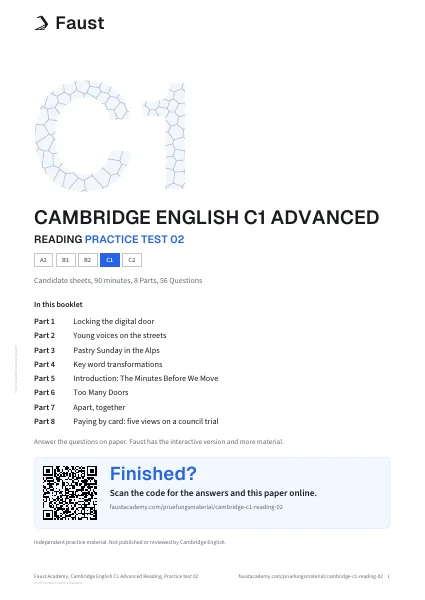
Cambridge C1 Advanced Reading practice test 2 is a reading paper for the Cambridge C1 Advanced exam. It takes 90 minutes. The PDF has 16 pages and 8 sections. You can download the PDF for free, with no account.
Updated 4 November 2026, Faust Academy team
In this paper
- Locking the digital door
- Young voices on the streets
- Pastry Sunday in the Alps
- Key word transformations
- Introduction: The Minutes Before We Move
Exam material is in English.
Every PDF is free. How Faust marks
Independent Faust practice material. Not published or endorsed by the Cambridge University Press and Assessment.
Inside the paper
Part 1
For questions 1 to 8, read the text below and decide which answer (A, B, C or D) best fits each gap. There is an example at the beginning (0). Mark your answers on the separate answer sheet.
Locking the digital door
Streaming services have (0) transformed the way families watch television, and with that change has come a new set of anxieties. Most streaming platforms now let parents (1) ........ younger viewers access to any title above a chosen age rating. Setting this up takes minutes, and many parents understandably consider the job done once the menu is closed. Yet such tools can easily (2) ........ parents into a false sense of security. It is (3) ........ noting that a restriction is only as strong as the PIN that protects it. A child who has watched a parent type in the code can lift every setting in a (4) ........ of seconds. Siblings, meanwhile, frequently share a single profile, or simply borrow an adult's, so that the limits apply to nobody in particular. Filters that work profile by profile therefore often (5) ........ short of what families expect from them. This is by no (6) ........ an argument for doing without parental controls altogether. They remain a reasonable first line of defence, particularly for very young children who browse on their own. Used sensibly, they also let a parent (7) ........ a restriction for a single film without removing it from the whole profile, so that an older child can enjoy a carefully chosen thriller while the rest of the catalogue stays closed. Still, no filter, however sophisticated, allows families to (8) ........ with conversation entirely. A frank talk about why a programme is unsuitable often protects children long after the PIN has been guessed.
Example
0. Streaming services have (0) ........ the way families watch television, and with that change has come a new set of anxieties.
A) transformed
B) converted
C) exchanged
D) translated
Answer: A
1. Most streaming platforms now let parents (1) ........ younger viewers access to any title above a chosen age rating.
A) prevent
B) exclude
C) deny
D) prohibit
2. Yet such tools can easily (2) ........ parents into a false sense of security.
A) soothe
B) lull
C) pacify
D) calm
3. It is (3) ........ noting that a restriction is only as strong as the PIN that protects it.
A) worth
B) worthy
C) valuable
D) deserving
4. A child who has watched a parent type in the code can lift every setting in a (4) ........ of seconds.
A) point
B) case
C) question
D) matter
5. Filters that work profile by profile therefore often (5) ........ short of what families expect from them.
A) drop
B) fall
C) sink
D) run
6. This is by no (6) ........ an argument for doing without parental controls altogether.
A) way
B) account
C) means
D) measure
7. Used sensibly, they also let a parent (7) ........ a restriction for a single film without removing it from the whole profile, so that an older child can enjoy a carefully chosen thriller while the rest of the catalogue stays closed.
A) overrule
B) overturn
C) overcome
D) override
8. Still, no filter, however sophisticated, allows families to (8) ........ with conversation entirely.
A) waive
B) abandon
C) dispense
D) discard
Young voices on the streets
For questions 9 to 16, read the text below and think of the word which best fits each gap. Use only one word in each gap. There is an example at the beginning (0). Write your answers IN CAPITAL LETTERS on the separate answer sheet.
Young voices on the streets
Protests organised largely through social media have become a familiar feature of city life, and they tend to attract a far younger crowd than traditional marches ever did. Within hours, a single post can bring thousands of people together, many of whom have never attended a demonstration before. For those involved, the experience can be a powerful introduction to public life. Yet it takes only a handful of troublemakers smashing shop windows for an entire event to be branded a riot, and it is usually the peaceful majority who end up paying the price. In the aftermath, officials often raise the question of whether further gatherings should be permitted to go ahead. Banning protests outright, however, is far from straightforward. Not only do such measures punish the many for the actions of the few, but they also risk deepening young people's distrust of authority. Organisers, for their part, point out that they can hardly be expected to answer for every person who turns up, let alone those who arrive intending to cause trouble. Striking a fair balance will not be easy, but the alternative is arguably worse. What seems clear is that, unless the authorities and the organisers learn to cooperate, a generation that has only just discovered its political voice may decide it is not worth raising at all.
Example
9. Protests organised largely through social media have become a familiar feature of city life, and they tend to attract a far younger crowd (0) ........ traditional marches ever did. Within hours, a single post can bring thousands of people together, many of {{9}} have never attended a demonstration before. For those involved, the experience can be a powerful introduction to public life.
10. Yet it takes only a handful of troublemakers smashing shop windows for an entire event to be branded a riot, and {{10}} is usually the peaceful majority who end up paying the price. In the aftermath, officials often raise the question of {{11}} further gatherings should be permitted to go ahead. Banning protests outright, however, is {{12}} from straightforward.
11. Yet it takes only a handful of troublemakers smashing shop windows for an entire event to be branded a riot, and {{10}} is usually the peaceful majority who end up paying the price. In the aftermath, officials often raise the question of {{11}} further gatherings should be permitted to go ahead. Banning protests outright, however, is {{12}} from straightforward.
12. Yet it takes only a handful of troublemakers smashing shop windows for an entire event to be branded a riot, and {{10}} is usually the peaceful majority who end up paying the price. In the aftermath, officials often raise the question of {{11}} further gatherings should be permitted to go ahead. Banning protests outright, however, is {{12}} from straightforward.
13. {{13}} only do such measures punish the many for the actions of the few, but they also risk deepening young people's distrust of authority. Organisers, for their part, point out that they can hardly be expected to answer for every person who turns up, {{14}} alone those who arrive intending to cause trouble.
14. {{13}} only do such measures punish the many for the actions of the few, but they also risk deepening young people's distrust of authority. Organisers, for their part, point out that they can hardly be expected to answer for every person who turns up, {{14}} alone those who arrive intending to cause trouble.
15. Striking a fair balance will not be easy, but the alternative is arguably worse. What seems clear is that, {{15}} the authorities and the organisers learn to cooperate, a generation that has only just discovered its political voice may decide it is not worth raising {{16}} all.
16. Striking a fair balance will not be easy, but the alternative is arguably worse. What seems clear is that, {{15}} the authorities and the organisers learn to cooperate, a generation that has only just discovered its political voice may decide it is not worth raising {{16}} all.
Pastry Sunday in the Alps
For questions 17 to 24, read the text below. Use the word given in capitals at the end of some of the lines to form a word that fits in the gap in the same line. There is an example at the beginning (0). Write your answers IN CAPITAL LETTERS on the separate answer sheet.
Pastry Sunday in the Alps
Few visitors to the Alps in winter expect to witness a remarkable ceremony. Yet on the first Sunday of Lent, villages across Vorarlberg, Liechtenstein and southern Germany light towering bonfires, while an unmistakable smell of hot fat drifts from countless kitchens. Its source is the Funkenküchlein, a fried pastry so closely bound up with the day that in Vorarlberg the occasion is known simply as 'Pastry Sunday'. The recipe is deceptively simple: flour, eggs, milk and a little butter. Its preparation, however, demands real patience. The dough is rolled out and then stretched by hand until it is thin enough to see through, before being dropped briefly into hot fat and later dusted with icing sugar. Cooks insist that the temperature must be exactly right, since fat that is too cool leaves the pastries greasy and unappetising. Getting it right is a skill handed down through generations, often from grandmother to grandchild at the family stove. Although recipes vary considerably from one valley to the next, the pairing itself never changes: in many villages, pastry and fire have become inseparable, and neither seems quite complete without the other. Whatever the custom's origins, its survival owes much to families who still gather at dusk, a plate of warm pastries in hand, to watch the flames climb slowly into the cold night sky.
Example
17. and southern Germany light towering bonfires, while an {{17}} smell MISTAKE
18. The recipe is {{18}} simple: flour, eggs, milk and a little butter. DECEIVE
19. Its {{19}}, however, demands real patience. The dough is rolled out PREPARE
20. and {{20}}. Getting it right is a skill handed down APPETITE
21. through {{21}}, often from grandmother to grandchild at the family stove. GENERATE
22. Although recipes vary {{22}} from one valley to the next, the CONSIDER
23. have become {{23}}, and neither seems quite complete without the other. SEPARATE
24. Whatever the custom's origins, its {{24}} owes much to families who SURVIVE
Part 4
For questions 25 to 30, complete the second sentence so that it has a similar meaning to the first sentence, using the word given. Do not change the word given. You must use between three and six words, including the word given. Here is an example (0). Write only the missing words IN CAPITAL LETTERS on the separate answer sheet.
Key word transformations
The security agency believes that other MPs' phones are highly likely to have been targeted as well. The council's decision on the new library has been put off until next spring. Visitor numbers at the museum's new wing fell far short of the trustees' expectations. But for the quick action of the volunteers, the hikers would almost certainly have died. There would be no point in trying to persuade the referee to change his decision. Clara wishes she had accepted the job offer in Lisbon.
Example
Example
The architect denied being to blame for the delay.
25. The security agency believes that other MPs' phones {{25}} targeted as well.
26. The council's decision on the new library {{26}} until next spring.
27. Visitor numbers at the museum's new wing {{27}} the trustees' expectations.
28. But {{28}} the volunteers, the hikers would almost certainly have died.
29. There would {{29}} to persuade the referee to change his decision.
30. Clara {{30}} the job offer in Lisbon.
Part 5
You are going to read the introduction to a book about how people respond to public warnings of danger. For questions 31 to 36, choose the answer (A, B, C or D) which you think fits best according to the text. Mark your answers on the separate answer sheet.
Introduction: The Minutes Before We Move
On a still evening last October I was sitting in the kitchen of a rented cottage on a narrow lane on the English coast when the smell reached me. A wooden shed beside a holiday let two doors down had caught fire, and low grey smoke was creeping along the lane. Moments later every phone in the lane went off at once, mine included, with the harsh tone official alerts use. The message could hardly have been plainer: keep doors and windows closed and stay indoors. What happened next is the reason this book exists. Almost without exception, people opened their front doors and came out. They looked at the smoke, then at one another, and asked, in one form or another, what the others made of it. Was it serious? Was it coming our way? Only after a few minutes of comparing notes did they go back inside and shut their windows. The couple who had lived there for forty years behaved precisely as the family who had arrived on Saturday did, and it struck me then, as it strikes me now, that nobody in that lane had acted foolishly. Seen against the long history of public warning, the scene is a curious one. For centuries a community learned of danger from a church bell rung out of its usual hour; later came the siren, then the bulletin breaking into a radio or television programme. Today a message can travel from a control room straight to the phone in one's pocket, reaching an isolated farmhouse as quickly as a city flat, within seconds of being issued. The means of telling people they are in danger has been transformed. And yet those who plan for emergencies will tell you, often with a weary shrug, that the public seems to move no faster to protect itself than it did in the days of the bell. It is this mismatch that I set out to understand. The explanation most often offered, repeated in so many briefings that it has acquired the status of common sense, is that people have simply been warned too often. Told of floods that never come and storms that blow out to sea, they grow complacent and, like the villagers in the fable of the boy who cried wolf, stop listening. I would not dismiss this entirely; anyone who has stood in a car park because burnt toast set off a fire alarm knows how quickly a signal loses its force. But the theory is asked to carry far more than it can bear. And one suspects that its popularity among those who design and issue warnings owes something to a convenient feature: it locates the failure in the people at the receiving end, and leaves the system that addressed them largely unexamined. A different picture emerges if we ask where people look once a warning has reached them. Some years ago, in a village in a river valley, a flood siren sounded late one night. Most households, by the accounts later gathered, stayed where they were; a few looked out at the rain. What moved them in the end was a knock at the door. A handful of neighbours went from house to house, among them the woman who had run the village shop for as long as anyone could remember, and within half an hour the streets near the river were all but empty. The siren had said nothing the neighbours did not. The difference lay in the messenger: a familiar face on the doorstep carried an authority that a sound in the dark could not. None of this, I should stress, is a case for abandoning electronic alerts and going back to knocking on doors, which would be slower and could never reach every household. This book, then, is about a few minutes: the interval between the arrival of a warning and the moment someone acts on it. It asks how people interpret a message they did not expect, whom they turn to, and which signs in their surroundings they search for to confirm or dismiss it. The cases I draw on include people who moved at once as well as those who lingered, since the two have more in common than we tend to assume. Engineers and planners will find no blueprint here, and whether the equipment works as it should is a question for others. My concern is with the person holding the phone, and with the possibility that stepping outside to ask a neighbour's opinion is not a failure to respond at all, but a sensible way of weighing a message that has come out of nowhere.
31. What point does the writer make about the evening described in the first paragraph?
A) People's first reaction to the alert was to look for confirmation from those around them
B) The alert reached some people in the lane noticeably later than others
C) The instructions contained in the alert were difficult to interpret
D) Holidaymakers took longer to act on the alert than permanent residents did
32. What does 'this mismatch' in the second paragraph refer to?
A) the difference between how officials and the public assess a particular danger
B) the gap between improvements in delivering warnings and the speed at which people act on them
C) the contrast between the number of warnings issued and the number of genuine emergencies
D) the unequal reach of warning systems in towns and in the countryside
33. What is the writer's view of the explanation that frequent false alarms make people complacent?
A) It has been shown to have no basis in how people actually behave
B) It accounts for the behaviour of visitors better than that of local people
C) Part of its appeal is that it places the blame on those receiving warnings
D) It is the most convincing of the explanations currently available
34. The writer mentions the village where neighbours went from door to door in order to
A) suggest that older methods of warning should replace electronic systems
B) show that how far people trust a warning can depend on who brings it
C) argue that small communities are generally better prepared for emergencies
D) criticise the cost of installing modern alert technology
35. In the final paragraph, the writer makes clear that the book will
A) recommend practical improvements to the design of alert systems
B) assess which warning technologies have proved most reliable
C) focus mainly on people who chose to ignore the warnings they received
D) explore how people make sense of a warning in the moments after it arrives
36. An idea that recurs throughout the text is that people who hesitate after receiving a warning
A) are behaving more reasonably than is often assumed
B) tend to have experienced too many false alarms in the past
C) are mostly unfamiliar with the area they are staying in
D) would respond faster to traditional methods such as sirens
Part 6
You are going to read four reviews of a book about how young people decide what to do after leaving school. For questions 37 to 40, choose from the reviews A to D. The reviews may be chosen more than once.
Too Many Doors
Four reviewers comment on educational psychologist Miriam Castell's book A Reviewer one Miriam Castell spent years as a careers counsellor in British schools before turning to educational psychology, and it shows in the warmth of Too Many Doors. Her portraits of individual school leavers, frozen before university prospectuses, apprenticeship schemes and gap-year brochures, are vivid and often moving. Yet they amount to a handful of families, chosen, one suspects, because they illustrate her thesis so neatly. The thesis itself, that abundance can be as disabling as scarcity, will hardly startle anyone who has browsed the psychology shelves of the past twenty years. More troubling is her readiness to cast parents as the culprits. Parents make a convenient villain, yet it is hardly hovering mothers and fathers who set tuition fees or hollow out the graduate job market. Even so, I would press the final chapter on any sixth former I know: its exercises for narrowing down options are sensible, specific and quietly liberating. B Reviewer two That young people can be overwhelmed by choice is not, in itself, news; behavioural economists and popular psychologists have been making the point for decades, and Castell openly acknowledges her debt to them. What distinguishes Too Many Doors is method. Castell's case rests on something sturdier than anecdote: a decade of anonymised counselling records and the same school leavers followed up years later, some in jobs they love, others still drifting. The patterns she draws from this material are persuasive precisely because she reports the exceptions alongside the rule. She is even-handed about families, too, noting that parental anxiety is usually a reasonable response to an uncertain world rather than a character flaw. And where many books of this kind end in uplift, hers closes with tools a reader can actually use: a timetable for decisions, a method for testing a course before committing to it, and questions worth putting to any admissions tutor. C Reviewer three Much has been written about the tyranny of choice, but what is genuinely fresh here is the decision to examine that paralysis at the precise moment a teenager leaves school, a threshold the literature on choice has largely ignored. Castell is at her best on families. Her account of parents who, having sacrificed for their children's opportunities, cannot bear to see a single one go unused is shrewd and occasionally uncomfortable to read. Readers hoping for hard data, however, should look elsewhere: the book leans heavily on recollections from her own counselling room, and one is asked to take a good deal on trust. Its real disappointment, though, comes at the end. Having diagnosed the problem so acutely, Castell offers the bewildered eighteen-year-old little more than encouragement to stay calm and keep an open mind, which is advice such a reader has surely heard many times already. D Reviewer four Do eighteen-year-olds really suffer from having too many options? Miriam Castell thinks so, and she writes with conviction and considerable charm. But conviction is not proof. The young people who appear in these pages were, by her own account, those who sought her out for help, hardly a representative sample of a generation, and the book never tests its conclusions against anyone who made a choice without fuss. The argument is in any case a familiar one, borrowed largely intact from the shelf of bestsellers on decision-making. Castell is also rather hasty in holding anxious, ambitious parents responsible, when the pressure on school leavers comes chiefly from debt, rents and an employment market that rewards no one for patience. And the closing chapter of advice dissolves into the kind of reassuring generalities, 'follow your curiosity', 'no choice is final', that any careers leaflet could supply.
37. Which reviewer has a different opinion from the others on how well Miriam Castell supports her argument with evidence?
A) Reviewer one
B) Reviewer two
C) Reviewer three
D) Reviewer four
38. Which reviewer shares reviewer D's opinion on the part Castell believes parents play in young people's difficulties?
A) Reviewer one
B) Reviewer two
C) Reviewer three
D) Reviewer four
39. Which reviewer expresses a similar view to reviewer C regarding the value of the practical advice Castell offers young readers?
A) Reviewer one
B) Reviewer two
C) Reviewer three
D) Reviewer four
40. Which reviewer has a different view from reviewer B on whether Castell's central idea is original?
A) Reviewer one
B) Reviewer two
C) Reviewer three
D) Reviewer four
Part 7
You are going to read an extract from a magazine article. Six paragraphs have been removed from the extract. Choose from the paragraphs A to G the one which fits each gap (41 to 46). There is one extra paragraph which you do not need to use. Mark your answers on the separate answer sheet.
Apart, together
Over dinner last spring, my friend Harriet Lowe mentioned, quite casually, that she would be spending three weeks walking a stretch of the coastal path in Cornwall on her own. Her husband, Tom, would stay at home in Leeds, look after the garden and carry on going to work as usual. She might as well have announced that she was emigrating. The table fell silent, forks hovering, and after a pause someone asked, only half joking, whether everything was all right at home. (41) ........ Rachel Okafor, a relationship counsellor who has worked with couples in Manchester for more than twenty years, hears versions of that suspicion almost weekly. 'People talk about space as if it were a polite word for distance,' she says. 'In my experience, it's very often the opposite.' (42) ........ Recognising the need is one thing; raising it without alarming the person you love is quite another. Okafor finds that the trouble usually begins with the way the request is framed. (43) ........ Harriet, by contrast, first mentioned the walk almost a year before she set off, on an unremarkable Sunday morning, and put it to Tom as a question rather than an announcement. She chose that moment deliberately, she says, because nothing else was going on between them that the idea could be mistaken for. (44) ........ Those remarks, Okafor would argue, are precisely where the real conversation ought to have begun. Fears that stay unspoken tend to find indirect outlets, she says; the remedy is to agree, in concrete terms, what being apart will actually look like. For Harriet and Tom, that conversation finally took place over several evenings in the weeks before she left, and it proved rather less comfortable than either of them had anticipated. (45) ........ Okafor is unsurprised that such details proved so useful. 'Vague freedom is frightening,' she says. 'Specific freedom is far easier to live with.' The same principle, she adds, holds for far smaller liberties than a long walk: an evening class, a weekend with old friends, even an hour alone on a Saturday morning is easier to grant when both people know its shape in advance. Harriet finished the walk in late May, sunburnt and, by her own account, a little lighter in spirit. (46) ........ That, perhaps, is what the anxious dinner guest missed: time apart, handled with care, is not the opposite of closeness but one of the things that sustains it. Harriet, I notice, has already bought another map. A A request made in the middle of an argument, for instance, is almost bound to be heard as a punishment, however reasonable the words. So, too, is one presented as a decision already taken. What the other partner hears in either case is not 'I need this' but 'I need to get away from you', and from that point the conversation can only become defensive. B Not every couple, of course, finds such an arrangement so congenial. For some, Okafor concedes, a request for space genuinely is the first sign of a partner withdrawing, and in those cases no amount of careful negotiation will help. The difference, she suggests, usually shows in whether the person asking also talks about coming back. C In the end, they settled on a handful of simple arrangements. Harriet would phone every second evening rather than every night; Tom would not ask about her route in advance, so that she could change her plans freely; and neither of them would treat a missed call as a crisis. None of this was romantic, Harriet concedes, but it meant that each of them knew exactly where they stood. D The question was kindly meant, but it exposed an assumption most of us hold without ever examining it: that a couple who choose to spend time apart must already be drifting towards a more lasting separation. Harriet herself found the reaction faintly comic. 'We've been married for nineteen years,' she told me afterwards. 'If we were going to fall apart, I doubt a footpath would be what finally did it.' E What surprised them both was the homecoming. Tom had expected life simply to resume where it had left off; instead, he found that they had a great deal more to say to each other. 'She'd had three weeks of experiences I knew nothing about,' he says, 'and, oddly, so had I. We were interesting to each other again.' F In her view, every partnership has to balance two needs that pull in opposite directions: the wish to be known and held close, and the wish to remain a person in one's own right. Couples who suppress the second for the sake of the first rarely end up any closer. More often, she says, one partner begins to feel quietly erased, and the resentment that follows does far more damage than any weekend away. G Even so, Tom admits that his first response was less than generous. He did not object outright, but he found himself wondering what it said about him that his wife wanted three weeks without his company. 'I kept it to myself, which was a mistake,' he says. 'It came out sideways for months afterwards, in little remarks about whether she'd be packing a photo of me.'
41. Gap 41
A) A request made in the middle of an argument, for instance, is almost bound to be heard as a punishment, however reasonable the words. So, too, is one presented as a decision already taken. What the other partner hears in either case is not 'I need this' but 'I need to get away from you', and from that point the conversation can only become defensive
B) Not every couple, of course, finds such an arrangement so congenial. For some, Okafor concedes, a request for space genuinely is the first sign of a partner withdrawing, and in those cases no amount of careful negotiation will help. The difference, she suggests, usually shows in whether the person asking also talks about coming back
C) In the end, they settled on a handful of simple arrangements. Harriet would phone every second evening rather than every night; Tom would not ask about her route in advance, so that she could change her plans freely; and neither of them would treat a missed call as a crisis. None of this was romantic, Harriet concedes, but it meant that each of them knew exactly where they stood
D) The question was kindly meant, but it exposed an assumption most of us hold without ever examining it: that a couple who choose to spend time apart must already be drifting towards a more lasting separation. Harriet herself found the reaction faintly comic. 'We've been married for nineteen years,' she told me afterwards. 'If we were going to fall apart, I doubt a footpath would be what finally did it.'
E) What surprised them both was the homecoming. Tom had expected life simply to resume where it had left off; instead, he found that they had a great deal more to say to each other. 'She'd had three weeks of experiences I knew nothing about,' he says, 'and, oddly, so had I. We were interesting to each other again.'
F) In her view, every partnership has to balance two needs that pull in opposite directions: the wish to be known and held close, and the wish to remain a person in one's own right. Couples who suppress the second for the sake of the first rarely end up any closer. More often, she says, one partner begins to feel quietly erased, and the resentment that follows does far more damage than any weekend away
G) Even so, Tom admits that his first response was less than generous. He did not object outright, but he found himself wondering what it said about him that his wife wanted three weeks without his company. 'I kept it to myself, which was a mistake,' he says. 'It came out sideways for months afterwards, in little remarks about whether she'd be packing a photo of me.'
42. Gap 42
A) A request made in the middle of an argument, for instance, is almost bound to be heard as a punishment, however reasonable the words. So, too, is one presented as a decision already taken. What the other partner hears in either case is not 'I need this' but 'I need to get away from you', and from that point the conversation can only become defensive
B) Not every couple, of course, finds such an arrangement so congenial. For some, Okafor concedes, a request for space genuinely is the first sign of a partner withdrawing, and in those cases no amount of careful negotiation will help. The difference, she suggests, usually shows in whether the person asking also talks about coming back
C) In the end, they settled on a handful of simple arrangements. Harriet would phone every second evening rather than every night; Tom would not ask about her route in advance, so that she could change her plans freely; and neither of them would treat a missed call as a crisis. None of this was romantic, Harriet concedes, but it meant that each of them knew exactly where they stood
D) The question was kindly meant, but it exposed an assumption most of us hold without ever examining it: that a couple who choose to spend time apart must already be drifting towards a more lasting separation. Harriet herself found the reaction faintly comic. 'We've been married for nineteen years,' she told me afterwards. 'If we were going to fall apart, I doubt a footpath would be what finally did it.'
E) What surprised them both was the homecoming. Tom had expected life simply to resume where it had left off; instead, he found that they had a great deal more to say to each other. 'She'd had three weeks of experiences I knew nothing about,' he says, 'and, oddly, so had I. We were interesting to each other again.'
F) In her view, every partnership has to balance two needs that pull in opposite directions: the wish to be known and held close, and the wish to remain a person in one's own right. Couples who suppress the second for the sake of the first rarely end up any closer. More often, she says, one partner begins to feel quietly erased, and the resentment that follows does far more damage than any weekend away
G) Even so, Tom admits that his first response was less than generous. He did not object outright, but he found himself wondering what it said about him that his wife wanted three weeks without his company. 'I kept it to myself, which was a mistake,' he says. 'It came out sideways for months afterwards, in little remarks about whether she'd be packing a photo of me.'
43. Gap 43
A) A request made in the middle of an argument, for instance, is almost bound to be heard as a punishment, however reasonable the words. So, too, is one presented as a decision already taken. What the other partner hears in either case is not 'I need this' but 'I need to get away from you', and from that point the conversation can only become defensive
B) Not every couple, of course, finds such an arrangement so congenial. For some, Okafor concedes, a request for space genuinely is the first sign of a partner withdrawing, and in those cases no amount of careful negotiation will help. The difference, she suggests, usually shows in whether the person asking also talks about coming back
C) In the end, they settled on a handful of simple arrangements. Harriet would phone every second evening rather than every night; Tom would not ask about her route in advance, so that she could change her plans freely; and neither of them would treat a missed call as a crisis. None of this was romantic, Harriet concedes, but it meant that each of them knew exactly where they stood
D) The question was kindly meant, but it exposed an assumption most of us hold without ever examining it: that a couple who choose to spend time apart must already be drifting towards a more lasting separation. Harriet herself found the reaction faintly comic. 'We've been married for nineteen years,' she told me afterwards. 'If we were going to fall apart, I doubt a footpath would be what finally did it.'
E) What surprised them both was the homecoming. Tom had expected life simply to resume where it had left off; instead, he found that they had a great deal more to say to each other. 'She'd had three weeks of experiences I knew nothing about,' he says, 'and, oddly, so had I. We were interesting to each other again.'
F) In her view, every partnership has to balance two needs that pull in opposite directions: the wish to be known and held close, and the wish to remain a person in one's own right. Couples who suppress the second for the sake of the first rarely end up any closer. More often, she says, one partner begins to feel quietly erased, and the resentment that follows does far more damage than any weekend away
G) Even so, Tom admits that his first response was less than generous. He did not object outright, but he found himself wondering what it said about him that his wife wanted three weeks without his company. 'I kept it to myself, which was a mistake,' he says. 'It came out sideways for months afterwards, in little remarks about whether she'd be packing a photo of me.'
44. Gap 44
A) A request made in the middle of an argument, for instance, is almost bound to be heard as a punishment, however reasonable the words. So, too, is one presented as a decision already taken. What the other partner hears in either case is not 'I need this' but 'I need to get away from you', and from that point the conversation can only become defensive
B) Not every couple, of course, finds such an arrangement so congenial. For some, Okafor concedes, a request for space genuinely is the first sign of a partner withdrawing, and in those cases no amount of careful negotiation will help. The difference, she suggests, usually shows in whether the person asking also talks about coming back
C) In the end, they settled on a handful of simple arrangements. Harriet would phone every second evening rather than every night; Tom would not ask about her route in advance, so that she could change her plans freely; and neither of them would treat a missed call as a crisis. None of this was romantic, Harriet concedes, but it meant that each of them knew exactly where they stood
D) The question was kindly meant, but it exposed an assumption most of us hold without ever examining it: that a couple who choose to spend time apart must already be drifting towards a more lasting separation. Harriet herself found the reaction faintly comic. 'We've been married for nineteen years,' she told me afterwards. 'If we were going to fall apart, I doubt a footpath would be what finally did it.'
E) What surprised them both was the homecoming. Tom had expected life simply to resume where it had left off; instead, he found that they had a great deal more to say to each other. 'She'd had three weeks of experiences I knew nothing about,' he says, 'and, oddly, so had I. We were interesting to each other again.'
F) In her view, every partnership has to balance two needs that pull in opposite directions: the wish to be known and held close, and the wish to remain a person in one's own right. Couples who suppress the second for the sake of the first rarely end up any closer. More often, she says, one partner begins to feel quietly erased, and the resentment that follows does far more damage than any weekend away
G) Even so, Tom admits that his first response was less than generous. He did not object outright, but he found himself wondering what it said about him that his wife wanted three weeks without his company. 'I kept it to myself, which was a mistake,' he says. 'It came out sideways for months afterwards, in little remarks about whether she'd be packing a photo of me.'
45. Gap 45
A) A request made in the middle of an argument, for instance, is almost bound to be heard as a punishment, however reasonable the words. So, too, is one presented as a decision already taken. What the other partner hears in either case is not 'I need this' but 'I need to get away from you', and from that point the conversation can only become defensive
B) Not every couple, of course, finds such an arrangement so congenial. For some, Okafor concedes, a request for space genuinely is the first sign of a partner withdrawing, and in those cases no amount of careful negotiation will help. The difference, she suggests, usually shows in whether the person asking also talks about coming back
C) In the end, they settled on a handful of simple arrangements. Harriet would phone every second evening rather than every night; Tom would not ask about her route in advance, so that she could change her plans freely; and neither of them would treat a missed call as a crisis. None of this was romantic, Harriet concedes, but it meant that each of them knew exactly where they stood
D) The question was kindly meant, but it exposed an assumption most of us hold without ever examining it: that a couple who choose to spend time apart must already be drifting towards a more lasting separation. Harriet herself found the reaction faintly comic. 'We've been married for nineteen years,' she told me afterwards. 'If we were going to fall apart, I doubt a footpath would be what finally did it.'
E) What surprised them both was the homecoming. Tom had expected life simply to resume where it had left off; instead, he found that they had a great deal more to say to each other. 'She'd had three weeks of experiences I knew nothing about,' he says, 'and, oddly, so had I. We were interesting to each other again.'
F) In her view, every partnership has to balance two needs that pull in opposite directions: the wish to be known and held close, and the wish to remain a person in one's own right. Couples who suppress the second for the sake of the first rarely end up any closer. More often, she says, one partner begins to feel quietly erased, and the resentment that follows does far more damage than any weekend away
G) Even so, Tom admits that his first response was less than generous. He did not object outright, but he found himself wondering what it said about him that his wife wanted three weeks without his company. 'I kept it to myself, which was a mistake,' he says. 'It came out sideways for months afterwards, in little remarks about whether she'd be packing a photo of me.'
46. Gap 46
A) A request made in the middle of an argument, for instance, is almost bound to be heard as a punishment, however reasonable the words. So, too, is one presented as a decision already taken. What the other partner hears in either case is not 'I need this' but 'I need to get away from you', and from that point the conversation can only become defensive
B) Not every couple, of course, finds such an arrangement so congenial. For some, Okafor concedes, a request for space genuinely is the first sign of a partner withdrawing, and in those cases no amount of careful negotiation will help. The difference, she suggests, usually shows in whether the person asking also talks about coming back
C) In the end, they settled on a handful of simple arrangements. Harriet would phone every second evening rather than every night; Tom would not ask about her route in advance, so that she could change her plans freely; and neither of them would treat a missed call as a crisis. None of this was romantic, Harriet concedes, but it meant that each of them knew exactly where they stood
D) The question was kindly meant, but it exposed an assumption most of us hold without ever examining it: that a couple who choose to spend time apart must already be drifting towards a more lasting separation. Harriet herself found the reaction faintly comic. 'We've been married for nineteen years,' she told me afterwards. 'If we were going to fall apart, I doubt a footpath would be what finally did it.'
E) What surprised them both was the homecoming. Tom had expected life simply to resume where it had left off; instead, he found that they had a great deal more to say to each other. 'She'd had three weeks of experiences I knew nothing about,' he says, 'and, oddly, so had I. We were interesting to each other again.'
F) In her view, every partnership has to balance two needs that pull in opposite directions: the wish to be known and held close, and the wish to remain a person in one's own right. Couples who suppress the second for the sake of the first rarely end up any closer. More often, she says, one partner begins to feel quietly erased, and the resentment that follows does far more damage than any weekend away
G) Even so, Tom admits that his first response was less than generous. He did not object outright, but he found himself wondering what it said about him that his wife wanted three weeks without his company. 'I kept it to myself, which was a mistake,' he says. 'It came out sideways for months afterwards, in little remarks about whether she'd be packing a photo of me.'
Part 8
You are going to read a magazine article in which five people give their views on replacing cash support for asylum seekers with a prepaid payment card. For questions 47 to 56, choose from the people (A to E). The people may be chosen more than once. Mark your answers on the separate answer sheet.
Paying by card: five views on a council trial
When Calderford City Council replaced cash support for asylum seekers with a prepaid payment card, it promised a simpler and safer system. A year into the trial, we asked five people with a stake in it how things are going. A Priya Shah I am a caseworker at the Harbour Lane Refugee Project. The card was sold to us as the end of paperwork; instead, my colleagues lose entire afternoons chasing blocked cards and top-ups that never arrived. Each case means a call to the provider, then to the council, and often back to the provider once the two have failed to agree whose fault it was. What worries me more is what we never see. Many of our clients simply won't report a declined payment; they're afraid that complaining might somehow count against their claim. We tell them it can't, but people who have spent years facing officials who held their future in their hands are understandably reluctant to test that promise. B Tom Hollis As the council officer running the trial, I make no apology for the principle. Staff used to hand out cash in envelopes at three offices every week, which was slow, costly and not especially safe for anyone. Now the money arrives on the same day for everyone, and the administrative savings have been considerable. That said, the rollout was not flawless. With hindsight, we had the technology in place well before we had asked how people actually go about their weekly shopping. Nobody had checked, for instance, which of the cheaper market traders could take the card. The monthly cash limit comes up constantly, and I understand why. I'd happily look again at the cash limit, but it's written into our contract with the card provider, and that isn't something we can rewrite on our own. What we can do is add accepted shops month by month. C Amira Haddad I came to Britain three years ago with my son. I was dreading the checkout queue, convinced everyone would know at a glance. In fact, nobody gives the card a second look. It resembles any other bank card, and on that point I am glad to have been wrong. The difficulties lie elsewhere. When my son's school asks for coins for a trip, or he needs his bus fare, the monthly cash allowance is already gone. I plan as carefully as I can, but children's needs do not arrive on a timetable. Last term he missed a museum visit because the teacher wanted the money in an envelope and I had none left. Neighbours selling second-hand clothes online want a bank transfer, which the card cannot make. Each problem is small; together they turn every week into a puzzle. D Gareth Lowe I run a fruit and vegetable stall on Calderford's indoor market. Last spring a woman's card was declined three times at my stall, and I assumed my machine had broken. A call to the bank revealed otherwise. I doubt anyone sat down and decided to shut me out; my terminal is simply registered under a category the system doesn't recognise. Changing it means more forms and a fee I'm reluctant to pay for what may be a handful of customers. I'd be lying if I said my view had nothing to do with what ends up in my till at the end of the week. If the supermarkets keep these customers and I lose them, naturally I'll think the card is unfair. But my regulars also liked being able to haggle over a box of tomatoes, and you can't do that in a supermarket aisle. E Helen Marsh I study social policy at the University of Westmere. The council's savings are real enough, but what no spreadsheet records is the hours cardholders now spend finding somewhere that will accept the card. People we interviewed described crossing town to reach a particular discount shop, or paying more at a corner shop because it was the only accepted outlet nearby. That cost falls on cardholders rather than the council, which is precisely why it never appears in the official account. The claim that 'everyone pays by card these days' overlooks the fact that the rest of us choose to; we can still withdraw cash or transfer money whenever we like. None of this means the card should be scrapped. A more generous cash allowance and a wider range of retailers could preserve most of the administrative gains while removing much of the friction.
47. Which person admits that an initial worry about the card proved partly unfounded?
A) Priya Shah
B) Tom Hollis
C) Amira Haddad
D) Gareth Lowe
E) Helen Marsh
48. Which person questions whether the official figures measure what really matters?
A) Priya Shah
B) Tom Hollis
C) Amira Haddad
D) Gareth Lowe
E) Helen Marsh
49. Which person describes having to spend time on work the scheme was supposed to remove?
A) Priya Shah
B) Tom Hollis
C) Amira Haddad
D) Gareth Lowe
E) Helen Marsh
50. Which person suggests that a technical requirement, rather than a deliberate decision, may have excluded a small business?
A) Priya Shah
B) Tom Hollis
C) Amira Haddad
D) Gareth Lowe
E) Helen Marsh
51. Which person concedes that the scheme was introduced before its impact on everyday life had been properly considered?
A) Priya Shah
B) Tom Hollis
C) Amira Haddad
D) Gareth Lowe
E) Helen Marsh
52. Which person describes how the lack of cash makes it hard to meet family obligations?
A) Priya Shah
B) Tom Hollis
C) Amira Haddad
D) Gareth Lowe
E) Helen Marsh
53. Which person argues that comparing cardholders with ordinary bank customers is misleading?
A) Priya Shah
B) Tom Hollis
C) Amira Haddad
D) Gareth Lowe
E) Helen Marsh
54. Which person warns that people may keep quiet about problems so as not to draw attention to themselves?
A) Priya Shah
B) Tom Hollis
C) Amira Haddad
D) Gareth Lowe
E) Helen Marsh
55. Which person hints that the scheme's future is not entirely in local hands?
A) Priya Shah
B) Tom Hollis
C) Amira Haddad
D) Gareth Lowe
E) Helen Marsh
56. Which person acknowledges that their opinion may be coloured by their own commercial position?
A) Priya Shah
B) Tom Hollis
C) Amira Haddad
D) Gareth Lowe
E) Helen Marsh
More papers
All 2 Cambridge C1 Advanced Reading papers
Frequently asked questions
- How long is Cambridge C1 Advanced Reading practice test 2?
- The paper takes 90 minutes. The PDF has 16 pages, and the answer key is a separate PDF.
- Is Cambridge C1 Advanced Reading practice test 2 free?
- Yes. You can download the PDF for free, with no account.