
Cambridge C1 Advanced Listening practice test 1
- Engineered to the real Cambridge format
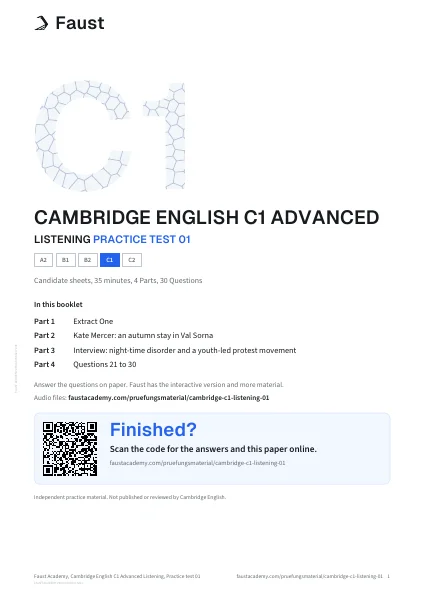
Cambridge C1 Advanced Listening practice test 1 is a listening paper for the Cambridge C1 Advanced exam. It takes 35 minutes. The PDF has 9 pages and 4 sections. The audio plays on this page. You can download the PDF for free, with no account.
Updated 4 November 2026, Faust Academy team
In this paper
- Kate Mercer: an autumn stay in Val Sorna
- Interview: night-time disorder and a youth-led protest movement
- Speaker 1
- Speaker 2
- Speaker 3
Exam material is in English.
Every PDF is free. How Faust marks
Independent Faust practice material. Not published or endorsed by the Cambridge University Press and Assessment.
Listening audio
Part 1
Part 2
Part 3
Part 4
Inside the paper
Part 1
You will hear three different extracts. For questions 1 to 6, choose the answer (A, B or C) which fits best according to what you hear. There are two questions for each extract.
1. Extract One. You hear two friends discussing foreign expressions used in English. What do the friends agree about?
A) It is wiser to avoid such expressions when speaking to native speakers of the original language
B) Such expressions lose much of their appeal once their original meaning is known
C) The attraction of such expressions in English has little to do with how authentic they are
2. Why does the man mention his grandmother?
A) to illustrate how a borrowed phrase can take on private family associations
B) to suggest that older speakers used the phrase more accurately
C) to show how the phrase's range of use has narrowed over time
3. Extract Two. You hear two friends talking about selling second-hand clothes online. How does the woman feel about selling her clothes online?
A) frustrated that the effort involved outweighs the money she makes
B) uneasy that it has become a justification for buying more
C) irritated by buyers who try to bargain the price down
4. How does the man respond to the woman's account?
A) He suggests she is overstating the problem
B) He suggests the platform itself shapes how people use it
C) He doubts that her experience is typical of most users
5. Extract Three. You hear a woman telling a friend about moving to a small Scottish island for work. What is she doing during the conversation?
A) defending her move against friends' criticism
B) admitting that she underestimated how isolated she would feel
C) reflecting on how her sense of what matters has changed
6. Why does the man mention his own journey to work?
A) to suggest her new routine is less different from city life than she thinks
B) to show sympathy for the practical difficulties she faces
C) to question whether she will be happy there in the long term
AN AUTUMN STAY IN VAL SORNA
You will hear {speaker_line}. For questions 7 to 14, complete the sentences with a word or short phrase.
7. Kate had originally planned to research a (7) {{7}} during her stay in the valley.
8. The hotel's founder, Elena, decided to restore the empty houses after the village's last (8) {{8}} closed.
9. Guests collect their keys from the (9) {{9}} rather than from a reception desk.
10. Kate compares the sound of the river at night to a (10) {{10}}.
11. Kate's favourite local cheese is matured wrapped in (11) {{11}}.
12. Kate was fascinated by the round stone buildings which villagers once filled with (12) {{12}} each winter.
13. Kate uses the word (13) {{13}} to describe her attitude to the idea of bringing more tourists to the valley.
14. Kate advises future visitors to pack (14) {{14}} for their stay in the valley.
Part 3
You will hear an interview in which a youth organiser called Nadia Okafor and a sociologist called Tom Whitfield are talking about how night-time disorder affected a youth-led protest movement. For questions 15 to 20, choose the answer (A, B, C or D) which fits best according to what you hear.
15. What does Nadia say about the evening when shops were first looted?
A) She had expected trouble and warned the police beforehand
B) She suspected that the looters had been sent to discredit the march
C) She mistook the early atmosphere in the centre for harmless celebration
D) She only learnt about the disorder from the following day's news
16. What does Tom suggest about the national press coverage of the protests?
A) Editors deliberately set out to present young people as a threat
B) Few reporters had been present at the peaceful daytime events
C) Reporting became more balanced once the disorder had died down
D) The dramatic quality of the night-time images outweighed any political bias
17. When Nadia was asked to condemn the violence on behalf of the movement, she felt
A) uneasy about answering for people the movement had no control over
B) worried that a condemnation would alienate younger supporters
C) keen to use the attention to restate the movement's demands
D) resentful that the police were not being questioned in the same way
18. According to Tom, many of the young people who stayed in the centre after dark were
A) committed activists frustrated by the march's lack of impact
B) drawn more by the sense of a shared occasion than by the cause itself
C) people who had travelled in from outside the city
D) motivated chiefly by their own financial hardship
19. Nadia and Tom agree that future demonstrations
A) should be limited to daylight hours
B) should rely more on online campaigning than on street presence
C) need a properly planned ending as much as a strong beginning
D) would benefit from closer coordination with the police
20. What does Nadia conclude about the effect of the night-time violence on the movement?
A) It has permanently cost the movement public sympathy
B) It forced the movement to define more clearly what it stands for
C) It caused divisions among the organisers that remain unresolved
D) Its impact has been far smaller than the media claimed
Part 4
You will hear five short extracts in which {extracts_line}. For questions 21 to 25, choose from the list (A to H) {task_one}. For questions 26 to 30, choose from the list (A to H) {task_two}. While you listen you must complete both tasks.
21. Speaker 1
A) It targeted people with little power to answer back
B) A legal adviser warned of possible action
C) It relied on a claim that turned out to be false
D) The studio audience failed to respond to it
E) Events made it out of date before broadcast
F) A rival show had already used a similar idea
G) The performer refused to deliver it
H) It would have made the episode overrun
22. Speaker 2
A) It targeted people with little power to answer back
B) A legal adviser warned of possible action
C) It relied on a claim that turned out to be false
D) The studio audience failed to respond to it
E) Events made it out of date before broadcast
F) A rival show had already used a similar idea
G) The performer refused to deliver it
H) It would have made the episode overrun
23. Speaker 3
A) It targeted people with little power to answer back
B) A legal adviser warned of possible action
C) It relied on a claim that turned out to be false
D) The studio audience failed to respond to it
E) Events made it out of date before broadcast
F) A rival show had already used a similar idea
G) The performer refused to deliver it
H) It would have made the episode overrun
24. Speaker 4
A) It targeted people with little power to answer back
B) A legal adviser warned of possible action
C) It relied on a claim that turned out to be false
D) The studio audience failed to respond to it
E) Events made it out of date before broadcast
F) A rival show had already used a similar idea
G) The performer refused to deliver it
H) It would have made the episode overrun
25. Speaker 5
A) It targeted people with little power to answer back
B) A legal adviser warned of possible action
C) It relied on a claim that turned out to be false
D) The studio audience failed to respond to it
E) Events made it out of date before broadcast
F) A rival show had already used a similar idea
G) The performer refused to deliver it
H) It would have made the episode overrun
26. Speaker 1
A) regretful that a bolder version was never tried
B) proud of having resisted outside pressure
C) still unsure whether it was the right call
D) amused that the material later turned up elsewhere
E) grateful that a colleague raised the problem
F) convinced the programme was better as a result
G) embarrassed at not having spotted the issue sooner
H) resentful at having been overruled
27. Speaker 2
A) regretful that a bolder version was never tried
B) proud of having resisted outside pressure
C) still unsure whether it was the right call
D) amused that the material later turned up elsewhere
E) grateful that a colleague raised the problem
F) convinced the programme was better as a result
G) embarrassed at not having spotted the issue sooner
H) resentful at having been overruled
28. Speaker 3
A) regretful that a bolder version was never tried
B) proud of having resisted outside pressure
C) still unsure whether it was the right call
D) amused that the material later turned up elsewhere
E) grateful that a colleague raised the problem
F) convinced the programme was better as a result
G) embarrassed at not having spotted the issue sooner
H) resentful at having been overruled
29. Speaker 4
A) regretful that a bolder version was never tried
B) proud of having resisted outside pressure
C) still unsure whether it was the right call
D) amused that the material later turned up elsewhere
E) grateful that a colleague raised the problem
F) convinced the programme was better as a result
G) embarrassed at not having spotted the issue sooner
H) resentful at having been overruled
30. Speaker 5
A) regretful that a bolder version was never tried
B) proud of having resisted outside pressure
C) still unsure whether it was the right call
D) amused that the material later turned up elsewhere
E) grateful that a colleague raised the problem
F) convinced the programme was better as a result
G) embarrassed at not having spotted the issue sooner
H) resentful at having been overruled
More papers
All 2 Cambridge C1 Advanced Listening papers
Frequently asked questions
- How long is Cambridge C1 Advanced Listening practice test 1?
- The paper takes 35 minutes. The PDF has 9 pages, and the answer key is a separate PDF. The audio for the paper plays on this page.
- Is Cambridge C1 Advanced Listening practice test 1 free?
- Yes. You can download the PDF for free, with no account.