
Cambridge C1 Advanced Listening practice test 4
- Engineered to the real Cambridge format
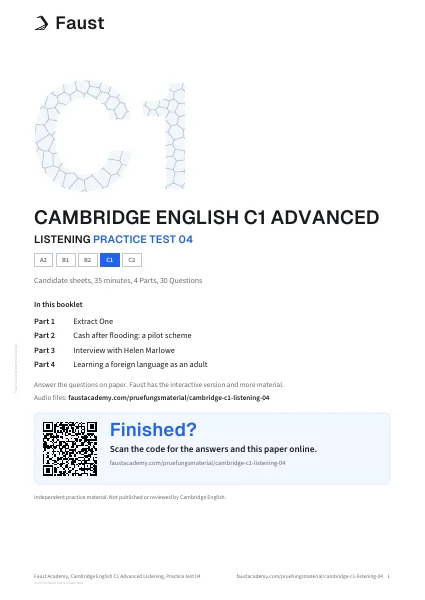
Cambridge C1 Advanced Listening practice test 4 is a listening paper for the Cambridge C1 Advanced exam. It takes 35 minutes. The PDF has 9 pages and 4 sections. The audio plays on this page. You can download the PDF for free, with no account. You can also practise it online.
Updated 17 November 2026, Faust Academy team
In this paper
- A talk on a cash pilot scheme after flooding
- Interview with Helen Marlowe
- Speaker 1
- Speaker 2
- Speaker 3
Exam material is in English.
Every PDF is free. How Faust marks
Independent Faust practice material. Not published or endorsed by the Cambridge University Press and Assessment.
Listening audio
Part 1
Part 2
Part 3
Part 4
Inside the paper
Part 1
You will hear three different extracts. For questions 1-6, choose the answer (A, B or C) which fits best according to what you hear. There are two questions for each extract.
1. You hear two friends discussing a photography exhibition of everyday street scenes. Which aspect of the exhibition do the friends disagree about?
A) how effective the lack of captions is
B) how well the photographs are arranged in the gallery
C) how striking the most famous images are
2. In the woman's opinion, photographers who capture moments of public distress are mainly motivated by
A) a wish to draw attention to a neglected problem
B) the prospect of winning professional recognition
C) a belief that they are recording history
3. You hear two colleagues talking about a new open-plan office. What is the man's main criticism of the arrangement?
A) It makes private phone calls difficult to take
B) It gives senior staff an unfair advantage over others
C) It leads to people interrupting one another's work
4. How does the woman respond to his criticism?
A) She accepts that the design needs to change
B) She suggests the problem is one of habit rather than design
C) She doubts that he has given the arrangement a fair trial
5. You hear a man telling a friend about taking up sea swimming in winter. What is he doing during the conversation?
A) justifying a decision that others thought foolish
B) admitting that his enthusiasm has faded
C) encouraging his friend to try it herself
6. Why does the woman mention her neighbour's experience?
A) to support his point about the benefits
B) to question whether his precautions make it safe
C) to suggest his explanation of the benefits may be incomplete
Cash after flooding: a pilot scheme
You will hear {speaker_line}. For questions 7 to 14, complete the sentences with a word or short phrase.
7. Before the pilot, Nadia had spent several years working as a {{7}} in the region.
8. Payments were sent directly to the families' {{8}}, so nobody had to travel to collect them.
9. Officials feared that some recipients would spend the money on {{9}}.
10. In most households, the first purchase was materials to repair their {{10}}.
11. Nadia uses the word {{11}} to describe the atmosphere in the local markets.
12. The scheme proved cheaper to run than traditional aid mainly because of lower {{12}} costs.
13. Nadia says the strongest criticism of the scheme came from {{13}} among neighbours who did not qualify.
14. Nadia hopes the next trial can be held during the {{14}}.
Part 3
You will hear an interview in which a presenter talks to a writer called Helen Marlowe about her book on a series of crimes in a river valley. For questions 15-20, choose the answer (A, B, C or D) which fits best according to what you hear.
15. What prompted Helen to write the book?
A) A publisher asked her to write about the region where she grew up
B) She realised that the fear she grew up with had never been properly examined
C) She was angry at the way earlier books had made the offenders seem fascinating
D) She discovered evidence that the police had mishandled the original investigations
16. How does Helen respond to critics who call her theory speculative?
A) She is irritated that reviewers have misrepresented what she argues
B) She regrets presenting the theory as more certain than the evidence allows
C) She accepts that it cannot be proved but believes it deserves to be taken seriously
D) She believes later research is more likely to refine her theory than overturn it
17. According to Helen, why were the region's circumstances at the time important to her theory?
A) Rapid change meant that people could come and go without anyone keeping track of them
B) Tight local budgets left the police unable to deal with serious crime
C) Suspicion of newcomers made residents unwilling to come forward as witnesses
D) The isolated landscape gave offenders places to hide what they had done
18. How does Helen react when the presenter suggests her argument could excuse the offenders?
A) She acknowledges the risk but argues that silence would serve the victims worse
B) She says the victims' families have approved her approach
C) She says the question belongs to psychologists rather than to writers
D) She insists that explaining the circumstances is not the same as excusing the crimes
19. What has surprised Helen about the reaction to her book in the region?
A) Older residents have been unwilling to talk about it publicly
B) Local readers have welcomed it warmly
C) Younger readers have taken little interest in it
D) The local press has been largely hostile to it
20. When asked what she mainly hopes will come of the book, Helen reveals
A) a hope that the police will reopen cases that were never solved
B) a hope that victims' families will finally receive public acknowledgement
C) a hope that communities will discuss how to protect vulnerable people
D) a hope that researchers will test her theory against other regions
Learning a foreign language as an adult
You will hear five short extracts in which {extracts_line}. For questions 21 to 25, choose from the list (A to H) {task_one}. For questions 26 to 30, choose from the list (A to H) {task_two}. While you listen you must complete both tasks.
21. Speaker 1
A) discovering their family roots
B) preparing for a move abroad
C) wanting to read literature in the original language
D) being required to by an employer
E) feeling embarrassed while travelling
F) wanting to talk to a partner's relatives
G) following medical advice
H) taking up a challenge after a milestone birthday
22. Speaker 2
A) discovering their family roots
B) preparing for a move abroad
C) wanting to read literature in the original language
D) being required to by an employer
E) feeling embarrassed while travelling
F) wanting to talk to a partner's relatives
G) following medical advice
H) taking up a challenge after a milestone birthday
23. Speaker 3
A) discovering their family roots
B) preparing for a move abroad
C) wanting to read literature in the original language
D) being required to by an employer
E) feeling embarrassed while travelling
F) wanting to talk to a partner's relatives
G) following medical advice
H) taking up a challenge after a milestone birthday
24. Speaker 4
A) discovering their family roots
B) preparing for a move abroad
C) wanting to read literature in the original language
D) being required to by an employer
E) feeling embarrassed while travelling
F) wanting to talk to a partner's relatives
G) following medical advice
H) taking up a challenge after a milestone birthday
25. Speaker 5
A) discovering their family roots
B) preparing for a move abroad
C) wanting to read literature in the original language
D) being required to by an employer
E) feeling embarrassed while travelling
F) wanting to talk to a partner's relatives
G) following medical advice
H) taking up a challenge after a milestone birthday
26. Speaker 1
A) proud of having overcome doubts about their ability
B) frustrated by a lack of progress
C) determined to reach fluency by a fixed date
D) relieved to be no longer worried about mistakes
E) encouraged by early results
F) amused by their own errors
G) surprised by how sociable it has made them
H) disappointed with the course
27. Speaker 2
A) proud of having overcome doubts about their ability
B) frustrated by a lack of progress
C) determined to reach fluency by a fixed date
D) relieved to be no longer worried about mistakes
E) encouraged by early results
F) amused by their own errors
G) surprised by how sociable it has made them
H) disappointed with the course
28. Speaker 3
A) proud of having overcome doubts about their ability
B) frustrated by a lack of progress
C) determined to reach fluency by a fixed date
D) relieved to be no longer worried about mistakes
E) encouraged by early results
F) amused by their own errors
G) surprised by how sociable it has made them
H) disappointed with the course
29. Speaker 4
A) proud of having overcome doubts about their ability
B) frustrated by a lack of progress
C) determined to reach fluency by a fixed date
D) relieved to be no longer worried about mistakes
E) encouraged by early results
F) amused by their own errors
G) surprised by how sociable it has made them
H) disappointed with the course
30. Speaker 5
A) proud of having overcome doubts about their ability
B) frustrated by a lack of progress
C) determined to reach fluency by a fixed date
D) relieved to be no longer worried about mistakes
E) encouraged by early results
F) amused by their own errors
G) surprised by how sociable it has made them
H) disappointed with the course
More papers
All 6 Cambridge C1 Advanced Listening papers
Frequently asked questions
- How long is Cambridge C1 Advanced Listening practice test 4?
- The paper takes 35 minutes. The PDF has 9 pages, and the answer key is a separate PDF. The audio for the paper plays on this page.
- Is Cambridge C1 Advanced Listening practice test 4 free?
- Yes. You can download the PDF for free, with no account. Online, one scored paper per part is free.