
Cambridge C1 Advanced Listening practice test 3
- Engineered to the real Cambridge format
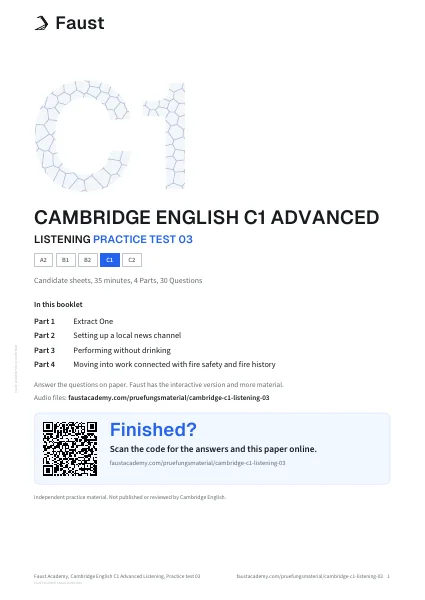
Cambridge C1 Advanced Listening practice test 3 is a listening paper for the Cambridge C1 Advanced exam. It takes 35 minutes. The PDF has 9 pages and 4 sections. The audio plays on this page. You can download the PDF for free, with no account. You can also practise it online.
Updated 17 November 2026, Faust Academy team
In this paper
- Setting up a local news channel
- Performing without drinking
- Speaker 1
- Speaker 2
- Speaker 3
Exam material is in English.
Every PDF is free. How Faust marks
Independent Faust practice material. Not published or endorsed by the Cambridge University Press and Assessment.
Listening audio
Part 1
Part 2
Part 3
Part 4
Inside the paper
Part 1
You will hear three different extracts. For questions 1 to 6, choose the answer (A, B or C) which fits best according to what you hear. There are two questions for each extract.
1. You hear two friends planning a winter craft session for children at a local library. What do the friends disagree about?
A) whether the children will prefer neat-looking results to messy ones
B) whether collecting the materials should be part of the activity
C) whether the volunteers need more preparation beforehand
2. How does the man react to the woman's final suggestion?
A) He is willing to accept it as a workable compromise
B) He doubts it will save as much time as she expects
C) He thinks it will make the session more appealing to parents
3. You hear two colleagues talking about their company's new desk-sharing arrangement. What is the woman's main reservation about it?
A) It has reduced the informal contact that helped teams solve problems
B) It makes it harder for people to concentrate on their work
C) It was brought in without staff being given a chance to comment
4. How does the man respond to her criticism?
A) He accepts that the arrangement should be abandoned
B) He suggests the problem could be solved if staff used the system differently
C) He argues that the conversations she values were seldom productive
5. You hear a woman telling a friend about the first children's workshop she ran at a community centre. How does she feel about the workshop now?
A) proud of the way she dealt with the problems that arose
B) relieved that the parents did not notice what went wrong
C) dissatisfied with her own performance despite encouraging signs
6. Why does the man mention his sourdough starter?
A) to show that mistakes at the start help people improve
B) to question how typical her experience was
C) to suggest she is judging the outcome too soon
A news channel for our town
You will hear {speaker_line}. For questions 7 to 14, complete the sentences with a word or short phrase.
7. Maya's original plan was to launch a {{7}} about local events.
8. She changed her plan after a {{8}} left many residents without reliable information.
9. Maya was surprised that so many of the first subscribers were {{9}}.
10. Every message on the channel is limited to {{10}}.
11. Maya uses the word {{11}} to describe the tone she wants for the channel.
12. The most widely shared posts are usually about {{12}}.
13. The biggest challenge for Maya is dealing with {{13}} that circulate before she can check them.
14. Next year, Maya hopes to train {{14}} to report for the channel.
Part 3
You will hear an interview in which a radio presenter called Tom Hartley is talking to a comedian called Nadia Okafor about performing without drinking alcohol. For questions 15 to 20, choose the answer (A, B, C or D) which fits best according to what you hear.
15. What does Nadia say about her early days as a performer?
A) She feared that not drinking would make other comedians see her as disapproving
B) She ignored an agent's warning that her choice could damage her career
C) She hoped that not drinking would help her stand out from other acts
D) She treated not drinking as a short experiment which then became permanent
16. How does Nadia feel about socialising with other performers after a show?
A) Resentful that she is rarely invited to join them
B) Weary of being expected to explain why she doesn't drink
C) Uncomfortable when people around her have drunk too much
D) Bored by the conversations that tend to take place
17. What is Nadia's attitude to making her non-drinking a theme in her act?
A) She is keen to build a whole show around it
B) She is concerned that she might come across as lecturing the audience
C) She is wary of it becoming the only thing she is known for
D) She is doubtful that audiences who drink will find it funny
18. Why does Nadia tell the story about the festival venue?
A) To show that organisers deliberately make life hard for sober performers
B) To explain why she once came close to giving up performing
C) To criticise the way festival audiences tend to behave towards her
D) To show how automatically the industry assumes that performers drink
19. What is Nadia's view of the suggestion that not drinking gives her an advantage on stage?
A) It helps her sharpen prepared material but matters less when she improvises
B) It gives her some practical benefits, but doesn't make her better than comics who drink
C) It counts for less than the years of stage experience she has built up
D) It is overstated, as nerves affect her performance far more than alcohol would
20. What is Nadia's attitude to the offer from a drinks company?
A) She is hesitant because accepting money might make her earlier statements seem less genuine
B) She is hesitant because she is not convinced the product is any good
C) She is hesitant because the fee seems too low for the work involved
D) She is hesitant because fellow comedians might tease her about it
Moving into work connected with fire safety and fire history
You will hear five short extracts in which {extracts_line}. For questions 21 to 25, choose from the list (A to H) {task_one}. For questions 26 to 30, choose from the list (A to H) {task_two}. While you listen you must complete both tasks.
21. Speaker 1
A) a redundancy that left no choice
B) a wish to use specialist skills in a practical setting
C) a family connection to the work
D) a desire to work outdoors
E) frustration with repetitive office routines
F) experience of a fire at a workplace
G) a lack of recognition in the previous job
H) a wish to teach young people
22. Speaker 2
A) a redundancy that left no choice
B) a wish to use specialist skills in a practical setting
C) a family connection to the work
D) a desire to work outdoors
E) frustration with repetitive office routines
F) experience of a fire at a workplace
G) a lack of recognition in the previous job
H) a wish to teach young people
23. Speaker 3
A) a redundancy that left no choice
B) a wish to use specialist skills in a practical setting
C) a family connection to the work
D) a desire to work outdoors
E) frustration with repetitive office routines
F) experience of a fire at a workplace
G) a lack of recognition in the previous job
H) a wish to teach young people
24. Speaker 4
A) a redundancy that left no choice
B) a wish to use specialist skills in a practical setting
C) a family connection to the work
D) a desire to work outdoors
E) frustration with repetitive office routines
F) experience of a fire at a workplace
G) a lack of recognition in the previous job
H) a wish to teach young people
25. Speaker 5
A) a redundancy that left no choice
B) a wish to use specialist skills in a practical setting
C) a family connection to the work
D) a desire to work outdoors
E) frustration with repetitive office routines
F) experience of a fire at a workplace
G) a lack of recognition in the previous job
H) a wish to teach young people
26. Speaker 1
A) surprised by how much stamina it demands
B) reassured by the support of colleagues
C) proud to be preserving something for the future
D) anxious about the responsibility
E) amused by other people's reactions
F) confident of promotion
G) relieved that their earnings have stayed steady
H) impatient for more practical involvement
27. Speaker 2
A) surprised by how much stamina it demands
B) reassured by the support of colleagues
C) proud to be preserving something for the future
D) anxious about the responsibility
E) amused by other people's reactions
F) confident of promotion
G) relieved that their earnings have stayed steady
H) impatient for more practical involvement
28. Speaker 3
A) surprised by how much stamina it demands
B) reassured by the support of colleagues
C) proud to be preserving something for the future
D) anxious about the responsibility
E) amused by other people's reactions
F) confident of promotion
G) relieved that their earnings have stayed steady
H) impatient for more practical involvement
29. Speaker 4
A) surprised by how much stamina it demands
B) reassured by the support of colleagues
C) proud to be preserving something for the future
D) anxious about the responsibility
E) amused by other people's reactions
F) confident of promotion
G) relieved that their earnings have stayed steady
H) impatient for more practical involvement
30. Speaker 5
A) surprised by how much stamina it demands
B) reassured by the support of colleagues
C) proud to be preserving something for the future
D) anxious about the responsibility
E) amused by other people's reactions
F) confident of promotion
G) relieved that their earnings have stayed steady
H) impatient for more practical involvement
More papers
All 6 Cambridge C1 Advanced Listening papers
Frequently asked questions
- How long is Cambridge C1 Advanced Listening practice test 3?
- The paper takes 35 minutes. The PDF has 9 pages, and the answer key is a separate PDF. The audio for the paper plays on this page.
- Is Cambridge C1 Advanced Listening practice test 3 free?
- Yes. You can download the PDF for free, with no account. Online, one scored paper per part is free.