
Cambridge B2 First Listening practice test 6
- Engineered to the real Cambridge format
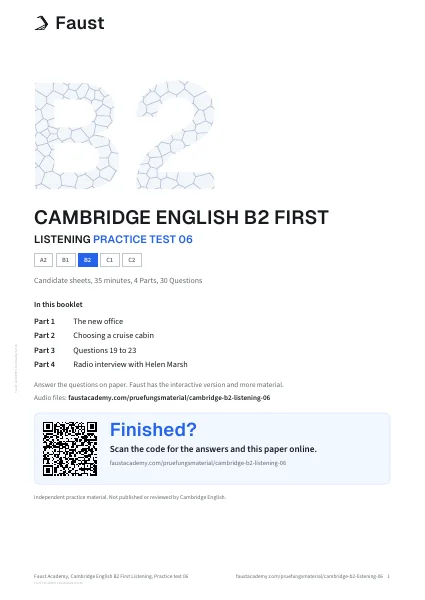
Cambridge B2 First Listening practice test 6 is a listening paper for the Cambridge B2 First exam. It takes 35 minutes. The PDF has 10 pages and 4 sections. The audio plays on this page. You can download the PDF for free, with no account. You can also practise it online.
Updated 17 November 2026, Faust Academy team
In this paper
- A small ski lift
- The new office
- A first long ride
- A first kitchen job
- The book club novel
Exam material is in English.
Every PDF is free. How Faust marks
Independent Faust practice material. Not published or endorsed by the Cambridge University Press and Assessment.
Listening audio
Part 1
Part 2
Part 3
Part 4
Inside the paper
Part 1
You will hear people talking in eight different situations. For questions 1-8, choose the best answer (A, B or C).
1. You hear a man talking to a friend about a small ski lift in the hills. What is he most worried about?
A) Nobody may be willing to take over the running of the lift
B) There may not be enough snow to make the lift worthwhile
C) The cost of repairing the equipment may be too high
2. You hear two colleagues talking about their new open-plan office. What does the woman say about it?
A) It makes communication between teams easier
B) It is too noisy for her to concentrate in
C) It will take her a while to get used to
3. You hear a woman talking about the first long-distance cycle ride she did. How did she feel when it was over?
A) disappointed with the time she had taken
B) surprised at how much she had enjoyed it
C) anxious about having to do it again
4. You hear a chef talking about his first job in a restaurant kitchen. What does he say about the experience?
A) It taught him more than his college course had
B) The long hours almost made him give up
C) His employer was stricter than he had expected
5. You hear two friends talking about a novel their book club has just read. What do they agree about?
A) The ending was easy to guess
B) The characters were convincing
C) The book was longer than necessary
6. You hear a woman making an announcement in a museum. What is she doing?
A) warning visitors about a change to the opening arrangements
B) recommending a particular exhibition to visitors
C) explaining how visitors can claim a refund
7. You hear a man talking about volunteering at a community garden. Why did he start doing it?
A) He wanted to meet people after retiring
B) He hoped to become fitter
C) He wanted to put his skills to use
8. You hear two flatmates talking about a broken washing machine. What do they decide to do?
A) pay for a repair themselves
B) ask the landlord to deal with it
C) buy a second-hand machine
Choosing a cruise cabin
You will hear {speaker_line}. For questions 9 to 18, complete the sentences with a word or short phrase.
9. According to Helen, the cabins that disappear soonest are those with a {{9}}.
10. Helen warns that people taking a walk on the {{10}} can see into the Deck 6 balconies.
11. For guests prone to seasickness, Helen suggests staying low down, near the {{11}}.
12. Helen suggests the smoke-free balconies at the front to people holidaying with {{12}}.
13. Helen warns that sleep may be disturbed in cabins underneath the {{13}}.
14. Helen recommends reserving a premium cabin a minimum of {{14}} before departure.
15. For passengers who like cocktails, Helen considers the {{15}} package the most economical.
16. The cabin Helen likes best at the moment is on Deck {{16}}.
17. Helen would change just one thing about standard cabins: they need more {{17}}.
18. Helen says beginners should look at the layout of the ship using the company's {{18}} before talking to an agent.
Part 3
You will hear five short extracts in which people are talking about a language course they took abroad. For questions 19-23, choose from the list (A-H) what each speaker liked most about the course they took. Use the letters only once. There are three extra letters which you do not need to use.
19. Speaker 1
A) the chance to practise outside the classroom
B) the friendliness of the other students
C) the quality of the teaching materials
D) the flexibility of the timetable
E) the knowledge of the teachers
F) the variety of social activities
G) the comfort of the accommodation
H) the use of technology in lessons
20. Speaker 2
A) the chance to practise outside the classroom
B) the friendliness of the other students
C) the quality of the teaching materials
D) the flexibility of the timetable
E) the knowledge of the teachers
F) the variety of social activities
G) the comfort of the accommodation
H) the use of technology in lessons
21. Speaker 3
A) the chance to practise outside the classroom
B) the friendliness of the other students
C) the quality of the teaching materials
D) the flexibility of the timetable
E) the knowledge of the teachers
F) the variety of social activities
G) the comfort of the accommodation
H) the use of technology in lessons
22. Speaker 4
A) the chance to practise outside the classroom
B) the friendliness of the other students
C) the quality of the teaching materials
D) the flexibility of the timetable
E) the knowledge of the teachers
F) the variety of social activities
G) the comfort of the accommodation
H) the use of technology in lessons
23. Speaker 5
A) the chance to practise outside the classroom
B) the friendliness of the other students
C) the quality of the teaching materials
D) the flexibility of the timetable
E) the knowledge of the teachers
F) the variety of social activities
G) the comfort of the accommodation
H) the use of technology in lessons
Part 4
You will hear part of a radio interview with a woman called Helen Marsh, who manages a leisure pool, a public swimming centre with pools and water slides. For questions 24-30, choose the best answer (A, B or C).
24. How does Helen feel about the daily water tests?
A) They have become so routine that she hardly notices them
B) They are repetitive, but she sees them as the most important part of her job
C) They take up time she would prefer to spend with visitors
25. What is the most common reason for Helen closing a pool temporarily?
A) The chemical levels in the water are outside the safe range
B) A piece of equipment has broken down
C) A swimmer has had an accident that makes cleaning necessary
26. When does Helen find talking to visitors most difficult?
A) when a popular slide has to stay closed on a warm day
B) when parents want children to swim in an area that is unsuitable
C) when people ask for their money back after a long wait
27. Why did Helen change the way warnings about the water are sent to staff?
A) The insurance company asked her to improve the system
B) She no longer wanted staff to depend on a single computer service
C) She wanted staff at other sites to see the readings at the same time
28. What does Helen say about the new automatic monitoring equipment?
A) She trusts it more than she trusts her staff's judgement
B) It has reduced the number of staff she needs on duty
C) It cannot replace checks carried out by people
29. What is Helen's opinion of the news coverage of incidents at other pools?
A) It is useful because it reminds everyone to take care
B) It is unfair to the leisure industry as a whole
C) It makes the dangers seem worse than they are
30. What does Helen hope to do in the next year?
A) build a new pool with extra slides
B) bring in outside inspectors to check her work
C) spend more time training her staff
More papers
Paper 1
Basketball player on a TV entertainment show
Paper 2
Village shop owner on local radio
Paper 3
Savings Accounts Abroad
Paper 4
Flatmates and the jumper
Paper 5
Voicemail message
Frequently asked questions
- How long is Cambridge B2 First Listening practice test 6?
- The paper takes 35 minutes. The PDF has 10 pages, and the answer key is a separate PDF. The audio for the paper plays on this page.
- Is Cambridge B2 First Listening practice test 6 free?
- Yes. You can download the PDF for free, with no account. Online, one scored paper per part is free.