
Cambridge B2 First Reading practice test 1
- Engineered to the real Cambridge format
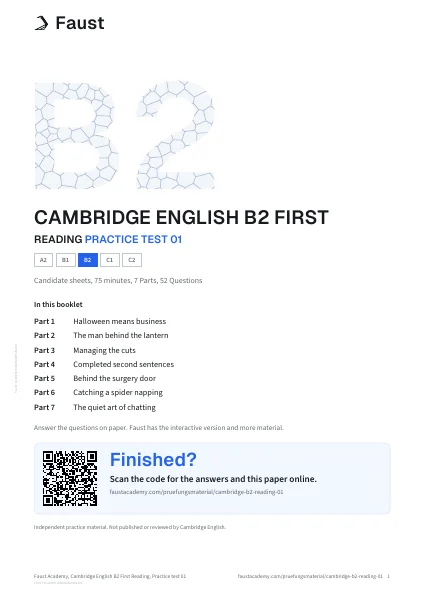
Cambridge B2 First Reading practice test 1 is a reading paper for the Cambridge B2 First exam. It takes 75 minutes. The PDF has 14 pages and 7 sections. You can download the PDF for free, with no account.
Updated 4 November 2026, Faust Academy team
In this paper
- Halloween means business
- The man behind the lantern
- Managing the cuts
- Completed second sentences
- Behind the surgery door
Exam material is in English.
Every PDF is free. How Faust marks
Independent Faust practice material. Not published or endorsed by the Cambridge University Press and Assessment.
Inside the paper
Part 1
For questions 1 to 8, read the text below and decide which answer (A, B, C or D) best fits each gap. There is an example at the beginning (0). Mark your answers on the separate answer sheet.
Halloween means business
Until fairly recently, most adults in Britain (0) took little notice of Halloween, leaving it to children with home-made masks and a bag of sweets. Things have changed. For many British households, the last evening of October has (1) ........ a major date in the shopping calendar. Shops expect a busy season, and shoppers are (2) ........ to spend more on decorations than ever before. Pumpkins, lights and plastic skeletons now fill shelves from early September. Retailers report that sales of fancy dress have (3) ........ off in recent years. This is particularly true among adults, who increasingly (4) ........ part in themed parties at home or at work. Office competitions for the best costume are now common, and some pubs offer prizes for the most frightening outfit. Not everyone (5) ........ of the trend, however. Some parents say they feel under (6) ........ to buy their children a new costume every year. Meanwhile, environmental groups point out that many cheap outfits are worn only once before being (7) ........ away and ending up in landfill. There are signs that shops are listening. Several high-street chains have started holding costume swap events, which have (8) ........ out to be surprisingly popular. Families bring last year's outfits and leave with something different, often without spending a penny.
Example
0. Until fairly recently, most adults in Britain (0) ........ little notice of Halloween, leaving it to children with home-made masks and a bag of sweets.
A) took
B) paid
C) gave
D) made
Answer: A
1. For many British households, the last evening of October has (1) ........ a major date in the shopping calendar.
A) developed
B) grown
C) become
D) changed
2. Shops expect a busy season, and shoppers are (2) ........ to spend more on decorations than ever before.
A) likely
B) probable
C) possible
D) presumable
3. Retailers report that sales of fancy dress have (3) ........ off in recent years.
A) set
B) gone
C) kept
D) taken
4. This is particularly true among adults, who increasingly (4) ........ part in themed parties at home or at work.
A) have
B) take
C) make
D) play
5. Not everyone (5) ........ of the trend, however.
A) agrees
B) supports
C) approves
D) accepts
6. Some parents say they feel under (6) ........ to buy their children a new costume every year.
A) pressure
B) stress
C) force
D) strain
7. Meanwhile, environmental groups point out that many cheap outfits are worn only once before being (7) ........ away and ending up in landfill.
A) put
B) cleared
C) packed
D) thrown
8. Several high-street chains have started holding costume swap events, which have (8) ........ out to be surprisingly popular.
A) worked
B) turned
C) come
D) found
Part 2
For questions 9 to 16, read the text below and think of the word which best fits each gap. Use only one word in each gap. There is an example at the beginning (0). Write your answers IN CAPITAL LETTERS on the separate answer sheet.
The man behind the lantern
Every October, families all over Britain carve faces into pumpkins and put candles inside them. Few of them, however, know where the custom comes from. According to an old Irish tale, there was once a man called Jack who was so mean that everyone knew him as Stingy Jack. One evening he invited the Devil for a drink but, as usual, he had no intention of paying. Instead, he persuaded his guest to turn himself into a coin to settle the bill. Jack then slipped the coin into his pocket next to a small silver cross, which had been blessed by a priest, so the Devil could not change back. The Devil was only set free after promising to leave Jack in peace for a year. When Jack eventually died, heaven would not accept such a dishonest man, and the Devil, still furious at having been tricked, refused to take him either. Instead, he sent Jack away with a burning coal to light his way. According to the story, Jack has been wandering the earth ever since, carrying the coal inside a hollowed-out turnip. People in Ireland began carving turnip lanterns to keep his restless spirit away. When many Irish families settled in North America in the nineteenth century, they found that pumpkins were much easier to carve than turnips, and the jack-o'-lantern as we know it was born.
Example
9. Every October, families (0) ........ over Britain carve faces into pumpkins and put candles inside them. Few of them, however, know where the custom comes {{9}} .
10. According to an old Irish tale, there was once a man called Jack who was {{10}} mean that everyone knew him as Stingy Jack. One evening he invited the Devil for a drink but, {{11}} usual, he had no intention of paying. Instead, he persuaded his guest to turn himself {{12}} a coin to settle the bill. Jack then slipped the coin into his pocket next to a small silver cross, {{13}} had been blessed by a priest, so the Devil could not change back. The Devil was only set free after promising to leave Jack {{14}} peace for a year.
11. According to an old Irish tale, there was once a man called Jack who was {{10}} mean that everyone knew him as Stingy Jack. One evening he invited the Devil for a drink but, {{11}} usual, he had no intention of paying. Instead, he persuaded his guest to turn himself {{12}} a coin to settle the bill. Jack then slipped the coin into his pocket next to a small silver cross, {{13}} had been blessed by a priest, so the Devil could not change back. The Devil was only set free after promising to leave Jack {{14}} peace for a year.
12. According to an old Irish tale, there was once a man called Jack who was {{10}} mean that everyone knew him as Stingy Jack. One evening he invited the Devil for a drink but, {{11}} usual, he had no intention of paying. Instead, he persuaded his guest to turn himself {{12}} a coin to settle the bill. Jack then slipped the coin into his pocket next to a small silver cross, {{13}} had been blessed by a priest, so the Devil could not change back. The Devil was only set free after promising to leave Jack {{14}} peace for a year.
13. According to an old Irish tale, there was once a man called Jack who was {{10}} mean that everyone knew him as Stingy Jack. One evening he invited the Devil for a drink but, {{11}} usual, he had no intention of paying. Instead, he persuaded his guest to turn himself {{12}} a coin to settle the bill. Jack then slipped the coin into his pocket next to a small silver cross, {{13}} had been blessed by a priest, so the Devil could not change back. The Devil was only set free after promising to leave Jack {{14}} peace for a year.
14. According to an old Irish tale, there was once a man called Jack who was {{10}} mean that everyone knew him as Stingy Jack. One evening he invited the Devil for a drink but, {{11}} usual, he had no intention of paying. Instead, he persuaded his guest to turn himself {{12}} a coin to settle the bill. Jack then slipped the coin into his pocket next to a small silver cross, {{13}} had been blessed by a priest, so the Devil could not change back. The Devil was only set free after promising to leave Jack {{14}} peace for a year.
15. When Jack eventually died, heaven would not accept such a dishonest man, and the Devil, still furious at having been tricked, refused to take him either. Instead, he sent Jack away with a burning coal to light his way. According to the story, Jack has been wandering the earth ever {{15}} , carrying the coal inside a hollowed-out turnip.
16. People in Ireland began carving turnip lanterns to keep his restless spirit away. When many Irish families settled in North America in the nineteenth century, they found that pumpkins were much easier to carve {{16}} turnips, and the jack-o'-lantern as we know it was born.
Managing the cuts
For questions 17 to 24, read the text below. Use the word given in capitals at the end of some of the lines to form a word that fits in the gap in the same line. There is an example at the beginning (0). Write your answers IN CAPITAL LETTERS on the separate answer sheet.
Managing the cuts
Harwell Motors, a car manufacturer in the Midlands, has been steadily cutting costs for almost three years. Daniel Price, who manages a team of forty, spends much of his week explaining the company's voluntary redundancy scheme to staff. 'When the cuts were first announced, a deep sense of insecurity spread across the factory,' he says. 'People who had worked here for decades suddenly wondered whether they would still have a job. 'Some conversations end unexpectedly well. One colleague told me she had always wanted to retrain as a teacher, and a generous one-off settlement from the firm finally made that possible. Others feel betrayed after years of loyal service, and I completely understand that.' The difficult part, Daniel explains, is that the company must also hold on to its most experienced people. 'Our best engineers can easily find work elsewhere, so the leaving packages tempt exactly the wrong people. Keeping them here tests our powers of persuasion, and money alone is rarely enough. They want to know there is a future here.' He admits it would be dishonest to pretend the cuts are over. 'I tell my team the truth, even when it's bad news. Still, I've had more sleepless nights in the past three years than in the rest of my career put together.'
Example
17. forty, spends much of his week explaining the company's voluntary {{17}} REDUNDANT
18. {{18}} spread across the factory,' he says. 'People who had SECURE
19. 'Some conversations end {{19}} well. One colleague told me she had EXPECT
20. {{20}} from the firm finally made that possible. Others feel SETTLE
21. on to its most {{21}} people. 'Our best engineers can easily EXPERIENCE
22. Keeping them here tests our powers of {{22}}, and money alone PERSUADE
23. He admits it would be {{23}} to pretend the cuts are over. HONEST
24. I've had more {{24}} nights in the past three years than SLEEP
Part 4
For questions 25 to 30, complete the second sentence so that it has a similar meaning to the first sentence, using the word given. Do not change the word given. You must use between two and five words, including the word given. Here is an example (0). Write only the missing words IN CAPITAL LETTERS on the separate answer sheet.
Completed second sentences
The guide asked us not to touch the banners in the revolution exhibition. I wish I had booked the concert tickets earlier. Kate gave up eating meat two years ago. The new sofa was less comfortable than we had expected. I wouldn't have passed my driving test if my brother hadn't helped me practise. Tom must have left his umbrella on the bus.
Example
Example
My bike was stolen from outside the library yesterday.
25. The guide {{25}} the banners in the revolution exhibition.
26. I {{26}} the concert tickets earlier.
27. Kate {{27}} two years ago.
28. The new sofa {{28}} we had expected.
29. I {{29}} my driving test if my brother hadn't helped me practise.
30. Tom {{30}} his umbrella on the bus.
Part 5
You are going to read an article in which a dentist called Rachel talks about her working life. For questions 31 to 36, choose the answer (A, B, C or D) which you think fits best according to the text. Mark your answers on the separate answer sheet.
Behind the surgery door
Dentist Rachel Lomax describes what her working day is really like. Whenever I'm introduced to someone at a party and the subject of work comes up, I can usually predict what happens next. Either they make a joke about the drill, or they give me a knowing look, as if being a dentist means a large house and two holidays a year. I won't pretend the salary is bad, and yes, I spend part of every day holding a drill. But if you followed me around for a week, you'd notice that the actual dentistry takes up surprisingly little of my time. Most of it goes on talking: explaining, calming people down and occasionally persuading someone that a problem won't simply go away on its own. My practice is a small one, above a bakery on the high street in Hollingford, and I'm normally there by about quarter to eight. Tom, my dental nurse, will already have laid out the instruments the evening before, so the first thing we do together is sit down with a coffee and read through the day's list. What we're really looking at is the people behind the names. Mrs Harding, who is in her eighties, never comes without her daughter, and the two of them need a few extra minutes to get settled. Then there's the man booked at eleven who has cancelled on us twice already; if he turns up, I want to be ready to put him at ease before he changes his mind again. Not every conversation ends the way I'd like. Quite often I'll recommend treatment that would save a tooth, and the patient will ask whether it wouldn't be simpler, and cheaper, just to have it out. I go through the choices again as plainly as I can, I make a note of what they've decided, and then I go along with it. It's their mouth and their money, after all, and I know perfectly well how stretched many families are at the moment. Still, I'd be lying if I said I forgot about it the moment they left. More than once I've found myself going over a case in my head all the way home. Dental school taught me a great deal. By the time I qualified, I was comfortable deciding on a treatment quickly, without needing a senior colleague to look over my shoulder. What it didn't teach me was business. When I bought the practice at thirty-one, I suddenly became the person who had to make sure there was enough in the account at the end of every month to pay Tom, our receptionist and the hygienist. Three people's livelihoods depended on choices I was making, and nobody had prepared me for that. There were nights in that first year when I lay awake doing sums. Then there are the afternoons that remind me why I do it. Last month a seven-year-old called Leo came in with his mother, who looked almost as anxious as he did. Before he'd even sat down, she warned me that he had screamed the place down at his previous dentist. So we took it slowly. I let him hold the little mirror and showed him each instrument, telling him what it was for and letting him feel how the air blower tickled his hand. By the end he was grinning, and as he climbed off the chair he asked when he could come back. It's an afternoon like that which makes all the forms and phone calls worth it. People sometimes ask whether I'd go into dentistry again, knowing what I know now. I don't even have to think about it: yes. I love the problem-solving, and I love the moment when a nervous patient finally relaxes in the chair. If I did anything differently, I'd probably spend a few more years working in someone else's practice before taking on my own. That way I'd have learnt the business side by watching someone else get it wrong, rather than by getting it wrong myself.
31. In the first paragraph, what is Rachel's main point about her job?
A) People tend to exaggerate how much dentists earn
B) Most of her patients are frightened of treatment
C) The human side of the work matters more than people imagine
D) The technical skills took her longer to learn than she expected
32. Why does Rachel go through the appointment list with her nurse each morning?
A) to make sure the right instruments are ready for each treatment
B) to identify patients who may need extra time or attention
C) to decide which appointments could be moved to another day
D) to check which patients still owe the practice money
33. How does Rachel feel when patients decide not to follow her advice?
A) She worries that she did not explain the treatment clearly enough
B) She is annoyed that cost matters more to them than their health
C) She accepts their decision but finds it hard to stop thinking about it
D) She is determined to change their minds at their next appointment
34. In the fourth paragraph, what does 'that' refer to in 'nobody had prepared me for that'?
A) making quick decisions about treatment without help
B) being responsible for her staff's jobs and wages
C) dealing with complaints from unhappy patients
D) working much longer hours than she used to
35. Why does Rachel describe her appointment with a boy called Leo?
A) to explain how she treats children differently from adults
B) to suggest that children often learn their fear from their parents
C) to show that children are easier patients than adults
D) to give an example of a moment that makes the job worthwhile
36. What does Rachel say about choosing her career again?
A) She would rather specialise in treating children
B) She would choose it again but delay owning a practice
C) She would prefer a job with less responsibility
D) She would choose it again mainly because of the income
Part 6
You are going to read a newspaper article in which a scientist talks about how researchers can tell whether a spider is asleep. Six sentences have been removed from the article. Choose from the sentences A to G the one which fits each gap (37 to 42). There is one extra sentence which you do not need to use. Mark your answers on the separate answer sheet.
Catching a spider napping
Catching a spider napping Arachnologist Dr Helen Marsh explains how her team set out to discover whether jumping spiders really sleep. Whenever I tell people that I study sleep in spiders, the first question is always the same: how can you possibly tell whether an animal without eyelids is asleep? It's a fair point. With a cat or a person, we look for closed eyes, or we measure electrical activity in the brain. __(37)__ Its eight eyes have no lids and stay open all the time, and its brain is far too small for the electrodes we would use on a cat. That hasn't stopped my team at the University of Northbridge from trying. Jumping spiders are remarkable little hunters. Rather than spinning webs and waiting, they stalk their prey, and they are surprisingly good at learning routes, sometimes taking a long detour out of sight of an insect before finally reaching it. An animal that clever, we reasoned, might well need proper rest. So we kept a group of them in the laboratory and filmed them overnight using infrared cameras, which can see in the dark without disturbing them. Night after night, the cameras showed the spiders hanging motionless from a single silk thread, legs tucked in. __(38)__ So we needed to show that these still spiders were harder to wake than ones that were simply resting. To test this, we used a tiny motor to give each spider's thread a gentle tap. __(39)__ Those hanging motionless at night, by contrast, needed a much stronger shake before they moved at all. Being harder to wake in this way is one of the standard signs that scientists use to recognise sleep in any animal. The most exciting discovery, though, came from the eyes themselves. Although the spiders cannot close their eyes, their main pair have movable retinas sitting behind fixed lenses, which allows the animal to look around without turning its head. Every so often during the night, these retinas began to flick rapidly from side to side in short bursts. In very young spiders the body is almost transparent, so we could actually watch the retinas shifting behind the lenses. __(40)__ During these phases, the legs also twitched and curled, rather as a sleeping dog's paws sometimes do. It is tempting to say the spiders were dreaming, and plenty of readers have written to ask exactly that. I'm careful not to. __(41)__ What we can say is that their nights contain two distinct phases, a calm one and an active one, which repeat in a regular cycle. That pattern looks a lot like the way human sleep is organised, which is surprising enough on its own. If an animal with such a tiny nervous system, built along completely different lines from ours, needs sleep, it raises an obvious question: where did sleep come from in the first place? One possibility is that sleep appeared very early in the history of animals and has been passed down ever since. __(42)__ Either way, a sleeping spider tells us that sleep is far more widespread, and far older, than we once assumed. So next time you notice a spider hanging perfectly still in a corner, you might want to leave it in peace. A What we saw was remarkably similar to the rapid eye movements that occur when people dream. B That is why we chose to film the spiders during the day, when they are at their most active. C Neither of these signs is much use to anyone studying a jumping spider. D Alternatively, it may have developed separately in different groups, perhaps because any creature that learns needs time to process what it has learnt. E Stillness on its own proves very little, however, because a hunting spider may wait motionless for long periods before it leaps on its prey. F That would be a far bigger claim than our recordings can support. G A spider that was merely resting turned towards the vibration almost instantly.
37. Gap 37
A) What we saw was remarkably similar to the rapid eye movements that occur when people dream
B) That is why we chose to film the spiders during the day, when they are at their most active
C) Neither of these signs is much use to anyone studying a jumping spider
D) Alternatively, it may have developed separately in different groups, perhaps because any creature that learns needs time to process what it has learnt
E) Stillness on its own proves very little, however, because a hunting spider may wait motionless for long periods before it leaps on its prey
F) That would be a far bigger claim than our recordings can support
G) A spider that was merely resting turned towards the vibration almost instantly
38. Gap 38
A) What we saw was remarkably similar to the rapid eye movements that occur when people dream
B) That is why we chose to film the spiders during the day, when they are at their most active
C) Neither of these signs is much use to anyone studying a jumping spider
D) Alternatively, it may have developed separately in different groups, perhaps because any creature that learns needs time to process what it has learnt
E) Stillness on its own proves very little, however, because a hunting spider may wait motionless for long periods before it leaps on its prey
F) That would be a far bigger claim than our recordings can support
G) A spider that was merely resting turned towards the vibration almost instantly
39. Gap 39
A) What we saw was remarkably similar to the rapid eye movements that occur when people dream
B) That is why we chose to film the spiders during the day, when they are at their most active
C) Neither of these signs is much use to anyone studying a jumping spider
D) Alternatively, it may have developed separately in different groups, perhaps because any creature that learns needs time to process what it has learnt
E) Stillness on its own proves very little, however, because a hunting spider may wait motionless for long periods before it leaps on its prey
F) That would be a far bigger claim than our recordings can support
G) A spider that was merely resting turned towards the vibration almost instantly
40. Gap 40
A) What we saw was remarkably similar to the rapid eye movements that occur when people dream
B) That is why we chose to film the spiders during the day, when they are at their most active
C) Neither of these signs is much use to anyone studying a jumping spider
D) Alternatively, it may have developed separately in different groups, perhaps because any creature that learns needs time to process what it has learnt
E) Stillness on its own proves very little, however, because a hunting spider may wait motionless for long periods before it leaps on its prey
F) That would be a far bigger claim than our recordings can support
G) A spider that was merely resting turned towards the vibration almost instantly
41. Gap 41
A) What we saw was remarkably similar to the rapid eye movements that occur when people dream
B) That is why we chose to film the spiders during the day, when they are at their most active
C) Neither of these signs is much use to anyone studying a jumping spider
D) Alternatively, it may have developed separately in different groups, perhaps because any creature that learns needs time to process what it has learnt
E) Stillness on its own proves very little, however, because a hunting spider may wait motionless for long periods before it leaps on its prey
F) That would be a far bigger claim than our recordings can support
G) A spider that was merely resting turned towards the vibration almost instantly
42. Gap 42
A) What we saw was remarkably similar to the rapid eye movements that occur when people dream
B) That is why we chose to film the spiders during the day, when they are at their most active
C) Neither of these signs is much use to anyone studying a jumping spider
D) Alternatively, it may have developed separately in different groups, perhaps because any creature that learns needs time to process what it has learnt
E) Stillness on its own proves very little, however, because a hunting spider may wait motionless for long periods before it leaps on its prey
F) That would be a far bigger claim than our recordings can support
G) A spider that was merely resting turned towards the vibration almost instantly
Part 7
You are going to read a newspaper article about a hairdresser who teaches people how to make small talk. For questions 43 to 52, choose from the sections (A to D). The sections may be chosen more than once. Mark your answers on the separate answer sheet. Which section
The quiet art of chatting
A Arriving at the salon I had been told that Nadia Kerr was the best conversationalist in Manchester, and I arrived at Kerr Cuts, her small salon in the south of the city, ready to be swept along by a torrent of chat. I had pictured someone who could talk to a lamp post; instead, Nadia is softly spoken, almost shy, and she waits for me to sit down before she says anything at all. It turns out that shyness is where her story begins. She started as an apprentice at sixteen, so nervous that she rehearsed jokes on the bus to work. 'A senior stylist took me aside after a week and told me to stop trying to entertain everybody and just let them talk,' she says. 'At the time I thought it was the least helpful thing anyone had ever said to me. I needed to be told what to say, not to say less. It took me about five years to see that she'd handed me the whole secret.' B The Tuesday workshop These days, on Tuesday evenings, the chairs in the back room are pushed against the wall and a dozen adults, from a nervous graduate to a recently retired bank manager, sit in a circle. Some have come expecting a list of witty lines to memorise; they leave with something rather different. Nadia's first piece of advice is to avoid asking strangers about work. In her view, the question 'What do you do?' can sound like an assessment, and for someone between jobs it is the last thing they want to hear. Even people in work may not want to describe a job they can't stand. 'Instead, start with what you are both sharing right now: the music, the queue, the rain against the window,' she says. Not everyone in the room is convinced. 'Plenty of people on my courses tell me small talk is fake, that they'd rather say nothing than say something empty,' she admits. 'But I see it as a bridge. Nobody walks straight into a deep conversation. You cross over to it on the little things.' C Twenty years with scissors Looking back over two decades behind the chair, Nadia is convinced that listening matters far more than being quick-witted. 'People assume the skill is having a brilliant answer ready. It isn't, because a clever comeback just leaves the other person feeling they have to match it, and then nobody relaxes.' What she offers instead is attention. A client once mentioned, almost in passing, that her teenage daughter was terrified about an upcoming test on the roads. Nadia made a mental note, and six weeks later she asked whether the daughter had passed her driving test. The woman was so touched that she nearly cried. Nadia learnt that kind of attention partly by getting it wrong. 'Early on, a woman told me about her father being in hospital, and I jumped straight in with my own dad's operation. I thought I was being sympathetic. But she went quiet for the rest of the cut, and I realised I'd turned her story into mine.' D Back in the chair By late afternoon I am in the chair myself, and something unexpected happens: Nadia says almost nothing for ten minutes, and I find it oddly restful. Silence, she insists, is nothing to be afraid of. Indeed, one of her regulars, a hospital surgeon, comes in for forty minutes in which nobody expects a word from him, and he has told her that the peace is half of what he pays for. So how does she judge when to speak? 'I watch. If they close their eyes or reach for their phone, I leave it. If they keep catching my eye in the mirror, that's an invitation.' As she trims my fringe, I realise I have done most of the talking all day, and I have no idea how she managed it.
43. suggests that trying to sound clever can make the other person feel less relaxed?
A) Arriving at the salon
B) The Tuesday workshop
C) Twenty years with scissors
D) Back in the chair
44. describes how the writer's expectations about Nadia turned out to be wrong?
A) Arriving at the salon
B) The Tuesday workshop
C) Twenty years with scissors
D) Back in the chair
45. mentions a customer who prefers not to talk at all?
A) Arriving at the salon
B) The Tuesday workshop
C) Twenty years with scissors
D) Back in the chair
46. explains why asking people about their job may be a poor way to start a conversation?
A) Arriving at the salon
B) The Tuesday workshop
C) Twenty years with scissors
D) Back in the chair
47. gives an example of a small detail that Nadia remembered and mentioned later?
A) Arriving at the salon
B) The Tuesday workshop
C) Twenty years with scissors
D) Back in the chair
48. mentions advice that Nadia did not find useful at first?
A) Arriving at the salon
B) The Tuesday workshop
C) Twenty years with scissors
D) Back in the chair
49. suggests that the place where people meet can supply a topic of conversation?
A) Arriving at the salon
B) The Tuesday workshop
C) Twenty years with scissors
D) Back in the chair
50. explains how Nadia decides whether to break a silence?
A) Arriving at the salon
B) The Tuesday workshop
C) Twenty years with scissors
D) Back in the chair
51. describes a mistake that taught Nadia a lesson?
A) Arriving at the salon
B) The Tuesday workshop
C) Twenty years with scissors
D) Back in the chair
52. says that some people avoid small talk because they think it is not genuine?
A) Arriving at the salon
B) The Tuesday workshop
C) Twenty years with scissors
D) Back in the chair
More papers
All 2 Cambridge B2 First Reading papers
Frequently asked questions
- How long is Cambridge B2 First Reading practice test 1?
- The paper takes 75 minutes. The PDF has 14 pages, and the answer key is a separate PDF.
- Is Cambridge B2 First Reading practice test 1 free?
- Yes. You can download the PDF for free, with no account.