
Cambridge B2 First Listening practice test 2
- Engineered to the real Cambridge format
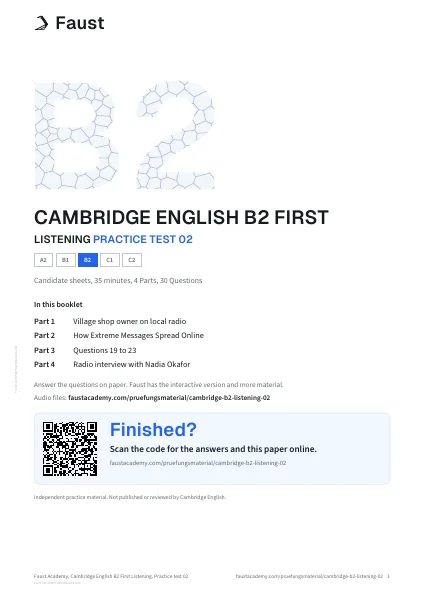
Cambridge B2 First Listening practice test 2 is a listening paper for the Cambridge B2 First exam. It takes 35 minutes. The PDF has 7 pages and 4 sections. The audio plays on this page. You can download the PDF for free, with no account.
Updated 4 November 2026, Faust Academy team
In this paper
- Village shop owner on local radio
- Phone message to a choir member
- Colleagues discussing a new office
- Friends back from a cycling holiday
- A woman talking about a pottery class
Exam material is in English.
Every PDF is free. How Faust marks
Independent Faust practice material. Not published or endorsed by the Cambridge University Press and Assessment.
Listening audio
Part 1
Part 2
Part 3
Part 4
Inside the paper
Part 1
You will hear people talking in eight different situations. For questions 1 to 8, choose the best answer (A, B or C).
1. You hear a woman who runs a family village shop talking on local radio. What does she say has helped the shop compete with large supermarkets?
A) opening for longer hours
B) having staff with time for customers
C) stocking produce from nearby farms
2. You hear a man leaving a phone message for a fellow choir member. Why is he calling?
A) to apologise for a mistake he made
B) to tell her about a change of time
C) to ask her to do something for him
3. You hear two colleagues talking about their new open-plan office. What does the woman dislike most about it?
A) the level of noise
B) the shortage of storage space
C) not having a desk of her own
4. You hear two friends talking about a cycling holiday they have just returned from. What do they both agree about?
A) The route was harder than they had expected
B) The places they stayed in were good value
C) The weather spoiled part of the trip
5. You hear a woman talking about the evening pottery class she has joined. How does she feel about it now?
A) surprised by how relaxing she finds it
B) frustrated by how slowly she is improving
C) worried about showing her work to others
6. You hear a man speaking on local radio about a museum. What is he doing?
A) reviewing a new exhibition
B) explaining a change to visiting arrangements
C) encouraging people to become members
7. You hear two neighbours talking about plans for a new car park in their town. The man thinks the council should have
A) asked residents for their views earlier
B) spent the money on improving bus services
C) chosen a different location for it
8. You hear a man telling a friend about a job interview he had. What does he say went wrong?
A) He was late for the interview
B) He knew too little about the company
C) He misunderstood one of the questions
Part 2
You will hear {speaker_line}. For questions 9 to 18, complete the sentences with a word or short phrase.
9. Helen's interest in the subject began during the years she spent as a {{9}}.
10. Helen says the everyday problem that extreme groups use most often to draw people in is {{10}}.
11. According to Helen, the posts that reach the largest audience are usually {{11}}.
12. Helen gets particularly annoyed when newspapers use the groups' own wording in their {{12}}.
13. When explaining the process to non-specialists, Helen compares it to a {{13}}.
14. Helen points out that {{14}} a false claim can end up giving it a larger audience.
15. The method Helen favours, which warns people about manipulation in advance, is known as {{15}}.
16. Participants in Helen's workshops now produce their own {{16}} to see how manipulation works.
17. In Helen's opinion, {{17}} have the best chance of reaching a teenager who is being drawn in.
18. Helen's team is currently working on a {{18}} aimed at secondary school pupils.
Part 3
You will hear five short extracts in which people are talking about a gadget they bought recently. For questions 19 to 23, choose from the list (A to H) what each speaker liked most about the gadget they bought. Use the letters only once. There are three extra letters which you do not need to use.
19. Speaker 1
A) the length of time it runs on one charge
B) the ease of getting it ready to use
C) its ability to survive accidents
D) the amount of time it frees up
E) the way it looks in the home
F) the advice given by the shop staff
G) the price they paid for it
H) the effect it has had on their habits
20. Speaker 2
A) the length of time it runs on one charge
B) the ease of getting it ready to use
C) its ability to survive accidents
D) the amount of time it frees up
E) the way it looks in the home
F) the advice given by the shop staff
G) the price they paid for it
H) the effect it has had on their habits
21. Speaker 3
A) the length of time it runs on one charge
B) the ease of getting it ready to use
C) its ability to survive accidents
D) the amount of time it frees up
E) the way it looks in the home
F) the advice given by the shop staff
G) the price they paid for it
H) the effect it has had on their habits
22. Speaker 4
A) the length of time it runs on one charge
B) the ease of getting it ready to use
C) its ability to survive accidents
D) the amount of time it frees up
E) the way it looks in the home
F) the advice given by the shop staff
G) the price they paid for it
H) the effect it has had on their habits
23. Speaker 5
A) the length of time it runs on one charge
B) the ease of getting it ready to use
C) its ability to survive accidents
D) the amount of time it frees up
E) the way it looks in the home
F) the advice given by the shop staff
G) the price they paid for it
H) the effect it has had on their habits
Part 4
You will hear part of a radio interview with a woman called Nadia Okafor, who produces podcasts for a regional radio station. For questions 24 to 30, choose the best answer (A, B or C).
24. What surprised Nadia when she first moved from presenting live programmes to making podcasts?
A) Podcast listeners expected a more relaxed style of presenting
B) Preparing a broadcast for podcast release involved far more work than she had assumed
C) Few of her colleagues showed any interest in the new format
25. According to Nadia, what is the main reason listeners catch up on programmes instead of listening live?
A) They want to skip the parts that don't interest them
B) They prefer to avoid the news and adverts between features
C) The programmes are broadcast when they are busy
26. What does Nadia say about listeners who download episodes rather than streaming them?
A) Many of them listen in places where the signal is unreliable
B) They are more likely to listen to the whole episode
C) They tend to be people who follow several series
27. How does Nadia feel about making the station's older programmes available online?
A) excited about introducing them to a new audience
B) frustrated by the time it takes to get permission
C) uneasy about how some of them may sound today
28. Why did the team change the way episodes are titled?
A) to help people find them through a search
B) to appeal to listeners outside the region
C) to reflect changes in the programmes' content
29. What has listener feedback made Nadia realise about episode length?
A) Shorter episodes are generally more popular
B) The right length depends on the type of programme
C) Listeners are happy with long episodes as long as they can pause them
30. What does Nadia hope will happen in the next few years?
A) Live radio will become less important to the station
B) More programmes will be made by listeners themselves
C) Some series will be created for podcast release only
More papers
All 2 Cambridge B2 First Listening papers
Frequently asked questions
- How long is Cambridge B2 First Listening practice test 2?
- The paper takes 35 minutes. The PDF has 7 pages, and the answer key is a separate PDF. The audio for the paper plays on this page.
- Is Cambridge B2 First Listening practice test 2 free?
- Yes. You can download the PDF for free, with no account.