
Cambridge B2 First Reading practice test 2
- Engineered to the real Cambridge format
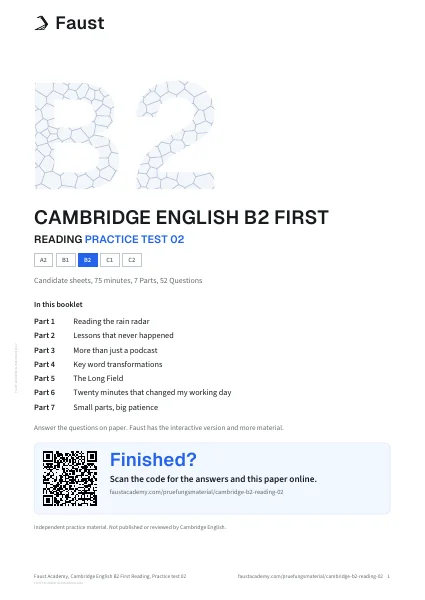
Cambridge B2 First Reading practice test 2 is a reading paper for the Cambridge B2 First exam. It takes 75 minutes. The PDF has 14 pages and 7 sections. You can download the PDF for free, with no account.
Updated 4 November 2026, Faust Academy team
In this paper
- Reading the rain radar
- Lessons that never happened
- More than just a podcast
- Key word transformations
- Twenty minutes that changed my working day
Exam material is in English.
Every PDF is free. How Faust marks
Independent Faust practice material. Not published or endorsed by the Cambridge University Press and Assessment.
Inside the paper
Part 1
For questions 1 to 8, read the text below and decide which answer (A, B, C or D) best fits each gap. There is an example at the beginning (0). Mark your answers on the separate answer sheet.
Reading the rain radar
Weather apps have (0) become a normal part of daily life in Britain. These days, many people check a rain radar app on their phone before they (1) ........ out on a bike ride or a long walk. But what exactly are they looking at? (2) ........ a traditional forecast, which describes the likely weather for a whole region over a day, a radar map shows exactly where rain is falling at this moment. Radar stations send out a beam that bounces back off raindrops, and the stronger the signal, the heavier the rain. Each colour on the map (3) ........ to a different intensity of rain, from light drizzle to heavy downpours. By comparing the latest images with those from the previous hour, the app can make (4) ........ guesses about where the showers will move next. These predictions work well for steady rain moving across the country. Thunderstorms, however, can (5) ........ up within minutes, so they do not always appear on the map in time to warn you. A dry patch on the screen is therefore no (6) ........ that you will get home without getting wet. Light drizzle from very low cloud may also be (7) ........ by the radar altogether, because the beam passes above it. So while the app is a useful tool, it still pays to (8) ........ an eye on the sky as well as on your phone.
Example
0. Weather apps have (0) ........ a normal part of daily life in Britain.
A) turned
B) become
C) grown
D) come
Answer: B
1. These days, many people check a rain radar app on their phone before they (1) ........ out on a bike ride or a long walk.
A) put
B) set
C) take
D) carry
2. (2) ........ a traditional forecast, which describes the likely weather for a whole region over a day, a radar map shows exactly where rain is falling at this moment.
A) Despite
B) Whereas
C) Although
D) Unlike
3. Each colour on the map (3) ........ to a different intensity of rain, from light drizzle to heavy downpours.
A) corresponds
B) matches
C) equals
D) compares
4. By comparing the latest images with those from the previous hour, the app can make (4) ........ guesses about where the showers will move next.
A) trained
B) schooled
C) educated
D) learned
5. Thunderstorms, however, can (5) ........ up within minutes, so they do not always appear on the map in time to warn you.
A) pile
B) build
C) grow
D) heap
6. A dry patch on the screen is therefore no (6) ........ that you will get home without getting wet.
A) pledge
B) warranty
C) security
D) guarantee
7. Light drizzle from very low cloud may also be (7) ........ by the radar altogether, because the beam passes above it.
A) missed
B) omitted
C) neglected
D) lacked
8. So while the app is a useful tool, it still pays to (8) ........ an eye on the sky as well as on your phone.
A) keep
B) hold
C) put
D) watch
Part 2
For questions 9 to 16, read the text below and think of the word which best fits each gap. Use only one word in each gap. There is an example at the beginning (0). Write your answers IN CAPITAL LETTERS on the separate answer sheet.
Lessons that never happened
In my final year at college, more than four hundred of my lessons were cancelled. Several teachers were off sick for months, and the college found it almost impossible to replace them. Instead of being taught, we were usually sent to the library with a worksheet and told to get on with it. At first, some of my classmates were delighted to have so much free time. I wasn't. I needed good grades to get into university, and with nobody to explain the difficult topics, I had to teach myself most of the history course from textbooks. When my results came out, they were lower than I had expected, so I decided to make a formal complaint. I argued that the college should take responsibility for the situation and that my grades should be reconsidered. My complaint was rejected. I was told that even though conditions had admittedly been far from ideal, the college had done everything it reasonably could. Two years on, I still wonder whether I was right to complain. What I am sure of is that students in my position deserve far more than a worksheet and an empty classroom.
Example
9. In my final year at college, more (0) ........ four hundred of my lessons were cancelled. Several teachers were off sick for months, and the college found it almost impossible to replace them. Instead {{9}} being taught, we were usually sent to the library with a worksheet and told to get {{10}} with it.
10. In my final year at college, more (0) ........ four hundred of my lessons were cancelled. Several teachers were off sick for months, and the college found it almost impossible to replace them. Instead {{9}} being taught, we were usually sent to the library with a worksheet and told to get {{10}} with it.
11. At first, some of my classmates were delighted to have so {{11}} free time. I wasn't. I needed good grades to get into university, and with nobody to explain the difficult topics, I had to teach {{12}} most of the history course from textbooks.
12. At first, some of my classmates were delighted to have so {{11}} free time. I wasn't. I needed good grades to get into university, and with nobody to explain the difficult topics, I had to teach {{12}} most of the history course from textbooks.
13. When my results came out, they were lower than I had expected, so I decided to make a formal complaint. I argued that the college should take responsibility {{13}} the situation and that my grades should be reconsidered. My complaint was rejected. I was told that even {{14}} conditions had admittedly been far from ideal, the college had done everything it reasonably could.
14. When my results came out, they were lower than I had expected, so I decided to make a formal complaint. I argued that the college should take responsibility {{13}} the situation and that my grades should be reconsidered. My complaint was rejected. I was told that even {{14}} conditions had admittedly been far from ideal, the college had done everything it reasonably could.
15. Two years on, I still wonder {{15}} I was right to complain. What I am sure of is {{16}} students in my position deserve far more than a worksheet and an empty classroom.
16. Two years on, I still wonder {{15}} I was right to complain. What I am sure of is {{16}} students in my position deserve far more than a worksheet and an empty classroom.
Part 3
For questions 17 to 24, read the text below. Use the word given in capitals at the end of some of the lines to form a word that fits in the gap in the same line. There is an example at the beginning (0). Write your answers IN CAPITAL LETTERS on the separate answer sheet.
More than just a podcast
Many of us regularly listen to podcasts on the way to work, but few people imagine that a programme could change lives. The eight producers behind Open Door, a weekly podcast made in Manchester, release more than forty episodes a year, and their work often reaches listeners in unexpected ways. Each week the team receives hundreds of responses, from short thank-you notes to long personal stories. What listeners mention most is the hosts' honesty about their own lives, which makes difficult subjects easier to talk about. Some episodes have even grown into something bigger. When host Priya Nair suggested an episode about the quarter-life crisis, many thought it an unlikely choice, and at first her idea was met with considerable scepticism within the team. Yet listeners soon proved her right. Many wrote that the episode had eased their feelings of loneliness and helped them see that others faced the same doubts. One listener even set up an online chat group, which still meets every month. For the team, this is perhaps the most encouraging part of the job: knowing that a programme can bring people together long after it ends.
Example
17. eight {{17}} behind Open Door, a weekly podcast made in Manchester, PRODUCE
18. listeners in {{18}} ways. Each week the team receives hundreds of EXPECT
19. {{19}}, from short thank-you notes to long personal stories. RESPOND
20. What listeners mention most is the hosts' {{20}} about their HONEST
21. suggested an episode about the quarter-life crisis, many thought it an {{21}} LIKE
22. choice, and at first her idea was met with considerable {{22}} SCEPTIC
23. that the episode had eased their feelings of {{23}} and helped LONELY
24. team, this is perhaps the most {{24}} part of the job: knowing COURAGE
Part 4
For questions 25 to 30, complete the second sentence so that it has a similar meaning to the first sentence, using the word given. Do not change the word given. You must use between two and five words, including the word given. Here is an example (0). Write only the missing words IN CAPITAL LETTERS on the separate answer sheet.
Key word transformations
It came as a surprise to most scientists that the research team detected the rare particles so early. Because of the heavy rain, we put off the opening of the community garden. Priya promised to send Tom the holiday photos the following day. Daniel must have forgotten about the dinner reservation. Laura has got used to cycling to work in the rain. The match will be cancelled unless the weather improves.
Example
Example
I had my bicycle repaired at the shop yesterday.
25. It {{25}} most scientists that the research team detected the rare particles so early.
26. Because of the heavy rain, we {{26}} of the community garden.
27. Priya {{27}} the holiday photos the following day.
28. Daniel {{28}} the dinner reservation.
29. Laura {{29}} to work in the rain.
30. The match will be cancelled {{30}}.
Part 5
You are going to read an extract from a novel in which a young man called Nathan talks about a plan to build a data centre near his village. For questions 31 to 36, choose the answer (A, B, C or D) which you think fits best according to the text. Mark your answers on the separate answer sheet.
The Long Field
People in Hollins Beck have always been good at disagreeing. Put six of them in a room and you would get seven opinions on parking by the church, the village hall and why the half-past-eight bus never came at half past eight. What you hardly ever got was everybody talking about the same thing at once. Then one Tuesday in March an envelope landed in every letterbox. Inside was a brochure from a company called Northcroft Compute, which planned to build a data centre on farmland below the village and promised up to two hundred local jobs. By lunchtime you couldn't buy a loaf without hearing the words 'server halls'. Even the farmers forgot their grumbling about milk prices for a morning. It turned out that Dad, Graham to everyone else, had known for weeks. Northcroft wanted the long field that runs down from our yard to the beck, and he had agreed to sell it. He told me that evening at the kitchen table, over the bank statements. Milk was fetching less than it had ten years ago, the overdraft grew every winter, and the barn roof was held together by luck and baler twine. 'I've done the sums twice, Nathan,' he said, tapping his pencil on the calculator. 'There isn't a third way of doing them.' He had sat up two nights working it all out himself. Soon the whole village knew what Northcroft were paying him: more than our family had ever seen. In May the postman brought Mrs Ellis next door another envelope, a week before the council planning meeting. She is eighty-one and long widowed. I was dropping off her eggs when she opened it on the doorstep: a cheque for four thousand pounds and a letter thanking her for her 'community goodwill'. She read the letter, then tore the cheque in half, and in half again, and pressed the pieces into my hand. 'Funny time for them to come over all generous,' she said. 'Seven days before the vote.' By that weekend, once everyone knew who had been sent a cheque, you could see the change in the Fleece. Those who had cashed their cheques sat near the fire; those who had been left out, or had sent theirs back, stood by the bar. Ken Dawson, who got nothing, had moved to the small table at the far end, and he stayed there. The night Dad and I walked in, the talk stopped, like a radio in a tunnel, then started again a little too loudly. Nobody mentioned the two hundred jobs any more. Nobody mentioned Dad's money either, though everyone knew the figure to the nearest thousand. People talked about football and diesel prices, and all the while the thing sat in the middle of the room as plainly as the fireplace: there were two villages now, one that had done well out of Northcroft and one that had been left standing at the bar. Everyone could see it, but nobody wanted to be the first to say it. Two evenings before the meeting I took the dog down the long field, which wasn't ours any more, though nothing yet showed it. The ground is as flat as a table, and the power line still hums along the top edge. But it was the curlews I noticed first, their bubbling calls rising over the rushes. Then the dry-stone wall Grandad rebuilt the summer before he died, every stone fitted by his own hands. I had walked dogs along that wall for years, and I realised I had never once really looked at it. Mrs Ellis was at her gate when I came back. 'Will you speak on Thursday, love? They'll listen to a young one.' I couldn't answer. I was thinking of Dad's pencil tapping on the calculator, and of the torn cheque she had pressed into my hand, and I couldn't make either of them go away. 'I honestly don't know,' I said gently. 'I'll think about it.' Going in, I tried to picture the valley in twenty years' time, and found I couldn't.
31. In the first paragraph, what is Nathan's main point about the village?
A) Most people there had been worried about its future for years
B) It took something unusual to make everyone focus on the same subject
C) Its residents were suspicious of anyone who came from outside
D) News travelled more slowly there than in the nearby towns
32. When Nathan's father says he has 'done the sums twice', he means that he
A) had checked carefully that the farm could not carry on as it was
B) had made sure he would get more money than his neighbours
C) had asked someone else to check the company's offer
D) had changed his mind about how much to ask for
33. Why did Mrs Ellis tear up the cheque?
A) She thought it was an insult compared with what Graham had received
B) She believed it was meant to stop people objecting to the plan
C) She doubted whether the cheque was genuine
D) She was angry that the company had not visited her in person
34. In the fifth paragraph, 'it' in 'nobody wanted to be the first to say it' refers to the fact that
A) the village had split into those who had gained from the deal and those who had not
B) the jobs the company had promised were unlikely to go to local people
C) Mrs Ellis had been right about the company from the start
D) Graham had been paid far more than anyone else in the village
35. What is Nathan's purpose in describing his walk across the field?
A) to explain why the company had chosen that particular site
B) to show he was starting to value things he had always taken for granted
C) to suggest that the land had never been good for farming
D) to describe an evening routine he had always enjoyed
36. What does the final paragraph suggest about Nathan?
A) He has decided to speak against the plan at the meeting
B) He resents Mrs Ellis for asking him to take sides
C) He feels torn between his father and his neighbour's concerns
D) He intends to leave the village once the building starts
Part 6
You are going to read a newspaper article in which a hospital nurse talks about learning to take short naps during her working day. Six sentences have been removed from the article. Choose from the sentences A to G the one which fits each gap (37 to 42). There is one extra sentence which you do not need to use. Mark your answers on the separate answer sheet.
Twenty minutes that changed my working day
A hospital nurse explains how she stopped fighting her afternoon tiredness. For most of my twenty-two years as a nurse on a busy surgical ward in Leeds, I believed that sleeping during the day was a sign of weakness. Naps, as far as I was concerned, were for small children and for people with nothing better to do. When the middle of a shift dragged, I did what everyone else did: I made another coffee, and by the end of the day I had usually got through five or six of them. Privately, though, I often felt so exhausted by mid-afternoon that I could barely read a patient's chart. (37) ........ In a team that prided itself on never stopping, being tired felt like failing. What changed my mind was a senior nurse called Margaret, who joined our ward four years ago. She was quite simply the most efficient person I have ever worked with: she remembered every patient's name, spotted problems before the doctors did and still found time to train the new staff. (38) ........ Yet every day, at around two o'clock, she would disappear into the staff room, set an alarm on her phone and sleep for exactly twenty minutes. (39) ........ At first, I assumed she must be ill or simply older and in need of more rest. When I finally asked her about it, she laughed and told me she had been doing it for thirty years. She had no intention of stopping now, she said, and suggested I try it myself before I made up my mind. So on my next day off, I did. I lay down on the sofa after lunch, pulled a blanket over my legs and decided that I would get up whenever I felt ready. When I woke, it was getting dark, my head ached and I felt worse than before. (40) ........ Margaret explained that after about half an hour the body slips into a much deeper stage of sleep, and waking from it leaves you feeling heavy and confused for a while. Keep it short, she said, and you wake up before you get there. The following week I set an alarm for twenty minutes, just as she did, and took my break in the quietest corner of the staff room. For the first few attempts I hardly slept at all. I simply lay there with my eyes closed, listening to the traffic outside the window, and got up feeling no different. After a few days, though, my body learned the routine, and I began to drift off within minutes and wake up clear-headed. (41) ........ My concentration in the late afternoon, when mistakes on a ward are most likely, improved noticeably, and I was less short-tempered at home. My husband noticed the difference before I did. These days I take my twenty minutes on every shift, and I have persuaded several of the younger nurses to do the same. Some of them are still embarrassed to be seen lying down in the staff room, and one or two prefer to slip out to their cars instead. I understand that completely, because I used to think the same way. I tell anyone who will listen that a short nap is not laziness but a tool, like a good pair of shoes. (42) ........ If you are sleeping badly at night, a short afternoon rest will not solve the problem, and a long one may even make it worse. But as a way of getting through the hardest part of the day, it has done more for me than any amount of coffee. A She called it her 'reset', and she never missed it. B None of this means a nap can replace a proper night's sleep. C The trouble was that I had slept for well over an hour. D It was not something I was prepared to admit to my colleagues. E Margaret admitted that she had once been just as sceptical as I was. F Nobody would have described her as lazy. G Within a week, I had stopped reaching for a third coffee.
37. Gap 37
A) She called it her 'reset', and she never missed it
B) None of this means a nap can replace a proper night's sleep
C) The trouble was that I had slept for well over an hour
D) It was not something I was prepared to admit to my colleagues
E) Margaret admitted that she had once been just as sceptical as I was
F) Nobody would have described her as lazy
G) Within a week, I had stopped reaching for a third coffee
38. Gap 38
A) She called it her 'reset', and she never missed it
B) None of this means a nap can replace a proper night's sleep
C) The trouble was that I had slept for well over an hour
D) It was not something I was prepared to admit to my colleagues
E) Margaret admitted that she had once been just as sceptical as I was
F) Nobody would have described her as lazy
G) Within a week, I had stopped reaching for a third coffee
39. Gap 39
A) She called it her 'reset', and she never missed it
B) None of this means a nap can replace a proper night's sleep
C) The trouble was that I had slept for well over an hour
D) It was not something I was prepared to admit to my colleagues
E) Margaret admitted that she had once been just as sceptical as I was
F) Nobody would have described her as lazy
G) Within a week, I had stopped reaching for a third coffee
40. Gap 40
A) She called it her 'reset', and she never missed it
B) None of this means a nap can replace a proper night's sleep
C) The trouble was that I had slept for well over an hour
D) It was not something I was prepared to admit to my colleagues
E) Margaret admitted that she had once been just as sceptical as I was
F) Nobody would have described her as lazy
G) Within a week, I had stopped reaching for a third coffee
41. Gap 41
A) She called it her 'reset', and she never missed it
B) None of this means a nap can replace a proper night's sleep
C) The trouble was that I had slept for well over an hour
D) It was not something I was prepared to admit to my colleagues
E) Margaret admitted that she had once been just as sceptical as I was
F) Nobody would have described her as lazy
G) Within a week, I had stopped reaching for a third coffee
42. Gap 42
A) She called it her 'reset', and she never missed it
B) None of this means a nap can replace a proper night's sleep
C) The trouble was that I had slept for well over an hour
D) It was not something I was prepared to admit to my colleagues
E) Margaret admitted that she had once been just as sceptical as I was
F) Nobody would have described her as lazy
G) Within a week, I had stopped reaching for a third coffee
Part 7
You are going to read a newspaper article about a young designer of model vehicle kits. For questions 43 to 52, choose from the sections (A to D). The sections may be chosen more than once. Mark your answers on the separate answer sheet.
Small parts, big patience
Tom Ashworth spends a day with a young kit designer in Leeds. A Monday morning If you are looking for Brickwell Models, do not rely on satellite navigation. The company is tucked away at the far end of an industrial estate on the edge of Leeds, and I drive past the entrance twice before spotting a hand-painted sign beside a loading bay. I should warn readers that anyone expecting a glass-walled design studio will be disappointed: Brickwell works from two rooms above a carpet warehouse, and the smell of new rugs follows you up the stairs. Graham Hollis, who founded the business fifteen years ago, greets me with an apology for the mess and hands me over to his chief designer, Priya Desai. At 26, she is responsible for most of the kits the company sells, and her desk shows that every piece begins as a pencil sketch on squared paper before it ever reaches the 3D printer humming in the corner. 'The printer is quicker than I am,' she says, 'but it can't think. The pencil is where I decide what a part is actually for.' B Over a cup of tea Mid-morning, we retreat to a tiny kitchen and Priya explains how she got here. Her career was not the route anyone had planned: her parents had pictured her as an architect and, as her mother put it, 'model cars were something you did at the weekend'. After an engineering degree she applied to a large toy manufacturer and was turned down, so she spent twelve months working in a bicycle repair shop in Hull. 'I was gutted at the time,' she says. Yet looking back, that rejection was the best thing that could have happened, because a year of fixing bikes taught her more about gears than any lecture. When she finally joined Brickwell, Graham told her on her first day to write the instructions before the design was finished, and she has done so ever since. 'If I can't explain a step in one simple sentence, the step is wrong, not the sentence.' C After lunch The afternoon is spent at the workbench, where her latest project, an 833-piece kit of a 1960s sports car, sits half assembled. It very nearly never got this far. Early test models looked perfect in photographs, but it was a group of volunteer builders, a retired railway engineer among them, who first noticed that the doors refused to shut. Two teenagers in the same group had sent in identical complaints within a day. The cause was a frame a fraction of a millimetre too wide, and there was no quick fix. So three weeks of drawings went straight in the bin and she started the chassis again from nothing. 'Painful,' she says, 'but cheaper than ten thousand angry emails.' She lifts the bonnet to show me the engine: tiny pistons, a fan belt, even a dipstick. She admits that once the bonnet clicks shut, nobody will ever see the engine again, 'but the builder knows it's there, and that's who it's for'. D Before the train home As the light fades, talk turns to the future. Graham hints that the firm may need bigger premises within a few years, and the sales team is keen to add app-controlled motors to future kits, so that a finished car could be driven around the kitchen floor. Priya's response is careful. 'I'm not sure,' she admits. 'Half the joy is sitting quietly with the pieces. I'd hate to lose that to a phone screen.' Her own ambitions lie elsewhere. Her seven-year-old nephew already gets through her current kits happily enough, with a little help from his father. But what she really wants is a kit for the adult who has never built anything and assumes they couldn't: fewer parts, bigger pieces and instructions that never make anyone feel stupid. When I leave for the station, she is back at the bench, pencil in hand.
43. Which paragraph describes a time when the designer had to throw away work she had already completed?
A) A Monday morning
B) B Over a cup of tea
C) C After lunch
D) D Before the train home
44. suggests that the designer's workplace is less impressive than visitors might expect?
A) A Monday morning
B) B Over a cup of tea
C) C After lunch
D) D Before the train home
45. reveals the designer's doubts about a direction her company is taking?
A) A Monday morning
B) B Over a cup of tea
C) C After lunch
D) D Before the train home
46. explains why an early disappointment turned out to be useful?
A) A Monday morning
B) B Over a cup of tea
C) C After lunch
D) D Before the train home
47. mentions people outside the company whose reactions influenced a product?
A) A Monday morning
B) B Over a cup of tea
C) C After lunch
D) D Before the train home
48. says that the designer's work combines traditional and modern methods?
A) A Monday morning
B) B Over a cup of tea
C) C After lunch
D) D Before the train home
49. indicates that the designer's family were not keen on her choice of career at first?
A) A Monday morning
B) B Over a cup of tea
C) C After lunch
D) D Before the train home
50. describes the designer's hope of attracting a different kind of customer?
A) A Monday morning
B) B Over a cup of tea
C) C After lunch
D) D Before the train home
51. mentions advice from a colleague that changed the way the designer worked?
A) A Monday morning
B) B Over a cup of tea
C) C After lunch
D) D Before the train home
52. explains why a carefully made part of a product cannot be seen once it is finished?
A) A Monday morning
B) B Over a cup of tea
C) C After lunch
D) D Before the train home
More papers
All 2 Cambridge B2 First Reading papers
Frequently asked questions
- How long is Cambridge B2 First Reading practice test 2?
- The paper takes 75 minutes. The PDF has 14 pages, and the answer key is a separate PDF.
- Is Cambridge B2 First Reading practice test 2 free?
- Yes. You can download the PDF for free, with no account.