
Cambridge B2 First Listening practice test 3
- Engineered to the real Cambridge format
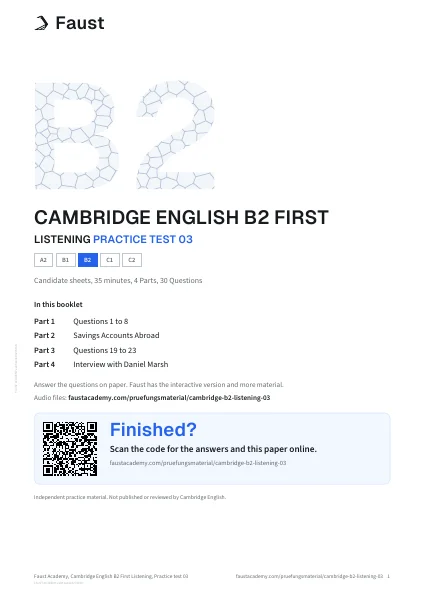
Cambridge B2 First Listening practice test 3 is a listening paper for the Cambridge B2 First exam. It takes 35 minutes. The PDF has 10 pages and 4 sections. The audio plays on this page. You can download the PDF for free, with no account. You can also practise it online.
Updated 17 November 2026, Faust Academy team
In this paper
- Speaker 1
- Speaker 2
- Speaker 3
- Speaker 4
- Speaker 5
Exam material is in English.
Every PDF is free. How Faust marks
Independent Faust practice material. Not published or endorsed by the Cambridge University Press and Assessment.
Listening audio
Part 1
Part 2
Part 3
Part 4
Inside the paper
Part 1
You will hear people talking in eight different situations. For questions 1 to 8, choose the best answer (A, B or C).
1. You hear a voicemail message from a woman to a friend. Why is she calling?
A) to suggest meeting before an event
B) to ask the friend to use her tickets
C) to complain about a change to a programme
2. You hear two colleagues talking about their new open-plan office. What is the man's main concern?
A) Team members now talk to each other less
B) The noise makes it hard to concentrate
C) Private conversations are difficult to have
3. You hear a chef talking about opening his first restaurant. What mistake does he say he made?
A) He chose a poor location for the restaurant
B) He did not allow enough money for running costs
C) He took on more staff than he needed
4. You overhear two friends talking about a cycling holiday. What did the man find most difficult?
A) riding for several days without a rest
B) cycling in poor weather
C) carrying heavy luggage uphill
5. You hear two people talking about a novel they have both read. What does the woman think about the ending?
A) It was too predictable
B) It was confusing
C) It felt rushed
6. You hear a boy talking to his mother after a school play. How does the boy feel?
A) relieved that it is finished
B) embarrassed about forgetting his lines
C) keen to take part in another production
7. You overhear two friends talking about their town's new library. What do they both like about it?
A) the range of events it offers
B) the quiet areas for studying
C) the modern design of the building
8. You hear a woman speaking on the radio. What is she doing?
A) advertising a local event
B) reviewing a new book
C) reporting on a community project
Savings Accounts Abroad
You will hear {speaker_line}. For questions 9 to 18, complete the sentences with a word or short phrase.
9. Daniel first became curious about foreign savings accounts after a colleague gave him a {{9}}.
10. Overseas banks often pay higher rates because they are keen to attract {{10}}.
11. Daniel approves of comparison websites that cover more than {{11}} banks.
12. Most of these accounts are denominated in {{12}}, though a few use another currency.
13. Even a yearly interest total of only {{13}} has to be reported on a tax return.
14. Daniel is annoyed that some banks provide their statements in nothing but {{14}}.
15. To convert interest into pounds, Daniel recommends the exchange rates supplied by {{15}}.
16. The item that goes missing most often is the annual {{16}} issued by the bank.
17. People whose finances are complicated should make their first call to {{17}}.
18. Daniel advises gathering paperwork from {{18}}, well before the filing deadline.
Part 3
You will hear five short extracts in which people are talking about their visit to a city. For questions 19 to 23, choose from the list (A to H) what each speaker liked most about the city they visited. Use the letters only once. There are three extra letters which you do not need to use.
19. Speaker 1
A) the number of small venues for live music
B) the friendliness of the local people
C) the quality of the street food
D) the ease of getting around on foot
E) the beauty of the old buildings
F) the choice of cheap places to stay
G) the green spaces beside the river
H) the range of independent record shops
20. Speaker 2
A) the number of small venues for live music
B) the friendliness of the local people
C) the quality of the street food
D) the ease of getting around on foot
E) the beauty of the old buildings
F) the choice of cheap places to stay
G) the green spaces beside the river
H) the range of independent record shops
21. Speaker 3
A) the number of small venues for live music
B) the friendliness of the local people
C) the quality of the street food
D) the ease of getting around on foot
E) the beauty of the old buildings
F) the choice of cheap places to stay
G) the green spaces beside the river
H) the range of independent record shops
22. Speaker 4
A) the number of small venues for live music
B) the friendliness of the local people
C) the quality of the street food
D) the ease of getting around on foot
E) the beauty of the old buildings
F) the choice of cheap places to stay
G) the green spaces beside the river
H) the range of independent record shops
23. Speaker 5
A) the number of small venues for live music
B) the friendliness of the local people
C) the quality of the street food
D) the ease of getting around on foot
E) the beauty of the old buildings
F) the choice of cheap places to stay
G) the green spaces beside the river
H) the range of independent record shops
Part 4
You will hear part of a radio interview with a man called Daniel Marsh, who is a product manager and uses voice dictation software in his daily work. For questions 24 to 30, choose the best answer (A, B or C).
24. What first made Daniel try dictation?
A) He had begun to get pain in his hands from typing
B) He wanted to finish his written work during the working day
C) A colleague told him it would save him time
25. Why did Daniel move from a paid dictation app to an open-source one?
A) The price of the subscription had gone up too much
B) The paid app was not accurate enough for his work
C) He wanted more control over where his recordings were processed
26. What problem does Daniel mention about using dictation in the office?
A) He feels self-conscious talking to his computer in an open-plan space
B) The software often misunderstands technical terms
C) Colleagues have complained about the noise he makes
27. What does Daniel find most valuable about speaking rather than typing?
A) It produces finished text more quickly
B) It helps him to think more freely
C) It means he makes fewer mistakes
28. What advice does Daniel give to people who want to start using dictation?
A) Use it at first for private notes rather than messages to colleagues
B) Spend time learning the software's correction commands early on
C) Start with one type of task you do regularly
29. What does Daniel say about the claim that dictation has doubled his productivity?
A) The real benefit is that he now does tasks he used to put off
B) He has measured the improvement carefully over several months
C) It is only true of his email and messaging
30. What concern does Daniel express about the technology?
A) It could make parts of his job unnecessary
B) He might come to depend on it too much
C) It may soon become too expensive to use
More papers
Paper 4
Flatmates and the jumper
Paper 5
Voicemail message
Paper 6
A small ski lift
Paper 1
Basketball player on a TV entertainment show
Paper 2
Village shop owner on local radio
Frequently asked questions
- How long is Cambridge B2 First Listening practice test 3?
- The paper takes 35 minutes. The PDF has 10 pages, and the answer key is a separate PDF. The audio for the paper plays on this page.
- Is Cambridge B2 First Listening practice test 3 free?
- Yes. You can download the PDF for free, with no account. Online, one scored paper per part is free.