
IELTS General Training Reading practice test 5
- Engineered to the real IELTS format
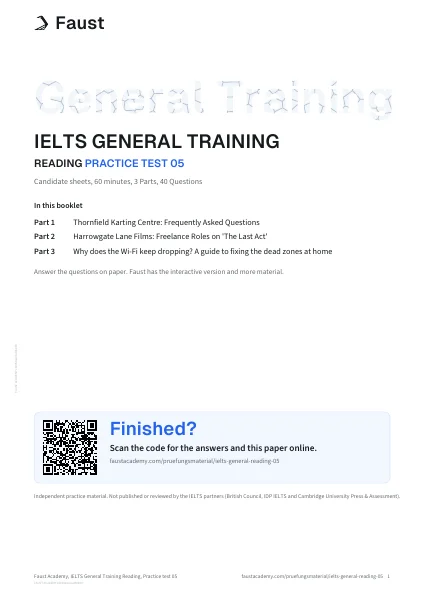
IELTS General Training Reading practice test 5 is a reading paper for the IELTS General Training exam. It takes 60 minutes. The PDF has 12 pages and 3 sections. You can download the PDF for free, with no account.
Updated 4 November 2026, Faust Academy team
In this paper
- Thornfield Karting Centre: Frequently Asked Questions
- Breezeline Swift cordless vacuum cleaner: online customer reviews
- Harrowgate Lane Films: Freelance Roles on 'The Last Act'
- Calder & Finch Logistics: Volunteering as a Workplace First Aider
- Why does the Wi-Fi keep dropping? A guide to fixing the dead zones at home
Exam material is in English.
Every PDF is free. How Faust marks
Independent Faust practice material. Not published or endorsed by the IELTS partners (British Council, IDP IELTS and Cambridge University Press and Assessment).
Inside the paper
SECTION 1
SECTION 1 Questions 1 to 14
Thornfield Karting Centre: Frequently Asked Questions
Thornfield Karting Centre has an indoor track and an outdoor track on the edge of Redbury. Here are the answers to the questions our customers ask most often. Who can drive? Adult sessions are open to anyone aged 16 or over. Junior sessions are open to drivers aged 8 to 15. All junior drivers must also be at least 1.3 metres tall. This is because shorter drivers cannot reach the pedals safely. Most sessions are arranged by age group, so juniors and adults usually drive separately. On Sunday mornings we run family sessions, when parents can drive alongside their children if the children are aged 12 or over. How do I book? You can book online up to two hours before your session. Drivers who arrive without booking are welcome to pay at reception if there are places left. During school holidays, sessions often fill up several days in advance, so we recommend planning ahead. What should I wear? Helmets and overalls are included in the price of every session. Driving gloves are available to buy in our shop, and all drivers must wear closed shoes. Long hair should be tied back, and scarves must be removed before driving. What happens if the weather is bad? Our outdoor track stays open in light rain, and the karts are fitted with special tyres for wet conditions. If we have to cancel a session because of heavy rain or lightning, we do not give cash refunds, but you will receive credit that can be used at any time in the next six months. We will always send you a text message as early as possible. Is there a junior championship? Many professional drivers started their careers in karting. Junior drivers who have completed ten sessions with us may apply to enter our junior championship, which runs from April to September. Races take place on the first Saturday of each month, and results are displayed on the board in our café. Can friends and family watch? Friends and family are welcome to watch free of charge from our viewing gallery, although children under 14 must be with an adult. Our café, next to the gallery, serves hot and cold drinks and light meals all day.
Breezeline Swift cordless vacuum cleaner: online customer reviews
A Priya Our house has three floors, so I bought this for downstairs and still use my older corded machine upstairs. It does a brilliant job on hard floors and rugs. The diagrams in the instruction leaflet were confusing, and in the end I had to watch a video online to see how the wall bracket fitted. Once it was on the wall, though, charging was simple. B Tom We have a large dog, and it gets the hair off the sofa in seconds. My only complaint is the battery. The website says the battery lasts 40 minutes, but on full power I get about 25. On the normal setting it does a bit better, so I save full power for the carpets. I've already recommended it to my brother. C Elena I actually ordered this as a birthday present for my mother, but after trying it once I kept it and bought her a second one. It's light and easy to carry upstairs, and the dust container empties without any mess. I wasn't sure how to clean the filter, but the questions page on the company website explained it clearly. D Marcus My old vacuum cleaner finally gave up after eight years, so I needed a new one quickly. Setting this one up took five minutes, and it is much quieter than my previous model. However, we have a cat, and her hair gets wrapped round the brush, so I have to cut it free with scissors every week. E Joanne One of the brush heads was missing from the box, so I rang the helpline and they sent it within two days. Apart from that, I'm very happy. The battery lasts long enough to clean my whole flat, including the kitchen floor. The weight is fine for me, but my elderly neighbour tried it and found it hard to hold up when cleaning the ceiling corners.
1. Children aged seven may join a junior session if they are tall enough.
TRUE) TRUE
FALSE) FALSE
NOT GIVEN) NOT GIVEN
2. Adults and children can sometimes be on the track at the same time.
TRUE) TRUE
FALSE) FALSE
NOT GIVEN) NOT GIVEN
3. It costs less to book a session online than to pay at reception.
TRUE) TRUE
FALSE) FALSE
NOT GIVEN) NOT GIVEN
4. Drivers have to pay an extra charge to use a helmet.
TRUE) TRUE
FALSE) FALSE
NOT GIVEN) NOT GIVEN
5. Customers whose session is cancelled because of a storm get their money back.
TRUE) TRUE
FALSE) FALSE
NOT GIVEN) NOT GIVEN
6. The winner of the junior championship is offered a place in a professional racing team.
TRUE) TRUE
FALSE) FALSE
NOT GIVEN) NOT GIVEN
7. Visitors who only want to watch do not need to pay.
TRUE) TRUE
FALSE) FALSE
NOT GIVEN) NOT GIVEN
8. The customer bought the vacuum cleaner to replace an older one that had stopped working.
A) Priya
B) Tom
C) Elena
D) Marcus
E) Joanne
9. The battery did not last as long as the customer expected.
A) Priya
B) Tom
C) Elena
D) Marcus
E) Joanne
10. The customer had to contact the company about a problem.
A) Priya
B) Tom
C) Elena
D) Marcus
E) Joanne
11. The customer found the instructions difficult to follow.
A) Priya
B) Tom
C) Elena
D) Marcus
E) Joanne
12. The customer had planned to give the vacuum cleaner to someone else.
A) Priya
B) Tom
C) Elena
D) Marcus
E) Joanne
13. The vacuum cleaner works well in a home with animals.
A) Priya
B) Tom
C) Elena
D) Marcus
E) Joanne
14. The customer thinks the vacuum cleaner may be too heavy for some people.
A) Priya
B) Tom
C) Elena
D) Marcus
E) Joanne
Section 2: Freelance documentary roles and workplace first aid training
SECTION 2 Questions 15 to 27
Harrowgate Lane Films: Freelance Roles on 'The Last Act'
Harrowgate Lane Films is a small independent production company based in Bristol. We have been asked to make a sixty-minute documentary for broadcast next spring, marking 25 years since the death of the playwright Edwin Marsh, whose plays about life in northern mill towns are still performed across the country. The programme will combine interviews with actors and directors who worked with him, footage of early productions and material that has never been shown in public. We are now looking for three freelancers to join our team. A Archive Researcher You will find and secure the film clips, photographs and documents that bring Marsh's story to life. This involves searching television and theatre collections, and contacting the playwright's family to borrow private letters and photographs that they have kept since his death. All licence fees for footage and photographs must be kept within a total budget of £12,000, and you will keep a running record of costs. For this reason, the post needs someone who has already negotiated licence fees with broadcasters or picture libraries. Apart from occasional visits to archives, you can work from home for most of the contract. Two of the main collections are in London and Glasgow; you will travel to these by train, and your fares will be paid back. The role starts six weeks before filming, so that material is ready in time for the interviews. B Production Coordinator You will keep the shoot running smoothly from day to day. You will book travel and hotels for our interviewees and make sure they are comfortable on the day of filming. You will also draw up the daily call sheet and make sure the crew has everything it needs. Filming takes place over three weeks at theatres and former mill buildings in Lancashire and Yorkshire, and you will be on location throughout. A full driving licence is essential, as you will drive the crew van between locations. We are looking for someone with previous experience of location work, ideally on factual programmes. The role starts two weeks before filming, and you will stay on for one week after filming ends to return hired equipment. C Assistant Editor You will work alongside our senior editor to shape many hours of interviews and archive material into the finished programme. Your tasks will include organising footage, preparing rough versions of scenes, and typing interviewees' names and dates for the on-screen captions. The contract starts the week after the final day of filming and runs for eight weeks. You must be based at our edit suite in Bristol throughout, as the senior editor will review your work daily. The programme has to be delivered by a fixed deadline set by the channel, so you should be comfortable working steadily under pressure. If you have not used our editing system before, we will pay for you to attend a short course before you start. How to apply Please send your CV and a short covering letter to jobs@harrowgatelanefilms.co.uk by 20 November, stating clearly which role you are applying for.
Calder & Finch Logistics: Volunteering as a Workplace First Aider
Every site and office building at Calder & Finch must have enough trained first aiders to cover all shifts, including periods of holiday and sickness. At present our head office in Leeds is short of volunteers on the second and third floors, and we would welcome interest from staff in any department. No previous medical knowledge is needed, but you should be calm in difficult situations and willing to take responsibility. Applying Because first aid training takes place during working hours, you will need written approval from your supervisor before you apply. This is simply to make sure your team can manage while you are away. Once you have it, complete the short application form on the staff intranet and attach the approval. The Health and Safety Officer will then book you a place on the next available course and confirm the dates by email. Training The initial three-day course is run on site by an external provider. It covers how to respond to injuries, burns, breathing difficulties and sudden illness, and much of the time is spent practising on training equipment. The three-day course finishes with a practical assessment, followed by a short written quiz. Successful candidates are awarded a certificate, valid for three years, and you will also receive a green badge to wear on your lanyard, so that colleagues can recognise you quickly in an emergency. Anyone who does not pass first time may repeat the course at no cost. To stay qualified, you must attend a two-day refresher course before your certificate expires. The Health and Safety Officer keeps a record of expiry dates and will remind you three months in advance, but it is your responsibility to make sure you attend. Payment and time In recognition of the extra responsibility, an allowance of £25 is added to your monthly salary for as long as your certificate remains valid. Time spent on training and dealing with incidents counts as normal working time. Your duties Once qualified, you will be asked to respond to incidents in your area and to keep basic supplies in order. In practice this means you should check the first aid cabinet on your floor on the first Monday of each month; the kits in company vans are checked by the drivers. Any items that are running low should be reordered through the Facilities team. After dealing with any incident, however minor, you should complete an incident report on the staff intranet within 24 hours. These records help us to spot patterns and make the workplace safer for everyone.
15. Training will be provided if the successful applicant needs it.
A) Archive Researcher
B) Production Coordinator
C) Assistant Editor
16. The role includes looking after people who appear in the film.
A) Archive Researcher
B) Production Coordinator
C) Assistant Editor
17. Work on this role begins after filming has ended.
A) Archive Researcher
B) Production Coordinator
C) Assistant Editor
18. Most of the work can be done from home.
A) Archive Researcher
B) Production Coordinator
C) Assistant Editor
19. The person will be responsible for staying within a set budget.
A) Archive Researcher
B) Production Coordinator
C) Assistant Editor
20. Applicants must be able to drive.
A) Archive Researcher
B) Production Coordinator
C) Assistant Editor
21. • Volunteers must get written approval from their {{21}} before applying.
22. • The initial course lasts three days and ends with a practical {{22}}.
23. • Those who pass are given a {{23}} that remains valid for three years.
24. • Before this runs out, they must attend a two-day {{24}} course.
25. • First aiders receive a monthly {{25}} of £25 on top of their pay.
26. • Each month they check the {{26}} on their own floor.
27. • After any incident they complete an incident {{27}} on the staff intranet.
Fixing the dead zones: a guide to better Wi-Fi at home
Read the text below and answer Questions 28 to 40.
Why does the Wi-Fi keep dropping? A guide to fixing the dead zones at home
A When the video call freezes for the third time in an evening, most of us react in the same way. We ring the internet provider to complain, or we start wondering whether it is time to pay for a faster package. Yet in many homes the line coming into the building is perfectly healthy. The trouble begins after the signal leaves the router, because Wi-Fi is simply a radio wave, and radio waves grow weaker the further they travel and the more they have to pass through. Every wall, floor and cupboard between your router and your laptop takes a bite out of the signal. Thick brick and concrete do the most damage, and metal, from a fridge door to the foil backing on some insulation, can block it almost entirely. Water absorbs it too, which is why a large fish tank or a row of radiators can leave one corner of a room strangely quiet. In blocks of flats there is a further problem: dozens of neighbouring networks crowd onto the same few channels, and each one adds to the noise your devices have to cope with. B Before you spend a penny, try moving the router itself. Many people leave it wherever the engineer happened to install it, often on the floor behind the television or in a hallway cupboard at one end of the house. A central position works far better, and so does height: a shelf or the top of a bookcase lets the signal spread out instead of being swallowed by furniture. Keep it away from the microwave, which uses a similar frequency, and from that fish tank. Restarting the router every few weeks clears out minor faults that build up over time, and it takes less than a minute. If you live in a busy block, it is also worth logging into the router's settings and switching to a less crowded channel; free apps on most phones will show you which ones your neighbours are using. The box supplied by your provider may well be several years old, but even an elderly router often performs noticeably better once it has been given a sensible home. C When these steps are not enough, the first gadget most people buy is a Wi-Fi repeater, sometimes sold as an extender. It plugs into a socket, picks up the router's signal and broadcasts it again further into the house. Repeaters are the cheapest fix on the market, but there is a catch. Because a repeater has to listen and then repeat on the same channel, the speed you actually get can drop by as much as half. Phones and laptops are also stubborn: they tend to cling to the router's fading signal rather than switch to the repeater. The result can be a device showing one bar of Wi-Fi while a much stronger connection sits unused a few metres away. Placement matters as well. A common mistake is to put the repeater in the dead zone itself, where it has almost nothing to pass on; it belongs roughly halfway between the router and the room that needs help. For a flat with two or three rooms, a repeater is usually enough. D Powerline adapters take a different route altogether: they use the electrical wiring already running through your walls. One adapter sits next to the router and is connected to it with a short cable; a second goes into a socket in the distant room, where it either provides its own Wi-Fi or lets you plug in a computer or games console directly. Because the data travels through copper rather than through the air, thick walls make no difference. In a modern home with tidy wiring the results can be impressive. Results are far less reliable in older buildings, where the circuits may have been extended again and again over the decades. It is also important to plug each adapter directly into a wall socket, as an extension lead can weaken the signal considerably, and the same is true of sockets shared with heaters or washing machines. Some owners worry that the signal can travel a little beyond their own flat's wiring, but adapters are encrypted as standard, so this is rarely a real concern. E The most complete answer is a mesh system. Instead of one device doing all the work, a mesh system spreads it across several units that talk to each other, usually called nodes. You place them around the home, perhaps one on each landing or at either end of a long bungalow, and they work out among themselves the best path for your data. Because they share a single network name and password, your phone hops from one node to the next without interruption as you walk around. There is no need to choose a different network when you go upstairs, and no dropped call as you carry your phone into the kitchen. Mesh is the most expensive of the options described here, with a set of three nodes typically costing several times the price of a repeater. In most cases the main node can replace the provider's router entirely, although some households prefer to keep the old box connected. Even so, for anyone in a house spread over several floors, it is money well spent.
28. Section A
i) Turning the power supply into a data network
Comparing the prices charged by internet providers
A popular add-on device and its drawbacks
What stands between the router and the user
v) Protecting a home network from the neighbours
Improvements that require no new equipment
A team of units for larger homes
How the latest routers differ from older models
29. Section B
i) Turning the power supply into a data network
Comparing the prices charged by internet providers
A popular add-on device and its drawbacks
What stands between the router and the user
v) Protecting a home network from the neighbours
Improvements that require no new equipment
A team of units for larger homes
How the latest routers differ from older models
30. Section C
i) Turning the power supply into a data network
Comparing the prices charged by internet providers
A popular add-on device and its drawbacks
What stands between the router and the user
v) Protecting a home network from the neighbours
Improvements that require no new equipment
A team of units for larger homes
How the latest routers differ from older models
31. Section D
i) Turning the power supply into a data network
Comparing the prices charged by internet providers
A popular add-on device and its drawbacks
What stands between the router and the user
v) Protecting a home network from the neighbours
Improvements that require no new equipment
A team of units for larger homes
How the latest routers differ from older models
32. Section E
i) Turning the power supply into a data network
Comparing the prices charged by internet providers
A popular add-on device and its drawbacks
What stands between the router and the user
v) Protecting a home network from the neighbours
Improvements that require no new equipment
A team of units for larger homes
How the latest routers differ from older models
33. Which TWO problems with repeaters does the writer mention?
A) They reduce the speed of the connection
B) Devices may stay connected to the weaker signal from the router
C) They suffer interference from microwave ovens
D) They need to be restarted every few weeks to work properly
E) They have to be placed inside the area with no signal
34. Which TWO problems with repeaters does the writer mention?
A) They reduce the speed of the connection
B) Devices may stay connected to the weaker signal from the router
C) They suffer interference from microwave ovens
D) They need to be restarted every few weeks to work properly
E) They have to be placed inside the area with no signal
35. Powerline adapters send the internet signal through the electrical {{35}} that already runs through a home's walls.
36. They often perform badly in {{36}} buildings, where the circuits may have been extended many times.
37. Each adapter should go straight into a wall socket, because using an extension {{37}} can weaken the signal.
38. A mesh system is made up of several small units, usually known as {{38}}, placed in different parts of the home.
39. As they share one network name, a phone can move between rooms without {{39}}.
40. Mesh is the most expensive choice, but the writer thinks it is worth paying for in a house spread over several {{40}}.
More papers
Paper 6
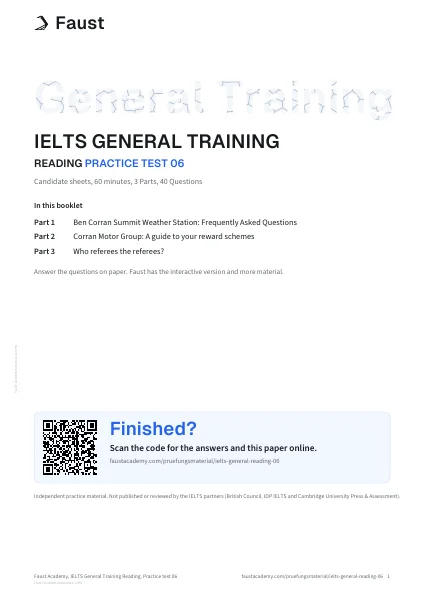
Ben Corran Summit Weather Station: Frequently Asked Questions
Paper 1
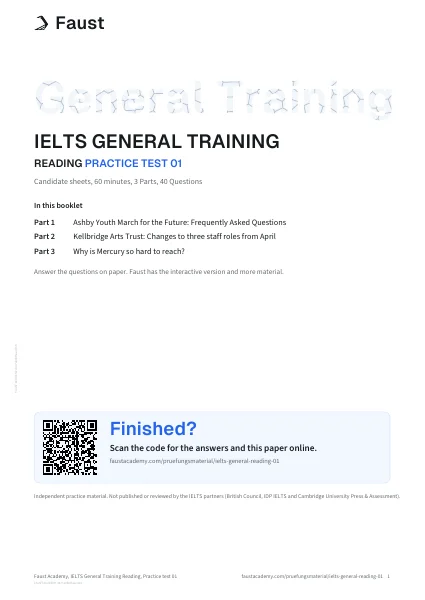
Ashby Youth March for the Future: Frequently Asked Questions
Paper 2
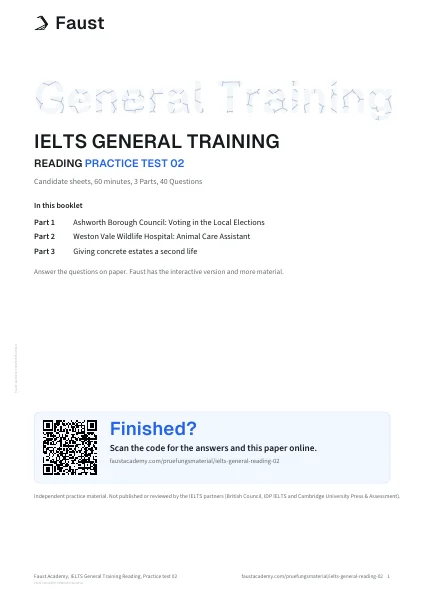
Ashworth Borough Council: Voting in the Local Elections
Paper 3
Hoffmann's Sausage Kitchen: Frequently Asked Questions
Paper 4
Strideline Pace 5 Sports Watch: Frequently Asked Questions (FAQs)
Frequently asked questions
- How long is IELTS General Training Reading practice test 5?
- The paper takes 60 minutes. The PDF has 12 pages, and the answer key is a separate PDF.
- Is IELTS General Training Reading practice test 5 free?
- Yes. You can download the PDF for free, with no account.