
IELTS General Training Reading practice test 2
- Engineered to the real IELTS format
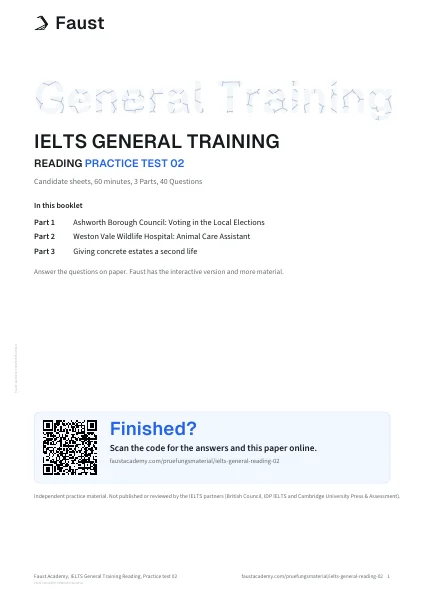
IELTS General Training Reading practice test 2 is a reading paper for the IELTS General Training exam. It takes 60 minutes. The PDF has 12 pages and 3 sections. You can download the PDF for free, with no account.
Updated 4 November 2026, Faust Academy team
In this paper
- Ashworth Borough Council: Voting in the Local Elections
- Greenplate meal boxes: online customer reviews
- Weston Vale Wildlife Hospital: Animal Care Assistant
- Brindle Logistics: Safe lifting guidance
- Giving concrete estates a second life
Exam material is in English.
Every PDF is free. How Faust marks
Independent Faust practice material. Not published or endorsed by the IELTS partners (British Council, IDP IELTS and Cambridge University Press and Assessment).
Inside the paper
Everyday information: local elections and meal box reviews
SECTION 1 Questions 1 to 14
Ashworth Borough Council: Voting in the Local Elections
Here are answers to some of the questions residents most often ask about voting in the Ashworth local elections. When can I vote in person? Polling stations are open from 7 am to 10 pm. If you are already in the queue at 10 pm, you will still be given a ballot paper, but nobody can join the queue after that time. The address of your polling station is printed on your poll card, which is posted to every registered voter about a month before the election. What do I need to take with me? You do not need to bring your poll card in order to vote, although it helps staff find your name more quickly. You will, however, need to show an accepted form of photo ID. A passport, a driving licence or a photocard bus pass are all suitable, and an out-of-date document can still be used if the photo is a good likeness. Can I bring my children? Children are welcome to come into the polling station with you, but they must not mark your ballot paper for you. Assistance dogs are also allowed. How does postal voting work? Postal voting packs are sent out about two weeks before polling day. Your completed vote must reach the council offices by 10 pm on polling day. You can return it by post or hand it in at any polling station in the borough. Can someone vote on my behalf? Yes. This is called voting by proxy, and the person you choose must also be registered to vote. The deadline for proxy applications is normally six working days before polling day. However, if you have a medical emergency after this date, you can still apply up to 5 pm on polling day itself. When will the results be known? Once the polls close, ballot boxes are sealed and taken to a secure store overnight. Counting begins at 9 am the following morning at Riverside Leisure Centre, and all results are expected by late afternoon. Results for each ward will be posted on the council website as soon as they are declared.
Greenplate meal boxes: online customer reviews
A Priya I first tried Greenplate with a half-price voucher that came through my door, and I've been a customer for almost a year now. The ingredients are always fresh, and the menu changes every week so I never get bored. I nearly cancelled after a busy month, but in the end I switched from a weekly box to one every fortnight, which suits me much better. My only wish is for more vegetarian choices. B Gareth The food itself is tasty, and my teenagers have even started helping in the kitchen. Be warned, though. The cards say thirty minutes, but most dishes took me closer to an hour once I had chopped everything. As someone with a big appetite, I also find the servings a little on the small side, so I usually add extra rice or bread. C Maureen For the first couple of weeks I found the cards confusing, as the steps refer to photos on the back, but I soon got used to them. The recipes are imaginative and I've learnt several new dishes. What bothers me is the waste. Every spoonful of spice comes in its own little plastic bag, and one box fills my recycling bin for the week. I'd happily pay a bit more for less wrapping. D Kwame A colleague kept telling me how good it was, so I finally signed up. Things didn't start well. My first box was booked for Thursday but turned up on Wednesday while I was at work, so it sat on the doorstep all afternoon. Luckily the cool bags inside were still cold and nothing had to be thrown away. Since then every delivery has been on time, and the box is sturdy enough to reuse for storage. E Sophie I assumed the portions would be tiny, as they often are with these services, but there was enough left over for my lunch the next day. My boxes always come on Monday as planned, though usually after 8 pm rather than during the morning slot I chose. The fish dishes are the highlight for me.
1. Voters who are queuing when the polling station closes will still be able to vote.
TRUE) TRUE
FALSE) FALSE
NOT GIVEN) NOT GIVEN
2. Voters must show their poll card at the polling station.
TRUE) TRUE
FALSE) FALSE
NOT GIVEN) NOT GIVEN
3. Children may go with an adult into the polling station.
TRUE) TRUE
FALSE) FALSE
NOT GIVEN) NOT GIVEN
4. The council reminds postal voters who have not yet returned their ballot papers.
TRUE) TRUE
FALSE) FALSE
NOT GIVEN) NOT GIVEN
5. All applications to vote by proxy must be received at least six working days before polling day.
TRUE) TRUE
FALSE) FALSE
NOT GIVEN) NOT GIVEN
6. The election results will be announced on the evening of polling day.
TRUE) TRUE
FALSE) FALSE
NOT GIVEN) NOT GIVEN
7. Members of the public are allowed to watch the count.
TRUE) TRUE
FALSE) FALSE
NOT GIVEN) NOT GIVEN
8. The customer was unhappy with the amount of packaging.
A) Review A: Priya
B) Review B: Gareth
C) Review C: Maureen
D) Review D: Kwame
E) Review E: Sophie
9. The customer chose to get deliveries less often instead of cancelling.
A) Review A: Priya
B) Review B: Gareth
C) Review C: Maureen
D) Review D: Kwame
E) Review E: Sophie
10. A box was delivered on a different day from the one the customer expected.
A) Review A: Priya
B) Review B: Gareth
C) Review C: Maureen
D) Review D: Kwame
E) Review E: Sophie
11. The meals took longer to prepare than the recipe cards suggested.
A) Review A: Priya
B) Review B: Gareth
C) Review C: Maureen
D) Review D: Kwame
E) Review E: Sophie
12. The customer had expected the portions to be smaller.
A) Review A: Priya
B) Review B: Gareth
C) Review C: Maureen
D) Review D: Kwame
E) Review E: Sophie
13. The customer started using the service after a friend recommended it.
A) Review A: Priya
B) Review B: Gareth
C) Review C: Maureen
D) Review D: Kwame
E) Review E: Sophie
14. The customer found the recipe instructions difficult to follow at first.
A) Review A: Priya
B) Review B: Gareth
C) Review C: Maureen
D) Review D: Kwame
E) Review E: Sophie
Section 2: Working with wildlife and safe lifting at work
SECTION 2 Questions 15 to 27
Weston Vale Wildlife Hospital: Animal Care Assistant
Weston Vale Wildlife Hospital Animal Care Assistant (part-time, 24 hours per week) Weston Vale Wildlife Hospital is a charity-run rescue centre on the edge of the city park. We treat injured, sick and orphaned wild animals found in the city, from hedgehogs and foxes to pigeons, gulls and the occasional swan, and we return them to the wild once they have recovered. We are looking for a reliable Animal Care Assistant to join our small team of vets, nurses and volunteers. Main duties Each morning you will clean the enclosures and prepare food for the patients. Diets vary greatly from species to species, so you will follow the feeding charts displayed in the kitchen. The carrying baskets used on rescue collections are the responsibility of our drivers, who clean them as soon as they return to the hospital. Assistants also spend part of each shift answering the public helpline. In spring, many calls come from people who have found fox cubs or fledglings in their gardens and believe they have been abandoned. You will advise them to watch the animal from a distance for several hours, since parents usually return; only if the young animal is injured, or still alone the next morning, should it be brought in. Leaving healthy young animals where they are gives them the best chance of survival. Accurate records are essential to our work. You will update the log for every patient with its weight and any medication given; treatment notes are written by the vets. About you No formal qualifications are needed, as full training is provided. Previous experience with pets is common among applicants, but the hospital values experience of handling livestock more highly. You should be calm, physically fit and comfortable working outdoors in all weathers. Hours The hospital is open every day of the year. The rota requires every assistant to work two weekends each month, while evening shifts are optional. These later shifts finish at 9 pm and are paid at a higher hourly rate. Training In your first fortnight you will shadow an experienced assistant and complete safe-handling training; a first aid course follows after three months. All training takes place during paid working hours. Your first day On your first morning, sign in at reception and then collect your uniform and gloves, supplied free of charge, from the storeroom next to the kitchen. Please bring your own waterproof boots, as these are not provided. How to apply Send a CV and a short covering letter to our staff coordinator, Helen Okafor, explaining why you would like to work with wildlife. Shortlisted applicants will be invited to spend a trial morning at the hospital before the interview.
Brindle Logistics: Safe lifting guidance
Brindle Logistics Safe lifting: guidance for new warehouse staff Welcome to the team. Much of the work in our warehouse involves moving cartons by hand, and poor lifting technique is one of the commonest causes of injury in jobs like yours. Most of these injuries can be avoided by following a few simple rules, which are explained below. Please read this guide carefully before your first shift and keep it for reference. Know the weight Never guess how heavy a carton is. The delivery note lists the total weight of the consignment, but the weight of each individual carton is printed on its label. If the label is missing or cannot be read, treat the carton as heavy and ask for it to be weighed before you move it. Know your limit You may lift cartons of up to 20 kg on your own, provided you feel comfortable doing so. Loads between 20 and 25 kg should be lifted by two people working together, and anything above 25 kg must be moved with a trolley. These are kept beside the loading doors and must be returned there after use. Plan the lift Before lifting, check that your route to the bay is clear. Pallets are always kept inside the yellow lines, so the main hazard is loose packaging straps, which are often left on the floor after deliveries are unpacked. If you see any, pick them up and put them in the recycling bins at the end of each aisle. Also make sure you know where you are going to put the load down, so that you do not have to stop halfway with your arms full. Lift safely Stand close to the carton with your feet apart, bend your knees and keep your back straight as you lift. Hold the load close to your body, with the heaviest side nearest to you. Never twist your back while holding a load; move your feet to change direction instead. When you put the carton down, bend your knees again rather than leaning forward. If something goes wrong Report any strain or pain to your shift supervisor before you go home, even if it seems minor; the first aider deals only with injuries needing immediate treatment. Small problems that are recorded early are much easier to deal with than those that are ignored for weeks. Training and assessment All new staff watch a short training video in their first week, and after one month a trainer carries out a practical assessment of their lifting technique on the warehouse floor. Staff who need more practice will be given extra support and assessed again a fortnight later.
15. • cleaning the {{15}} and preparing food every morning
16. • advising callers who find a young fox or bird to watch it from a distance for several {{16}}
17. • updating the {{17}} with every patient's weight and medication
18. • experience of handling {{18}} is especially valued
19. • must be available for two {{19}} each month
20. • safe-handling training completed during the first {{20}}
21. • free uniform and gloves collected from the {{21}} on the first morning
22. The weight of each carton is shown on its {{22}}.
23. Loads above 25 kg must always be moved with a {{23}}.
24. Before lifting, workers should check that their route is clear of packaging {{24}}.
25. Staff must not {{25}} their back while holding a load.
26. Any strain or pain should be reported to a {{26}} before the end of the shift.
27. After one month, new staff take a {{27}} assessment of their lifting technique.
Giving concrete estates a second life
Read the text below and answer Questions 28 to 40.
Giving concrete estates a second life
A Harrowfield, a small market town in the north of England, is best known for its Saturday market and its old stone bridge. Less visible to visitors is the Ferndale estate, a group of eleven concrete blocks on the eastern edge of town. When they went up in the early 1970s, the flats were advertised as the last word in modern living, with central heating, fitted kitchens and views across the valley. Half a century later, the picture is very different. Today almost one flat in five on the Ferndale estate stands empty, and most of those who remain are over sixty. Young people who grow up there tend to leave as soon as they finish school, usually for jobs in Leeds or Manchester, and few of them come back. The effects are felt well beyond the estate: with fewer customers, several shops in the town centre have closed their doors in recent years. The council is now determined to make Ferndale a place where people actually want to live again, but it knows that good intentions alone will not fill empty flats. B Rather than starting from nothing, Harrowfield has asked for help from Calder Bridge, a town twenty miles away that faced the same problem two decades ago. Its own concrete estate, Hillside, was then in an even worse state than Ferndale is now, and many people in Calder Bridge expected it to be flattened. Last spring a group of Harrowfield councillors spent two days there, walking round the estate and questioning the officers who had managed the project. What interested them most was how Calder Bridge council had reached its central decision. Instead of demolishing the whole of Hillside, it knocked down only four of the worst blocks and kept the rest. Part of the reasoning was technical. An engineers' survey showed that the concrete frames were still perfectly sound. Pulling everything down and rebuilding would also have meant finding homes elsewhere for hundreds of tenants for several years. The council did own a spare site on the edge of town, but it was later used for a new primary school. C The first and most visible step was to make the buildings themselves smaller and more comfortable. The top two storeys were removed from the tallest blocks, which took several hundred empty flats off the market at a stroke. This had a useful side effect. Without the top floors, mains water pressure could reach every tap, so the water tanks stayed but the electric pumps on the roofs were no longer needed. With fewer floors, it finally became affordable to install lifts, so that older tenants no longer had to move out when the stairs became too much for them. Ramps were added at the main entrances, and a few single ground-floor flats were adapted for wheelchair users. Elsewhere, pairs of one-bedroom flats were knocked together to create larger homes for families. Each household also gained some outdoor space of its own: upper flats gained balconies, while those on the ground floor were given small private gardens at the front. Finally, the outside walls were tackled. Brick cladding was considered, but it would have been too slow and too expensive to lay by hand. Instead, the blocks were wrapped in insulated panels made in a factory and fixed in place within days, and tenants' heating bills fell sharply. D Just as much effort went into the land between the blocks, which had been little more than car parks and grass that nobody used. Since many tenants no longer owned cars, some of the car parks were dug up and turned into play areas and vegetable plots, which are now looked after by a residents' group. Rows of garages that had stood empty for years were converted into workshops, rented at low cost to local craftspeople and small firms. Today they house a furniture restorer, a bicycle repairer and a small printing business, among others. None of these businesses existed before the building work: the workshops filled up only once the scaffolding had come down, and a small café opened on a former car park the following year. People who had lived on the estate for decades say that, for the first time, there are reasons to stop and talk outside rather than hurry indoors. E Not everyone welcomed the changes at first. Many Hillside tenants feared that smarter flats would mean higher rents, and that they would eventually be pushed out to make room for wealthier newcomers. Once the plans were published, residents organised a petition about rents, which was signed by several hundred households and handed in at the town hall. The council's response did much to calm the mood. The council promised that anyone living on the estate before the work began would pay no more than before for at least ten years. Tenants who had to move out for a while during the building work were also given the right to return to their own flat, rather than simply being offered whatever was available. Harrowfield intends to copy this guarantee for Ferndale. As one of its councillors put it after the visit, an estate can only come back to life if the people who stayed through the hard years are still there to enjoy it.
28. Section A
i) Making the blocks smaller and easier to live in
Protecting the people who already live there
The original promise of modern living
An estate that is losing its people
v) New uses for the spaces between buildings
Attracting young people back to the estate
Learning from a neighbour that went first
Bringing shops back to the town centre
29. Section B
i) Making the blocks smaller and easier to live in
Protecting the people who already live there
The original promise of modern living
An estate that is losing its people
v) New uses for the spaces between buildings
Attracting young people back to the estate
Learning from a neighbour that went first
Bringing shops back to the town centre
30. Section C
i) Making the blocks smaller and easier to live in
Protecting the people who already live there
The original promise of modern living
An estate that is losing its people
v) New uses for the spaces between buildings
Attracting young people back to the estate
Learning from a neighbour that went first
Bringing shops back to the town centre
31. Section D
i) Making the blocks smaller and easier to live in
Protecting the people who already live there
The original promise of modern living
An estate that is losing its people
v) New uses for the spaces between buildings
Attracting young people back to the estate
Learning from a neighbour that went first
Bringing shops back to the town centre
32. Section E
i) Making the blocks smaller and easier to live in
Protecting the people who already live there
The original promise of modern living
An estate that is losing its people
v) New uses for the spaces between buildings
Attracting young people back to the estate
Learning from a neighbour that went first
Bringing shops back to the town centre
33. Which TWO reasons does the writer give for Calder Bridge council's decision not to demolish the whole Hillside estate?
A) Most residents signed a petition against demolition
B) The concrete frames of the blocks were found to be in good condition
C) Local businesses depended on the estate's residents
D) There was no other land in the town on which to build
E) Rebuilding would have meant moving residents elsewhere for years
34. Which TWO reasons does the writer give for Calder Bridge council's decision not to demolish the whole Hillside estate?
A) Most residents signed a petition against demolition
B) The concrete frames of the blocks were found to be in good condition
C) Local businesses depended on the estate's residents
D) There was no other land in the town on which to build
E) Rebuilding would have meant moving residents elsewhere for years
35. Many of the tallest blocks were made lower, which reduced the number of empty flats and meant that the {{35}} on their roofs were no longer needed.
36. Once the buildings were lower, the council could afford to install {{36}}.
37. Some pairs of small flats were joined together to make homes suitable for {{37}}.
38. Tenants on the ground floor were given private {{38}} at the front of the blocks.
39. The outside walls were covered with insulated {{39}}, which lowered heating bills.
40. Rows of empty garages were turned into cheap {{40}} for local craftspeople and small firms.
More papers
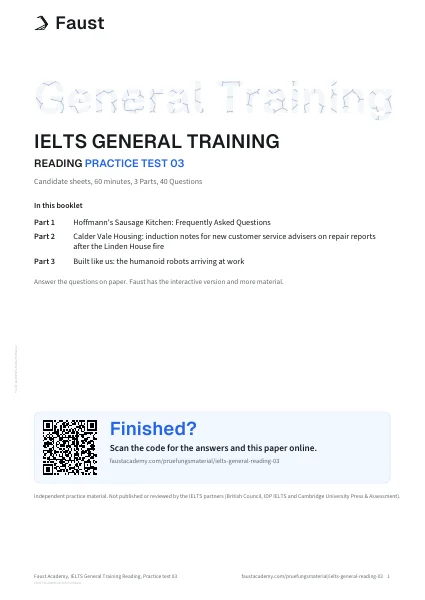
Paper 3
Hoffmann's Sausage Kitchen: Frequently Asked Questions
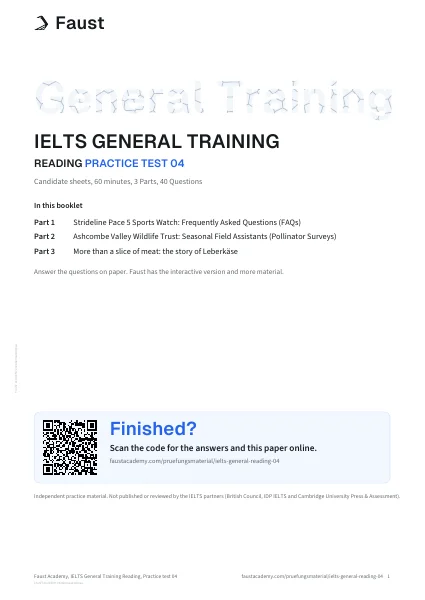
Paper 4
Strideline Pace 5 Sports Watch: Frequently Asked Questions (FAQs)
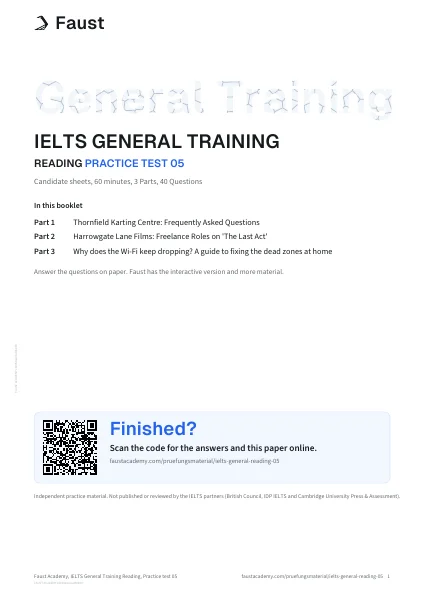
Paper 5
Thornfield Karting Centre: Frequently Asked Questions
Paper 6
Ben Corran Summit Weather Station: Frequently Asked Questions
Paper 1
Ashby Youth March for the Future: Frequently Asked Questions
Frequently asked questions
- How long is IELTS General Training Reading practice test 2?
- The paper takes 60 minutes. The PDF has 12 pages, and the answer key is a separate PDF.
- Is IELTS General Training Reading practice test 2 free?
- Yes. You can download the PDF for free, with no account.