
IELTS General Training Reading practice test 1
- Engineered to the real IELTS format
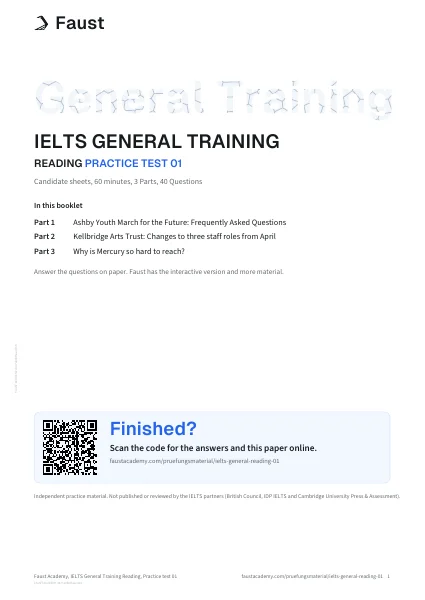
IELTS General Training Reading practice test 1 is a reading paper for the IELTS General Training exam. It takes 60 minutes. The PDF has 12 pages and 3 sections. You can download the PDF for free, with no account.
Updated 4 November 2026, Faust Academy team
In this paper
- Ashby Youth March for the Future: Frequently Asked Questions
- Kestrel Removals: Online customer reviews
- Kellbridge Arts Trust: Changes to three staff roles from April
- Brightwell Logistics: A guide to the mentoring scheme for new staff
- Why is Mercury so hard to reach?
Exam material is in English.
Every PDF is free. How Faust marks
Independent Faust practice material. Not published or endorsed by the IELTS partners (British Council, IDP IELTS and Cambridge University Press and Assessment).
Inside the paper
SECTION 1
SECTION 1 Questions 1 to 14
Ashby Youth March for the Future: Frequently Asked Questions
On Saturday 14 November, young people from across Ashby will march together to call for better schools, stronger action on climate change and homes that local families can afford. Here are answers to the questions we are asked most often. Where and when does the march take place? The march sets off from Riverside Park at 11 am and finishes in Town Hall Square at about 2.30 pm. Short speeches by students from local schools and colleges will follow at the finish. Who can take part? Everyone who shares our aims is welcome. Anyone under 16 must be accompanied by a parent or another responsible adult; students aged 16 and over are welcome to come on their own. How should I get there? Parking in the town centre will be very limited on the day. Buses on routes 4 and 12 will be diverted away from the High Street between 10 am and 4 pm, but they will still stop at the railway station, so we recommend coming by bus or train. The station is a ten-minute walk from the start. What should I bring? Placards and banners are welcome, but they must be carried on cardboard tubes rather than wooden or metal sticks. Please keep your messages friendly and respectful. There will be no water points along the route, so please bring a refillable bottle. Several cafés in Town Hall Square will be open when the march arrives. Who will be looking after us? Stewards in yellow jackets will be walking with the march to give directions and help anyone who has lost their group. First aid tents, run by volunteers from the Ashby Community Medical Team, will be at Riverside Park and Town Hall Square. If you feel unwell on the way, tell the nearest steward. I can't walk very far. Can I still take part? Yes. You don't have to walk the whole route: if you prefer, you can join the march where it passes Bridge Street at around 12.30 pm. Bridge Street is roughly halfway along the route, and there are benches nearby where you can wait.
Kestrel Removals: Online customer reviews
A Priya I got quotes from three different firms, and although this one wasn't the cheapest, it was the only one that included packing materials. Two days before the move, a delivery of flat-pack boxes, tape and paper arrived at my door, and the team that came on the day was quick and cheerful. I've already recommended them to my boss for when our office moves to a new building next spring. B Tom Our flat is on the third floor and I was really worried our sofa wouldn't make it round the bend in the narrow staircase. The two men took the feet off, wrapped it in blankets and had it down in ten minutes. Not everything went perfectly. One leg of our dining table got badly scratched on the way down, but the manager apologised and covered the cost of having it repaired. C Joanne We'd been told the team would be with us at 8 am, but it was after ten when the van finally pulled up outside. Nobody phoned to warn us, which was frustrating, as we had to collect the keys to our new house by four. Once they got started, though, they worked incredibly hard and we made it with half an hour to spare. Good movers, poor communication. D Marcus I'd originally booked the small van to save money, but a week before the move I realised it would never hold everything, so I had to upgrade to the large one. The office staff made the change without any fuss and only charged the difference. The job took longer than I'd expected, nearly seven hours for a two-bedroom house, but nothing was broken and the crew stayed polite and patient all day. E Helen I was all set to write a complaint when one box of kitchen things seemed to be missing, but it turned up in the garage the next morning, so I didn't bother. Apart from that small scare, the move was smooth. The men put every piece of furniture exactly where I wanted it and even helped me put the bed back together.
1. The march will finish at the same place where it starts.
TRUE) TRUE
FALSE) FALSE
NOT GIVEN) NOT GIVEN
2. Young people under 16 need an adult with them if they take part.
TRUE) TRUE
FALSE) FALSE
NOT GIVEN) NOT GIVEN
3. People going to the march can travel on local buses free of charge that day.
TRUE) TRUE
FALSE) FALSE
NOT GIVEN) NOT GIVEN
4. Signs held up on wooden sticks are not allowed on the march.
TRUE) TRUE
FALSE) FALSE
NOT GIVEN) NOT GIVEN
5. The organisers will give out drinking water at points along the route.
TRUE) TRUE
FALSE) FALSE
NOT GIVEN) NOT GIVEN
6. All the stewards on the march have been trained in first aid.
TRUE) TRUE
FALSE) FALSE
NOT GIVEN) NOT GIVEN
7. It is possible to join the march after it has already left the starting point.
TRUE) TRUE
FALSE) FALSE
NOT GIVEN) NOT GIVEN
8. The removal team arrived later than the time that had been agreed.
A) Priya
B) Tom
C) Joanne
D) Marcus
E) Helen
9. The customer looked at prices from other companies before booking.
A) Priya
B) Tom
C) Joanne
D) Marcus
E) Helen
10. The customer first booked a vehicle that was too small.
A) Priya
B) Tom
C) Joanne
D) Marcus
E) Helen
11. The customer decided not to make a complaint after all.
A) Priya
B) Tom
C) Joanne
D) Marcus
E) Helen
12. The company paid to repair something that was damaged during the move.
A) Priya
B) Tom
C) Joanne
D) Marcus
E) Helen
13. The customer has suggested the company for a future move at her place of work.
A) Priya
B) Tom
C) Joanne
D) Marcus
E) Helen
14. The customer was concerned that large furniture would not fit through a narrow space.
A) Priya
B) Tom
C) Joanne
D) Marcus
E) Helen
Section 2: Work-related texts
SECTION 2 Questions 15 to 27
Kellbridge Arts Trust: Changes to three staff roles from April
To all staff As most of you will know, Kellbridge District Council has reduced its annual grant to the Trust by almost a fifth. The Board has looked carefully at where savings can be made without closing either of our venues, and the result is a set of changes to three roles, which will take effect from 1 April. Staff currently in these posts have already met their managers individually, and anyone with further questions should contact Human Resources. Front of House Supervisor The Playhouse will no longer open to the public at the start of the week, as ticket sales on those days have been consistently low. As the Playhouse will be closed on Mondays and Tuesdays, contracted hours for this post will fall from 37 to 30 per week. Pay will be adjusted accordingly, although the hourly rate is unchanged. Supervisors will continue to lead the evening teams and will work alongside the volunteer ushers, who remain under the management of the Friends of Kellbridge Playhouse, so any questions about usher shifts should still go to the Friends' coordinator. We are also replacing our box office software. All Front of House Supervisors must complete training on the new ticketing system by the end of March. Sessions will run in the second half of that month so that everyone is confident before the first April performances. Learning and Outreach Officer Until now, this post has been paid for from the Playhouse budget and has focused on drama workshops. In future it will cover both venues. The Learning and Outreach Officer will deliver sessions at both the Playhouse and the Museum each week, and will continue to run the paid holiday workshops, whose fees help to cover the cost of materials. Because this post is now funded by a one-off council grant, it will be offered as an 18-month fixed-term contract. The Trust hopes to find longer-term support during that period but cannot promise this. The post holder may also attend an optional course on working with schools, which is offered by the regional arts network at several points throughout the year. Collections Assistant The Museum will open an hour later each morning, from 11 am instead of 10 am. However, the Collections Assistant's working hours will stay the same: the extra time before opening will be used for cataloguing the large number of objects that have never been fully recorded. The post holder will recruit and draw up the weekly rota for a small team of volunteers who will help with cataloguing. The work will involve moving between the stores in the basement and the galleries upstairs, but the post will remain based entirely in the Museum building. The Collections Assistant will also support the Trust's bids to national heritage funds by preparing descriptions and photographs of objects. Despite these additional duties, the post remains permanent. We recognise that these changes are not easy, particularly for colleagues whose hours are being reduced, and we thank everyone for their patience. Sarah Okafor, Director
Brightwell Logistics: A guide to the mentoring scheme for new staff
Starting a new job can be demanding, especially in a company as large as ours, with warehouse, transport planning, customer services and office teams all working to tight schedules. To help new employees settle in, Brightwell Logistics offers every new member of staff a mentor for their first year. This guide explains how the scheme works and what you can expect from it. Who will my mentor be? Your mentor will be an experienced colleague who has worked for Brightwell for at least three years. Unlike your line manager, who is responsible for your day-to-day work, your mentor is there to listen, share experience and help you find your way around the organisation. For this reason, mentors are always chosen from a different department from the new employee. Someone joining the accounts team, for example, might be paired with a transport planner, and in this way gain an understanding of parts of the business they would otherwise rarely see. Getting started Your mentor will contact you during your first two weeks to arrange an initial meeting. At the first meeting, the pair agree a simple written plan listing what the new employee hopes to achieve. This does not need to be detailed; three or four aims are usually enough, and they can be changed later as your role becomes clearer. How often will we meet? For the first six months, mentors and mentees normally meet for about an hour every fortnight; after that, they may choose to meet monthly. Meetings take place during working hours, and your line manager will be told that you need this time. If a meeting has to be cancelled, please rearrange it as soon as possible. What can we talk about? Most pairs discuss how the new employee is settling in, which training courses might be worth taking and how to build useful contacts across the company. Mentors are happy to talk about career development, but questions about pay should always be taken to your line manager. Confidentiality Conversations between mentor and mentee are confidential, except where there is a concern about someone's safety. In that case, the mentor will explain to you what they need to report and to whom. Preparing our mentors Before they are matched with anyone, all mentors attend half a day of training. This covers listening skills, setting realistic goals and knowing when to direct a colleague to other sources of help, such as Human Resources or the employee support line. At the end of the scheme When the scheme finishes, both mentor and mentee complete a short questionnaire about how useful they found it. Your answers help us to improve the scheme for future staff. Many mentees stay in touch with their mentors long after the formal year ends, and some go on to become mentors themselves.
15. Staff in this role will be expected to work at more than one site.
A) Front of House Supervisor
B) Learning and Outreach Officer
C) Collections Assistant
16. Staff in this role will help to prepare applications for grant funding.
A) Front of House Supervisor
B) Learning and Outreach Officer
C) Collections Assistant
17. Staff in this role will be paid for fewer hours than at present.
A) Front of House Supervisor
B) Learning and Outreach Officer
C) Collections Assistant
18. Staff in this role will be responsible for organising volunteers.
A) Front of House Supervisor
B) Learning and Outreach Officer
C) Collections Assistant
19. Staff in this role must complete training before the new arrangements start.
A) Front of House Supervisor
B) Learning and Outreach Officer
C) Collections Assistant
20. This role will be offered on a contract with a fixed end date.
A) Front of House Supervisor
B) Learning and Outreach Officer
C) Collections Assistant
21. • Each new employee is matched with an experienced colleague who works in a different {{21}}, so that they gain a wider view of the company.
22. • At the first meeting, the mentor and the new employee agree a simple written {{22}} that sets out their goals.
23. • For the first six months, meetings usually last about an hour and take place once every {{23}}.
24. • Mentors do not deal with questions about {{24}}; these should be taken to the line manager.
25. • Anything discussed in meetings is kept {{25}} unless someone's safety is at risk.
26. • Before being matched, every mentor attends half a day of {{26}}.
27. • When the scheme ends, both people fill in a short {{27}} about how useful it was.
Why is Mercury so hard to reach?
Read the text below and answer Questions 28 to 40.
Why is Mercury so hard to reach?
A Every month our science pages answer a question sent in by a reader, and this one comes from Martin Ellery, a keen amateur astronomer. On clear spring evenings, he tells us, he sets up his telescope in the garden and tries to catch Mercury, the smallest planet, as it hangs low over the western horizon. More often than not, it slips into the twilight before he has found it. But his question is not really about stargazing. He has read that Mercury, which travels much closer to the Sun than we do, can at times be nearer to Earth than Mars is. On a map of the Solar System, then, it looks like the easier destination. Yet the record of space travel tells a different story. So why does a spacecraft that could reach Mars in about seven months need around seven years to get to Mercury? It is an excellent question, and the answer has surprisingly little to do with distance. B To understand it, think about what happens to anything that leaves Earth and heads inwards. The Sun's gravity pulls on it constantly, and the closer the craft comes, the stronger that pull becomes. Travelling towards the Sun is rather like a ball rolling downhill: the further it goes, the faster it moves. By the time a craft has fallen all the way in from Earth's distance, it is moving at a tremendous speed. Aiming at such a small planet is, perhaps surprisingly, the easy part. Navigators can plot the route very precisely, and a craft can be guided to the right point with great accuracy. Mercury is the fastest-moving planet in the Solar System, completing a circuit of the Sun in just 88 days, but a craft that simply fell in from Earth would arrive faster still, and instead of settling into orbit alongside it, it would fly straight past and carry on. The difficulty, then, is not getting to Mercury at all. It is arriving slowly enough to stay. C The obvious answer would be to fire the engines in reverse, but braking this way would mean carrying a huge quantity of fuel. All that extra fuel would make the craft heavier at launch, which in turn would require a bigger and more expensive rocket. Every kilogram lifted off the ground costs money, and a mission that needed such a rocket might never be approved at all. Other destinations offer some help with this problem. Craft arriving at Mars can dip into its thin layer of air and let the friction take off some of their speed, saving fuel they would otherwise burn. Unlike Mars, Mercury has almost no atmosphere, so there is no air to act as a brake. Nor can the planet do the job by itself. Mercury is a small world, and its gravity is too weak to capture a fast-moving visitor on its own. Engines alone are too costly, and the planet offers no natural help, so planners have had to look elsewhere. D Instead, mission planners send the craft on a long series of flybys: one of Earth, two of Venus and six of Mercury itself. Each time the craft swings close to a planet, the planet's gravity takes away a little of its speed. Flybys are more often known as a way of speeding spacecraft up on their way to the outer planets, but approached from the right direction, the same effect works in reverse. Gradually, pass by pass, the craft's path around the Sun shrinks until it is close to Mercury's own, and the final arrival needs only a modest push from its own engines. The method saves an enormous amount of fuel, but it adds several years to the journey. It also demands patience before the mission even begins: the planets must be lined up correctly, so launch can only happen in certain short periods, and a missed opportunity can mean a long wait. Between flybys, engineers on the ground send small corrections so that the craft stays on its planned path. The craft's small thrusters carry them out, nudging it by tiny amounts. E For Priya Nair, a trajectory engineer, the long cruise is far from empty time. 'People imagine we just wait for seven years,' she says, 'but there is always something to do.' During the cruise, her team switches on and tests the instruments one by one, checking that they have survived launch and still work as designed. They also practise the procedures they will follow on arrival, rehearsing each step so that nothing is left to chance when the moment comes. The flybys themselves bring opportunities. When the craft passes Venus, its instruments can make early observations of that planet, giving scientists useful data years before the main mission starts. During one flyby, the cameras take test pictures, which allow the team to check focus and exposure. Throughout, sunshades protect the instruments from the intense heat near Mercury, where sunlight is many times stronger than on Earth. 'By the time we arrive,' Nair says, 'we want the craft and the team to be ready for anything.'
28. Section A
i) Using neighbouring worlds to lose speed
How an atmosphere can help a spacecraft arrive
A journey that takes far longer than expected
Making good use of the years in transit
v) The first close-up images of Mercury
Why simply firing the engines is not the answer
The fixed dates on which a mission must leave Earth
The real problem is arriving too fast
29. Section B
i) Using neighbouring worlds to lose speed
How an atmosphere can help a spacecraft arrive
A journey that takes far longer than expected
Making good use of the years in transit
v) The first close-up images of Mercury
Why simply firing the engines is not the answer
The fixed dates on which a mission must leave Earth
The real problem is arriving too fast
30. Section C
i) Using neighbouring worlds to lose speed
How an atmosphere can help a spacecraft arrive
A journey that takes far longer than expected
Making good use of the years in transit
v) The first close-up images of Mercury
Why simply firing the engines is not the answer
The fixed dates on which a mission must leave Earth
The real problem is arriving too fast
31. Section D
i) Using neighbouring worlds to lose speed
How an atmosphere can help a spacecraft arrive
A journey that takes far longer than expected
Making good use of the years in transit
v) The first close-up images of Mercury
Why simply firing the engines is not the answer
The fixed dates on which a mission must leave Earth
The real problem is arriving too fast
32. Section E
i) Using neighbouring worlds to lose speed
How an atmosphere can help a spacecraft arrive
A journey that takes far longer than expected
Making good use of the years in transit
v) The first close-up images of Mercury
Why simply firing the engines is not the answer
The fixed dates on which a mission must leave Earth
The real problem is arriving too fast
33. Which TWO features of Mercury itself does the writer say make it difficult for a spacecraft to stop there?
A) The planet moves very fast along its orbit around the Sun
B) The planet's gravity is too weak to capture a fast spacecraft
C) Heat from the planet's surface makes it risky for a craft to slow down close to it
D) There is almost no air around the planet to slow a craft down
E) The planet's small size gives a craft only a tiny target to aim at
34. Which TWO features of Mercury itself does the writer say make it difficult for a spacecraft to stop there?
A) The planet moves very fast along its orbit around the Sun
B) The planet's gravity is too weak to capture a fast spacecraft
C) Heat from the planet's surface makes it risky for a craft to slow down close to it
D) There is almost no air around the planet to slow a craft down
E) The planet's small size gives a craft only a tiny target to aim at
35. As a spacecraft gets closer to the Sun, its speed keeps rising, much as a ball's does when it is rolling {{35}}.
36. Reversing the engines to slow down would require the craft to take on board vast amounts of {{36}}, and the added weight would mean launching it on a larger and costlier {{37}}.
37. Reversing the engines to slow down would require the craft to take on board vast amounts of {{36}}, and the added weight would mean launching it on a larger and costlier {{37}}.
38. Planners instead route it past several planets in a sequence of {{38}}, so that it loses a little speed each time.
39. The fuel saving comes at the price of extra {{39}} of travel.
40. Teams back on Earth transmit minor {{40}} so that the craft does not drift off course.
More papers
Paper 2
Ashworth Borough Council: Voting in the Local Elections
Paper 3
Hoffmann's Sausage Kitchen: Frequently Asked Questions
Paper 4
Strideline Pace 5 Sports Watch: Frequently Asked Questions (FAQs)
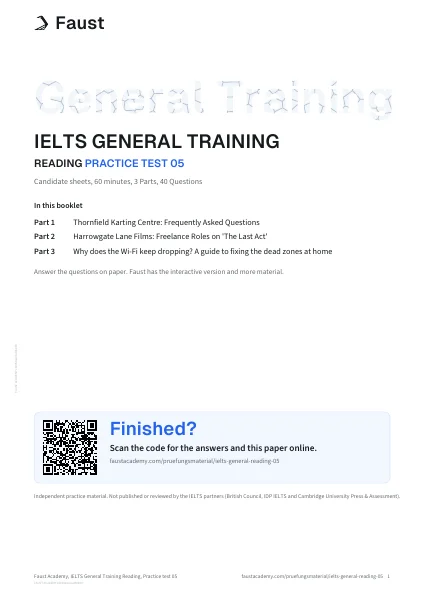
Paper 5
Thornfield Karting Centre: Frequently Asked Questions
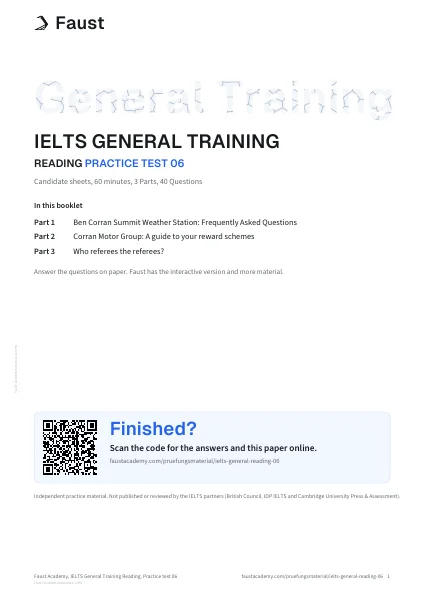
Paper 6
Ben Corran Summit Weather Station: Frequently Asked Questions
Frequently asked questions
- How long is IELTS General Training Reading practice test 1?
- The paper takes 60 minutes. The PDF has 12 pages, and the answer key is a separate PDF.
- Is IELTS General Training Reading practice test 1 free?
- Yes. You can download the PDF for free, with no account.