
IELTS General Training Listening practice test 6
- Engineered to the real IELTS format
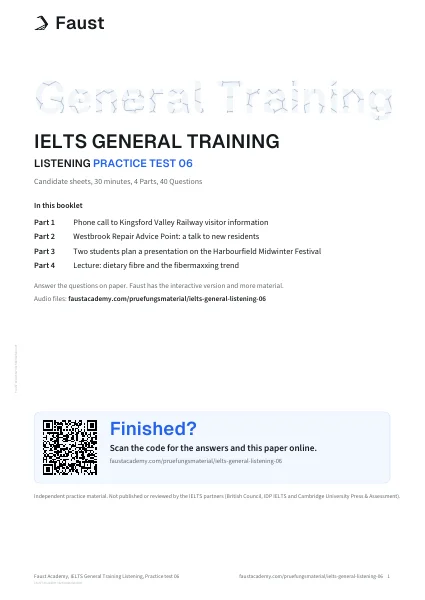
IELTS General Training Listening practice test 6 is a listening paper for the IELTS General Training exam. It takes 30 minutes. The PDF has 10 pages and 4 sections. The audio plays on this page. You can download the PDF for free, with no account.
Updated 4 November 2026, Faust Academy team
In this paper
- Phone call to Kingsford Valley Railway visitor information
- Westbrook Repair Advice Point: a talk to new residents
- Two students plan a presentation on the Harbourfield Midwinter Festival
- Lecture: dietary fibre and the fibermaxxing trend
Exam material is in English.
Every PDF is free. How Faust marks
Independent Faust practice material. Not published or endorsed by the IELTS partners (British Council, IDP IELTS and Cambridge University Press and Assessment).
Listening audio
Part 1
Part 2
Part 3
Part 4
Inside the paper
Part 1
Listen and answer questions 1 to 10.
1. • Heritage train leaves Kingsford station at {{1}} a.m.
2. • Adult return ticket: £{{2}}
3. • Get off at {{3}} Halt
4. • Famous for its stone {{4}}
5. • Guided tour meets at the main {{5}}
6. • Tour lasts about {{6}} minutes
7. • No photos allowed in the {{7}}
8. • Lunch: café in the old {{8}} by the market square
9. • Walk up the hill to the castle {{9}}
10. • Castle grounds close at {{10}} p.m.
A talk to new residents about the Westbrook Repair Advice Point
Listen and answer questions 11 to 20.
11. The Westbrook Repair Advice Point was first set up by
A) a group of local garage owners
B) the local council
C) drivers who had had problems with repairs
12. According to Helen, most disputes with garages are about
A) bills that are higher than the estimate
B) repairs that take longer than promised
C) work that the customer did not ask for
13. What does Helen say is the most important thing to do before leaving a vehicle at a garage?
A) take photographs of the vehicle
B) get a written estimate
C) agree a maximum amount to spend
14. If a conversation with a mechanic becomes angry, Helen advises people to
A) leave and contact the advice service
B) stay and ask to speak to a manager
C) refuse to pay until the problem is solved
15. Which TWO services does the advice point offer free of charge?
A) checking a repair bill
B) going with members to a garage
C) an inspection by an independent mechanic
D) a model letter for complaints
E) legal representation
16. Which TWO services does the advice point offer free of charge?
A) checking a repair bill
B) going with members to a garage
C) an inspection by an independent mechanic
D) a model letter for complaints
E) legal representation
17. Which TWO pieces of advice does Helen give about bicycle repairs?
A) keep the receipt for any new parts
B) ask to take the old parts home
C) book a service in the winter months
D) test the bike before paying
E) only use shops that belong to the scheme
18. Which TWO pieces of advice does Helen give about bicycle repairs?
A) keep the receipt for any new parts
B) ask to take the old parts home
C) book a service in the winter months
D) test the bike before paying
E) only use shops that belong to the scheme
19. Which TWO changes will start next month?
A) an evening workshop on basic vehicle checks
B) an online booking system
C) longer opening hours on Saturdays
D) a list of recommended garages
E) training sessions for new volunteers
20. Which TWO changes will start next month?
A) an evening workshop on basic vehicle checks
B) an online booking system
C) longer opening hours on Saturdays
D) a list of recommended garages
E) training sessions for new volunteers
Planning a seminar presentation on emotion at a town festival
Listen and answer questions 21 to 30.
21. Which TWO reasons do the students give for choosing their presentation topic?
A) It connects with something one of them saw at a festival
B) No other students on the course have chosen a similar subject
C) Their tutor recommended it as a straightforward topic
D) There is plenty of published research they can use
E) They can collect material from people they already know
22. Which TWO reasons do the students give for choosing their presentation topic?
A) It connects with something one of them saw at a festival
B) No other students on the course have chosen a similar subject
C) Their tutor recommended it as a straightforward topic
D) There is plenty of published research they can use
E) They can collect material from people they already know
23. Which TWO problems do the students expect when they interview festival participants?
A) People may find it hard to describe their feelings
B) Background noise may spoil the recordings
C) People may say what they think the students want to hear
D) Older participants may refuse to be interviewed
E) Writing up the interviews may take too long
24. Which TWO problems do the students expect when they interview festival participants?
A) People may find it hard to describe their feelings
B) Background noise may spoil the recordings
C) People may say what they think the students want to hear
D) Older participants may refuse to be interviewed
E) Writing up the interviews may take too long
25. the opening-night procession
A) It allows people to show sadness openly
B) It costs more than many families can afford
C) It is the tradition they know least about
D) It brings different generations together
E) It is mainly aimed at visitors to the town
F) It has lost much of its original meaning
G) It could easily be copied in other places
H) It has become safer than it used to be
26. singing the town song at midnight
A) It allows people to show sadness openly
B) It costs more than many families can afford
C) It is the tradition they know least about
D) It brings different generations together
E) It is mainly aimed at visitors to the town
F) It has lost much of its original meaning
G) It could easily be copied in other places
H) It has become safer than it used to be
27. wearing home-made costumes
A) It allows people to show sadness openly
B) It costs more than many families can afford
C) It is the tradition they know least about
D) It brings different generations together
E) It is mainly aimed at visitors to the town
F) It has lost much of its original meaning
G) It could easily be copied in other places
H) It has become safer than it used to be
28. the lantern walk
A) It allows people to show sadness openly
B) It costs more than many families can afford
C) It is the tradition they know least about
D) It brings different generations together
E) It is mainly aimed at visitors to the town
F) It has lost much of its original meaning
G) It could easily be copied in other places
H) It has become safer than it used to be
29. neighbourhood street parties
A) It allows people to show sadness openly
B) It costs more than many families can afford
C) It is the tradition they know least about
D) It brings different generations together
E) It is mainly aimed at visitors to the town
F) It has lost much of its original meaning
G) It could easily be copied in other places
H) It has become safer than it used to be
30. the closing fireworks
A) It allows people to show sadness openly
B) It costs more than many families can afford
C) It is the tradition they know least about
D) It brings different generations together
E) It is mainly aimed at visitors to the town
F) It has lost much of its original meaning
G) It could easily be copied in other places
H) It has become safer than it used to be
Fibermaxxing and dietary fibre
Listen and answer questions 31 to 40.
31. What does the lecturer find most concerning about fibermaxxing?
A) It leads people to rely on supplements rather than whole foods
B) Its advice spreads without reference to individual medical conditions
C) It encourages people to judge foods by a single nutrient
32. According to the lecturer, what is the main reason most adults do not eat enough fibre?
A) Processed foods have replaced whole grains in many diets
B) People underestimate how much fibre they need each day
C) High-fibre foods are seen as less convenient to prepare
33. Soluble; oats, lentils and {{33}}; forms a {{34}} in the gut, which slows digestion
34. Soluble; oats, lentils and {{33}}; forms a {{34}} in the gut, which slows digestion
35. Insoluble; wholemeal bread, nuts and the {{35}} of fruit and vegetables; helps waste move through the {{36}} more quickly
36. Insoluble; wholemeal bread, nuts and the {{35}} of fruit and vegetables; helps waste move through the {{36}} more quickly
37. Resistant starch; potatoes or rice that have been cooked and then {{37}}; feeds bacteria in the large intestine
38. • Increase intake step by step over a few {{38}}
39. • Drink plenty of {{39}} alongside high-fibre foods
40. • Large amounts may reduce how well the body absorbs some {{40}}
More papers
Paper 1
Phone call to a consumer helpline about a holiday rental
Paper 2
Phone call to a second-hand computer shop
Paper 3
Phone call to Hollins Park Library about a children's poetry club
Paper 4
Phone call to Hollins Roasters
Paper 5
Phone call about a robot building workshop
Frequently asked questions
- How long is IELTS General Training Listening practice test 6?
- The paper takes 30 minutes. The PDF has 10 pages, and the answer key is a separate PDF. The audio for the paper plays on this page.
- Is IELTS General Training Listening practice test 6 free?
- Yes. You can download the PDF for free, with no account.