
Cambridge C2 Proficiency Listening practice test 4
- Engineered to the real Cambridge format
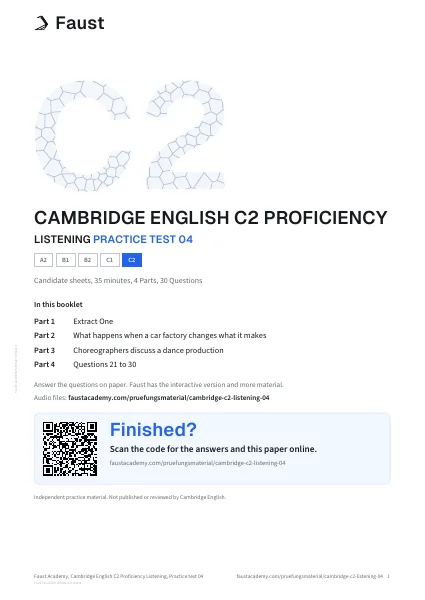
Cambridge C2 Proficiency Listening practice test 4 is a listening paper for the Cambridge C2 Proficiency exam. It takes 35 minutes. The PDF has 9 pages and 4 sections. The audio plays on this page. You can download the PDF for free, with no account. You can also practise it online.
Updated 17 November 2026, Faust Academy team
In this paper
- What happens when a car factory changes what it makes
- Choreographers discuss a dance production
- Speaker 1
- Speaker 2
- Speaker 3
Exam material is in English.
Every PDF is free. How Faust marks
Independent Faust practice material. Not published or endorsed by the Cambridge University Press and Assessment.
Listening audio
Part 1
Part 2
Part 3
Part 4
Inside the paper
Part 1
You will hear three different extracts. For questions 1-6, choose the answer (A, B or C) which fits best according to what you hear. There are two questions for each extract.
1. Extract One You hear a woman talking on the radio about a family tradition that came to an end. How does she feel about the way the tradition ended?
A) She wishes she had paid closer attention to the final occasion
B) She regrets that her family let the custom lapse through neglect
C) She is relieved that it ended without anyone having to decide
2. What does she suggest about trying to recognise a last time as it happens?
A) It helps people come to terms with a loss that is approaching
B) It tends to distort the experience it is meant to preserve
C) It is worthwhile only for occasions that are rare
3. Extract Two You hear two colleagues, a man and a woman, discussing a proposal to turn a disused railway station into a community repair workshop. What is the man's main concern about the proposal?
A) Volunteers may lose interest once the first year is over
B) The cost of renovating the building may exceed the grant
C) Neighbours may object to the noise the workshop produces
4. What do the two speakers agree on?
A) The workshop should open in stages rather than all at once
B) The council should be asked for a longer lease on the station
C) The grant application should include the salary of a coordinator
5. Extract Three You hear an interviewer talking to a museum curator about the decision to display facsimiles instead of original medieval manuscripts. How does the curator now regard the decision?
A) She remains uneasy that it compromised the museum's integrity
B) She is convinced that it resolved a contradiction in earlier practice
C) She resents that it was imposed on her department
6. The curator says critics of facsimiles are wrong to
A) assume that visitors cannot tell a copy from an original
B) overlook how expensive the copies are to produce
C) judge the worth of a display by how rare its objects are
Re-tooling a car factory
You will hear {speaker_line}. For questions 7 to 15, complete the sentences with a word or short phrase.
7. • Before cars were built there, the Calderbridge land was owned by a {{7}} company.
8. • During the war, production lines at the plant were switched over to making {{8}}.
9. • In the historian's view, the thing workers were most afraid to lose was their {{9}}.
10. • The largest single cost when a plant changes product is normally the {{10}}.
11. • Of all the departments in a car plant, the {{11}} copes best with a change of product.
12. • A conversion is only likely to succeed if the firm holds on to its {{12}}.
13. • In his own words, a heritage centre on a closed factory site amounts to a {{13}}.
14. • In the end, the Calderbridge conversion took {{14}}.
15. • The historian's chief recommendation is that a firm should consult {{15}} before any plans are announced.
Part 3
You will hear a discussion in which two choreographers, Marta Silva and Owen Pryce, talk about a community dance production with a cast of performers over the age of seventy, which won an unexpected popular award. For questions 16-20, choose the answer (A, B, C or D) which fits best according to what you hear.
16. Marta's decision to work with older performers came about because
A) she had grown tired of the demands of working with young professional dancers
B) she saw a group of retired amateurs moving in a way that struck her as unusually expressive
C) a funding body had made the involvement of older people a condition of its grant
D) she wanted to continue a project begun by a relative who had died
17. When Marta first proposed the project, what worried Owen most was that it
A) would put the physical safety of the cast at risk
B) could not be prepared properly in the time available
C) would fail to attract an audience beyond the performers' families
D) would be dismissed as a charming curiosity rather than serious art
18. How did Marta respond to the title of the award the production received?
A) She treated it as a joke that could be turned to the company's advantage
B) She resented being associated with sentimental work
C) She felt it undervalued the technical achievement of the cast
D) She was embarrassed to be praised for something she had not intended
19. What did Owen find hardest to adapt to during rehearsals?
A) the limited stamina of the performers
B) persuading the cast to accept direction
C) giving up his insistence on exact unison
D) fitting the work to the layout of the venue
20. What does Marta find most striking about the audience's response to the production?
A) how many people have come back to see it more than once
B) how many other companies have started similar projects
C) how long viewers stay afterwards to talk with the cast
D) how openly viewers weep during the final scene
Part 4
You will hear five short extracts in which {extracts_line}. For questions 21 to 25, choose from the list (A to H) {task_one}. For questions 26 to 30, choose from the list (A to H) {task_two}. You will hear the recording twice. While you listen, you must complete both tasks.
21. Speaker 1
A) a folding bicycle combined with trains
B) a car-sharing club
C) a long-distance coach service
D) an electric scooter
E) a ferry
F) lifts from colleagues
G) a tram line
H) walking almost everywhere
22. Speaker 2
A) a folding bicycle combined with trains
B) a car-sharing club
C) a long-distance coach service
D) an electric scooter
E) a ferry
F) lifts from colleagues
G) a tram line
H) walking almost everywhere
23. Speaker 3
A) a folding bicycle combined with trains
B) a car-sharing club
C) a long-distance coach service
D) an electric scooter
E) a ferry
F) lifts from colleagues
G) a tram line
H) walking almost everywhere
24. Speaker 4
A) a folding bicycle combined with trains
B) a car-sharing club
C) a long-distance coach service
D) an electric scooter
E) a ferry
F) lifts from colleagues
G) a tram line
H) walking almost everywhere
25. Speaker 5
A) a folding bicycle combined with trains
B) a car-sharing club
C) a long-distance coach service
D) an electric scooter
E) a ferry
F) lifts from colleagues
G) a tram line
H) walking almost everywhere
26. Speaker 1
A) saving enough money to pay for a holiday
B) getting to know neighbours
C) an improvement in health
D) feeling less stressed about parking
E) making use of journey time
F) having to plan ahead
G) feeling cut off from relatives
H) becoming critical of other people's driving
27. Speaker 2
A) saving enough money to pay for a holiday
B) getting to know neighbours
C) an improvement in health
D) feeling less stressed about parking
E) making use of journey time
F) having to plan ahead
G) feeling cut off from relatives
H) becoming critical of other people's driving
28. Speaker 3
A) saving enough money to pay for a holiday
B) getting to know neighbours
C) an improvement in health
D) feeling less stressed about parking
E) making use of journey time
F) having to plan ahead
G) feeling cut off from relatives
H) becoming critical of other people's driving
29. Speaker 4
A) saving enough money to pay for a holiday
B) getting to know neighbours
C) an improvement in health
D) feeling less stressed about parking
E) making use of journey time
F) having to plan ahead
G) feeling cut off from relatives
H) becoming critical of other people's driving
30. Speaker 5
A) saving enough money to pay for a holiday
B) getting to know neighbours
C) an improvement in health
D) feeling less stressed about parking
E) making use of journey time
F) having to plan ahead
G) feeling cut off from relatives
H) becoming critical of other people's driving
More papers
All 6 Cambridge C2 Proficiency Listening papers
Frequently asked questions
- How long is Cambridge C2 Proficiency Listening practice test 4?
- The paper takes 35 minutes. The PDF has 9 pages, and the answer key is a separate PDF. The audio for the paper plays on this page.
- Is Cambridge C2 Proficiency Listening practice test 4 free?
- Yes. You can download the PDF for free, with no account. Online, one scored paper per part is free.