
Cambridge C2 Proficiency Reading practice test 1
- Engineered to the real Cambridge format
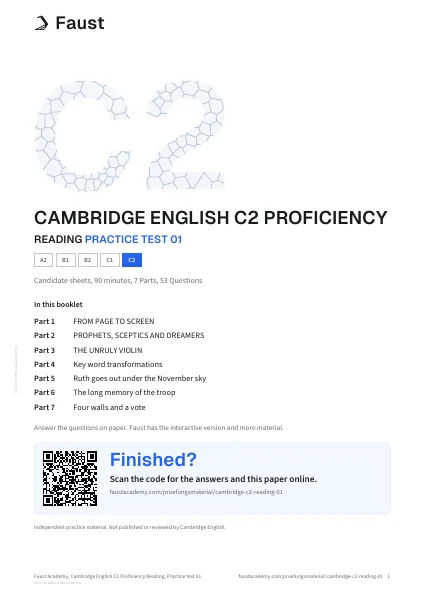
Cambridge C2 Proficiency Reading practice test 1 is a reading paper for the Cambridge C2 Proficiency exam. It takes 90 minutes. The PDF has 16 pages and 7 sections. You can download the PDF for free, with no account.
Updated 4 November 2026, Faust Academy team
In this paper
- FROM PAGE TO SCREEN
- PROPHETS, SCEPTICS AND DREAMERS
- Key word transformations
- Ruth goes out under the November sky
- The long memory of the troop
Exam material is in English.
Every PDF is free. How Faust marks
Independent Faust practice material. Not published or endorsed by the Cambridge University Press and Assessment.
Inside the paper
Part 1
For questions 1 to 8, read the text below and decide which answer (A, B, C or D) best fits each gap. Mark your answers on the separate answer sheet. There is an example at the beginning (0).
FROM PAGE TO SCREEN
Turning a much-admired novel into a film is a notoriously (0) thankless undertaking, and never more so than when the narrator is not human. When a novel unfolds entirely within the mind of its narrator, the film-maker inherits an unenviable task: showing openly on screen what the page could only (1) ........ at. Stories in which a mechanical companion is bought to ease a child's loneliness have clearly struck a (2) ........ with readers uneasy about how much of family life is now handed over to technology. Much of their power lies in the narrator's patient, puzzled observation of the people it serves. On screen, however, the quiet philosophical questions such stories raise are all too easily (3) ........ aside in favour of visual spectacle and a reassuring plot. A typical adaptation will pay lip (4) ........ to the narrator's uncertainty about its own nature in a line or two of voiceover before hurrying on to the next set piece. The central question, whether a machine capable of devotion can be said to have a self at all, is thus left not so (5) ........ unanswered as unasked. Reviewers have been quick to (6) ........ on this omission, arguing that it robs the story of the very disquiet that made the book worth adapting. The result may be warm, polished and thoroughly entertaining, but it is a far (7) ........ from the unsettling novel on which it is based. Whether such compromises amount to a betrayal or are simply the price of reaching a wider audience is, (8) ........ to say, a question on which viewers will differ.
Example
0. Turning a much-admired novel into a film is a notoriously (0) ........ undertaking, and never more so than when the narrator is not human.
A) thankless
B) graceless
C) careless
D) heedless
Answer: A
1. When a novel unfolds entirely within the mind of its narrator, the film-maker inherits an unenviable task: showing openly on screen what the page could only (1) ........ at.
A) suggest
B) hint
C) imply
D) indicate
2. Stories in which a mechanical companion is bought to ease a child's loneliness have clearly struck a (2) ........ with readers uneasy about how much of family life is now handed over to technology.
A) note
B) tone
C) chord
D) pitch
3. On screen, however, the quiet philosophical questions such stories raise are all too easily (3) ........ aside in favour of visual spectacle and a reassuring plot.
A) brushed
B) wiped
C) dusted
D) combed
4. A typical adaptation will pay lip (4) ........ to the narrator's uncertainty about its own nature in a line or two of voiceover before hurrying on to the next set piece.
A) tribute
B) homage
C) credit
D) service
5. The central question, whether a machine capable of devotion can be said to have a self at all, is thus left not so (5) ........ unanswered as unasked.
A) far
B) much
C) long
D) well
6. Reviewers have been quick to (6) ........ on this omission, arguing that it robs the story of the very disquiet that made the book worth adapting.
A) seize
B) grasp
C) clutch
D) grip
7. The result may be warm, polished and thoroughly entertaining, but it is a far (7) ........ from the unsettling novel on which it is based.
A) call
B) shout
C) howl
D) cry
8. Whether such compromises amount to a betrayal or are simply the price of reaching a wider audience is, (8) ........ to say, a question on which viewers will differ.
A) pointless
B) useless
C) needless
D) worthless
Part 2
For questions 9 to 16, read the text below and think of the word which best fits each space. Use only one word in each space. There is an example at the beginning (0). Write your answers IN CAPITAL LETTERS on the separate answer sheet.
PROPHETS, SCEPTICS AND DREAMERS
Rarely has a technology divided opinion so sharply as artificial intelligence. Broadly speaking, those who argue about its future fall into three camps. The first, the enthusiasts, can hardly wait for machines that outthink their makers, convinced that the result will be nothing short of a golden age for medicine and science. The second camp regards that same prospect with dread. Its members, whose ranks include some of the very engineers building these systems, warn that we must proceed with extreme caution, lest we create something we can neither understand nor control. The third camp dismisses both visions as so much hype. Were it not for the vast sums of money at stake, the sceptics claim, nobody would be talking about superintelligence at all. In their view, today's programs are sophisticated pattern-matchers and little more, and the promise of a thinking machine is a sales pitch rather than a forecast. For all their differences, the three camps have more in common than they might care to admit. Each is convinced that the stakes could hardly be higher, which is precisely why the quarrel has become so bitter. Whether the machines turn out to be saviours, threats or merely clever tools, the argument itself is unlikely to subside any time soon.
Example
9. Rarely has a technology divided opinion (0) ........ sharply as artificial intelligence. Broadly speaking, those who argue about its future fall {{9}} three camps. The first, the enthusiasts, can hardly wait for machines that outthink their makers, convinced that the result will be {{10}} short of a golden age for medicine and science.
10. Rarely has a technology divided opinion (0) ........ sharply as artificial intelligence. Broadly speaking, those who argue about its future fall {{9}} three camps. The first, the enthusiasts, can hardly wait for machines that outthink their makers, convinced that the result will be {{10}} short of a golden age for medicine and science.
11. The second camp regards that same prospect with dread. Its members, {{11}} ranks include some of the very engineers building these systems, warn that we must proceed with extreme caution, {{12}} we create something we can neither understand nor control.
12. The second camp regards that same prospect with dread. Its members, {{11}} ranks include some of the very engineers building these systems, warn that we must proceed with extreme caution, {{12}} we create something we can neither understand nor control.
13. The third camp dismisses both visions as so much hype. {{13}} it not for the vast sums of money at stake, the sceptics claim, nobody would be talking about superintelligence at {{14}}. In their view, today's programs are sophisticated pattern-matchers and little more, and the promise of a thinking machine is a sales pitch rather than a forecast.
14. The third camp dismisses both visions as so much hype. {{13}} it not for the vast sums of money at stake, the sceptics claim, nobody would be talking about superintelligence at {{14}}. In their view, today's programs are sophisticated pattern-matchers and little more, and the promise of a thinking machine is a sales pitch rather than a forecast.
15. {{15}} all their differences, the three camps have more in common than they might care to admit. Each is convinced that the stakes could hardly be higher, {{16}} is precisely why the quarrel has become so bitter. Whether the machines turn out to be saviours, threats or merely clever tools, the argument itself is unlikely to subside any time soon.
16. {{15}} all their differences, the three camps have more in common than they might care to admit. Each is convinced that the stakes could hardly be higher, {{16}} is precisely why the quarrel has become so bitter. Whether the machines turn out to be saviours, threats or merely clever tools, the argument itself is unlikely to subside any time soon.
Part 3
For questions 17 to 24, read the text below. Use the word given in capitals at the end of some of the lines to form a word that fits in the space in the same line. There is an example at the beginning (0). Write your answers IN CAPITAL LETTERS on the separate answer sheet.
THE UNRULY VIOLIN
Morwenna Hale is not your typical concert violinist, and her unconventional approach to performance has divided audiences across Europe. Trained at a prestigious conservatoire, she describes herself as a recovering perfectionist, someone who spent her twenties chasing flawless intonation at the expense of almost everything else. These days she prizes the risk and unpredictability of live performance far above polish. On stage she stamps relentlessly on the boards, turning her own feet into a percussion section, and breaks off mid-phrase to speak directly to the audience. At times she sings over her own playing, until her voice becomes almost indistinguishable from the instrument itself. Not everyone is enchanted. Some reviewers have voiced misgivings about what they see as mere theatricality, and classical purists complain that the music is too often buried beneath the spectacle. Yet even her harshest critics concede that her technique is undeniably formidable; she could play conventionally if she chose to. That, perhaps, is precisely the point. What irritates her detractors is less the volume than her stubborn refusal of easy categorisation: she is neither folk fiddler nor experimental composer, neither entertainer nor ascetic. Her concerts are loud, untidy and occasionally exasperating, but they remind listeners that a score is an invitation rather than a set of commandments. Audiences, it seems, are increasingly willing to accept that invitation.
Example
17. prestigious conservatoire, she describes herself as a recovering {{17}}, PERFECT
18. {{18}} of live performance far above polish. On stage she PREDICT
19. stamps {{19}} on the boards, turning her own feet into RELENT
20. her voice becomes almost {{20}} from the instrument itself. DISTINGUISH
21. Not everyone is enchanted. Some reviewers have voiced {{21}} about GIVE
22. what they see as mere theatricality, and classical {{22}} complain PURE
23. her harshest critics concede that her technique is {{23}} formidable; DENY
24. than her stubborn refusal of easy {{24}}: she is neither folk CATEGORY
Part 4
For questions 25 to 30, complete the second sentence so that it has a similar meaning to the first sentence, using the word given. Do not change the word given. You must use between three and eight words, including the word given. Here is an example (0). Write only the missing words on the separate answer sheet.
Key word transformations
No sooner had the new pension scheme been announced than providers began slashing their fees. It never crossed the playwright's mind to abandon the play, despite the poor reviews. Ruth's repeated attempts to persuade the allotment committee to extend the deadline were all to no avail. There is little chance of the trial results being published before next spring. The caterers seem to have got the wrong end of the stick about what we had asked for. Had it not been for the volunteers' help, the festival would not have gone ahead.
Example
Example (0)
The firm is said to be on the verge of being sold.
25. No {{25}} than providers began slashing their fees.
26. It never {{26}} the play, despite the poor reviews.
27. Ruth's repeated attempts to persuade the allotment committee to extend the deadline {{27}}.
28. There is {{28}} published before next spring.
29. The caterers seem {{29}} the stick about what we had asked for.
30. Had it {{30}}, the festival would not have gone ahead.
Ruth goes out under the November sky
You are going to read an extract from a novel. For questions 31 to 36, choose the answer (A, B, C or D) which you think fits best according to the text. Mark your answers on the separate answer sheet.
Ruth goes out under the November sky
The logs were in the bottom drawer of Tom's desk, eleven years of identical black notebooks, and for most of the autumn Ruth left them there. When at last she lifted one out, she was braced for nothing but columns: dates, times to the minute, magnitudes, a private shorthand of arrows and letters. She let her eyes slide over these as over a foreign timetable, turning pages more from duty than curiosity. It was in the margins that he ambushed her. 'Clear from 21.40. R. made lentil soup, took flask.' And further on: 'R. says it's too cold for anyone with sense. Right, as usual.' She sat a long while with that one. She had teased him, years ago, about his nights on the moor, the woollen hat and the thermos and the air of a man slipping off to a mistress; the joke had worn soft with use and then simply lapsed, as such jokes do. She had not imagined she was in the notebooks at all. She put them back in the drawer. Keeping them up was his discipline, not hers, and she had no intention of taking it on. The Fellside Astronomical Society held its November field night on a hillside above the reservoir. Graham Pell, the secretary, greeted her with a clipboard and said that Tom had been the most dependable observer they had ever had, which Ruth gathered was the highest praise at his disposal. His circular had mentioned an increased chance of bright meteors that month and a close pairing of Mars and Jupiter. Anyone who saw a fireball, he reminded them, should call out 'time' at once so that it could be logged for the society's reports; an unrecorded sighting, in his view, was a wasted one. Ruth made a note of this. When a young man in a student scarf said he had come for shooting stars, Graham said, 'Meteors,' without looking up. An hour later the same young man complained that nothing had happened. 'The sky doesn't owe anyone a performance,' said Graham. 'An increased chance is still only a chance.' Ruth stood a little apart, hands pushed into her sleeves. The night was perfectly clear, and the cold came up through the soles of her boots. Around her the talk thinned and stopped, not awkwardly, but as talk does among people with nothing to prove. Then, so gradually that she could not have said when it began, as her eyes forgot the torchlight, the sky began to fill. Stars she would have sworn were absent twenty minutes earlier pricked through, singly at first, then in drifts, until the Milky Way lay across the dark like breath on glass. This, she understood, was what Tom had meant when he said that the sky was earned, never simply given. It was Graham who pointed out the planets, low in the east above the fell: two bright points, one faintly ruddy, so close that a thumb at arm's length would have hidden both. 'They look like neighbours,' he said. 'They're nothing of the kind. Hundreds of millions of kilometres apart. It's simply a matter of where we happen to be standing.' He said it precisely, as he said everything, but not unkindly, and he waited until he saw she had followed. She had followed. She looked at the pair for a long time. People had always spoken of her and Tom as inseparable; at dinners they were seated together, in photographs they leaned in, and after the funeral friends had said they had never known a couple so close. She thought of the evenings he had spent up here while she sat at home, of the things neither of them had found a way to say, of the notebooks she had not known she was in. The fireball came half an hour later: not the quick scratch of an ordinary meteor but a slow, swelling bead of greenish light that seemed to hesitate, flare and leave a fading thread behind it. She knew at once what it was; Tom had described one to her so often that she felt she had seen it before. She knew, too, what she was meant to do. For several seconds she said nothing. It seemed to her that the thing belonged to no one else on that hillside, only to her and, absurdly, to Tom. Then a voice along the ridge shouted 'Time!' There was a scrabble of torches and pencils; she merely nodded in the dark. Afterwards, as the telescopes were folded into their cases, Graham came over with the log. 'You saw it first, didn't you?' he said quietly. She admitted that she had. He made no comment, but bent over the page by torchlight, and when she looked down she saw her own initials on the line, beside the code Tom had used for eleven years. Then he closed the book, said he hoped she would come again next month, and went to help the young man in the scarf with a tripod that would not fold.
31. When Ruth first reads Tom's observing logs, she
A) is reminded of how much his hobby had kept him away from her
B) finds them more personal than she had anticipated
C) gives up because the technical entries defeat her
D) feels she ought to keep them going in his place
32. What does Graham mean when he says that the sky 'doesn't owe anyone a performance'?
A) The society's field nights are meant for study, not entertainment
B) Cloud cover often ruins carefully arranged observing sessions
C) Observers shouldn't expect forecast events to happen when they want them
D) Newcomers to the society tend to give up too easily
33. What does 'This' refer to in the fourth paragraph?
A) the way the planets seemed to draw closer as the night went on
B) the comfortable silence that settled over the group
C) the slow appearance of fainter stars as her eyes adjusted
D) the cold that made it hard for her to stay still
34. Graham's explanation of how close Mars and Jupiter really are leads Ruth to
A) feel let down that the sight is less remarkable than she'd been led to believe
B) see a resemblance to something in her own life
C) suspect that he is simplifying things for her benefit
D) want to learn more about the science behind what she's seeing
35. Why does Ruth not call out when she sees the fireball?
A) She is not certain at first what she has seen
B) She is afraid of looking like an inexperienced member
C) She has forgotten what the society asks observers to do
D) She wants, for a moment, to keep the experience to herself
36. By the end of the extract, the impression given of Graham is that he
A) is fussy about detail but capable of real thoughtfulness
B) secretly resents newcomers interfering with the society's routine
C) cares about accurate records rather than about people
D) is trying to take over the place Tom held in the society
Part 6
You are going to read an extract from an article. Seven paragraphs have been removed from the extract. Choose from the paragraphs A to H the one which fits each gap (37 to 43). There is one extra paragraph which you do not need to use. Mark your answers on the separate answer sheet.
The long memory of the troop
Primates that survive an epidemic change their habits for years afterwards. Humans, it seems, are rather less teachable. Anna Whitcombe reports. On the edge of the Kessa reserve lies a pool that ought to be the busiest spot in the valley: deep, shaded and fed by a reliable spring. Yet the troop of some forty olive baboons that the primatologist Dr Helen Marlowe has followed for eleven years will walk an extra two kilometres in the dry season rather than drink from it. __(37)__ Once the illness had burned itself out, the water was sampled for two full seasons. By every test her team could devise, the pool was safe again. The troop, however, did not return, and eight years on it still has not. __(38)__ Custom, though, is a word Marlowe uses sparingly. She is wary of romanticising the behaviour: baboons, after all, know nothing of parasites. What they appear to have grasped is a cruder association between a place and a catastrophe. __(39)__ That balance, Marlowe suspects, is where the comparison with our own species becomes instructive, and also uncomfortable. Human societies, too, are periodically swept by contagion, and we can name the organism responsible and model its spread. In short, we have far better tools than baboons for understanding it. __(40)__ That distinction between episode and habit lies at the heart of a hypothesis that Marlowe's colleague, the behavioural ecologist Dr Samuel Okafor, has been testing against her field records. Okafor's hypothesis is disarmingly simple. __(41)__ Not everyone is persuaded. Some of his colleagues suspect that the comparison flatters the baboons. __(42)__ Marlowe concedes the point, though only up to a point. 'Yes, they are overcautious,' she says. 'But that misses what matters.' In her view, the real difference lies not in what the troop knows but in where that knowledge is kept. __(43)__ Whether that can be changed is another matter. Perhaps the question is not how to make people more fearful, but how to give a lesson somewhere to live. The answer, Marlowe suggests, may lie less in reminders than in the ordinary routines people follow without thinking. A And yet, for all that understanding, we appear to be remarkably quick to forget. Precautions adopted at considerable personal cost in the worst weeks of an outbreak tend to be quietly dropped once the immediate danger recedes, often long before anyone has declared it safe to do so. The handwashing lapses, the crowded carriage no longer feels like a gamble, and the whole episode passes into anecdote. It is not that people fail to learn anything; it is that what they learn is filed away as something that once happened to them, rather than absorbed into the way they go on living. B Their objection is that the troop's caution is a good deal less discriminating than it looks. Since the outbreak, the baboons have also given a wide berth to two smaller pools further down the valley, neither of which has ever harboured the parasite, and they have grown noticeably wary of any water fringed with the same tall reeds. An animal that shuns every source resembling the one that once harmed it is not reasoning about risk so much as flinching from a memory. Seen in that light, what passes for wisdom may be no more than a fear that has never been put to the test. C More remarkable still, the avoidance has outlived most of the animals who witnessed the deaths. Fewer than half of the present troop were alive during the outbreak, yet infants born years afterwards trail their mothers along the longer path without hesitation, and young males who transfer in from neighbouring troops adopt the detour within weeks of arriving. Nobody, so far as Marlowe can tell, is teaching anybody anything. The newcomers simply go where the others go. Somewhere along the line, a lesson that began as individual terror has hardened into something closer to custom. D Her second attempt fared no better. This time the team cut back the reeds that had crept around the margins, so that the approach to the water was as open as it had been before the outbreak, and left a scattering of the seed pods the baboons find hardest to resist along the bank. The troop's lookouts barked their alarm from the ridge, and not a single animal came down. Marlowe took it as confirmation that the animals were responding not to the water itself but to the place. E For a baboon, he argues, there is simply no rival account of the pool to weigh. The animals that drank there sickened, the survivors stopped drinking there, and nothing in the troop's world has since suggested otherwise. A human community, by contrast, has to set any precaution against livelihoods, convenience and a chorus of competing voices, some insisting the danger was overstated, others that it never ended. Under that pressure the lesson ceases to be a fact about the world and becomes an opinion about it, and opinions, unlike detours, can be revised over a single conversation. F The pool earned its reputation the hard way. Eight years ago, towards the end of an unusually long dry season, a waterborne parasite took hold among the animals that drank there most often. Within three months nearly a third of the adults were dead, the troop's oldest female among them, and Marlowe, then a doctoral student with a notebook and a borrowed vehicle, spent much of that season recording losses rather than behaviour. Outbreaks of this sort are hardly unknown among wild primates. What puzzled her was not the epidemic itself but what came after it. G It is kept, she argues, not in any single animal's head but in the daily round of the troop itself: in the route the dominant females take each morning, in the places the young are allowed to play, in which trees are slept in and which are passed by. No individual needs to recall why. Our own precautions, by contrast, tend to reside in announcements, notices and guidance that must be actively consulted and, sooner or later, are not. With nothing comparable to the shape of an ordinary day to settle into, the lesson has nowhere to live. H Such rough-and-ready caution does not come free. The longer route takes the troop across open ground where leopards hunt at dusk, and in the driest years the extra distance costs the weaker animals energy they can ill afford. A population that is too easily spooked loses its young to hunger and predators; one that is too bold loses them to disease. Over countless generations, natural selection has presumably had to strike some balance between the two.
37. Gap 37
A) And yet, for all that understanding, we appear to be remarkably quick to forget. Precautions adopted at considerable personal cost in the worst weeks of an outbreak tend to be quietly dropped once the immediate danger recedes, often long before anyone has declared it safe to do so. The handwashing lapses, the crowded carriage no longer feels like a gamble, and the whole episode passes into anecdote. It is not that people fail to learn anything; it is that what they learn is filed away as something that once happened to them, rather than absorbed into the way they go on living
B) Their objection is that the troop's caution is a good deal less discriminating than it looks. Since the outbreak, the baboons have also given a wide berth to two smaller pools further down the valley, neither of which has ever harboured the parasite, and they have grown noticeably wary of any water fringed with the same tall reeds. An animal that shuns every source resembling the one that once harmed it is not reasoning about risk so much as flinching from a memory. Seen in that light, what passes for wisdom may be no more than a fear that has never been put to the test
C) More remarkable still, the avoidance has outlived most of the animals who witnessed the deaths. Fewer than half of the present troop were alive during the outbreak, yet infants born years afterwards trail their mothers along the longer path without hesitation, and young males who transfer in from neighbouring troops adopt the detour within weeks of arriving. Nobody, so far as Marlowe can tell, is teaching anybody anything. The newcomers simply go where the others go. Somewhere along the line, a lesson that began as individual terror has hardened into something closer to custom
D) Her second attempt fared no better. This time the team cut back the reeds that had crept around the margins, so that the approach to the water was as open as it had been before the outbreak, and left a scattering of the seed pods the baboons find hardest to resist along the bank. The troop's lookouts barked their alarm from the ridge, and not a single animal came down. Marlowe took it as confirmation that the animals were responding not to the water itself but to the place
E) For a baboon, he argues, there is simply no rival account of the pool to weigh. The animals that drank there sickened, the survivors stopped drinking there, and nothing in the troop's world has since suggested otherwise. A human community, by contrast, has to set any precaution against livelihoods, convenience and a chorus of competing voices, some insisting the danger was overstated, others that it never ended. Under that pressure the lesson ceases to be a fact about the world and becomes an opinion about it, and opinions, unlike detours, can be revised over a single conversation
F) The pool earned its reputation the hard way. Eight years ago, towards the end of an unusually long dry season, a waterborne parasite took hold among the animals that drank there most often. Within three months nearly a third of the adults were dead, the troop's oldest female among them, and Marlowe, then a doctoral student with a notebook and a borrowed vehicle, spent much of that season recording losses rather than behaviour. Outbreaks of this sort are hardly unknown among wild primates. What puzzled her was not the epidemic itself but what came after it
G) It is kept, she argues, not in any single animal's head but in the daily round of the troop itself: in the route the dominant females take each morning, in the places the young are allowed to play, in which trees are slept in and which are passed by. No individual needs to recall why. Our own precautions, by contrast, tend to reside in announcements, notices and guidance that must be actively consulted and, sooner or later, are not. With nothing comparable to the shape of an ordinary day to settle into, the lesson has nowhere to live
H) Such rough-and-ready caution does not come free. The longer route takes the troop across open ground where leopards hunt at dusk, and in the driest years the extra distance costs the weaker animals energy they can ill afford. A population that is too easily spooked loses its young to hunger and predators; one that is too bold loses them to disease. Over countless generations, natural selection has presumably had to strike some balance between the two
38. Gap 38
A) And yet, for all that understanding, we appear to be remarkably quick to forget. Precautions adopted at considerable personal cost in the worst weeks of an outbreak tend to be quietly dropped once the immediate danger recedes, often long before anyone has declared it safe to do so. The handwashing lapses, the crowded carriage no longer feels like a gamble, and the whole episode passes into anecdote. It is not that people fail to learn anything; it is that what they learn is filed away as something that once happened to them, rather than absorbed into the way they go on living
B) Their objection is that the troop's caution is a good deal less discriminating than it looks. Since the outbreak, the baboons have also given a wide berth to two smaller pools further down the valley, neither of which has ever harboured the parasite, and they have grown noticeably wary of any water fringed with the same tall reeds. An animal that shuns every source resembling the one that once harmed it is not reasoning about risk so much as flinching from a memory. Seen in that light, what passes for wisdom may be no more than a fear that has never been put to the test
C) More remarkable still, the avoidance has outlived most of the animals who witnessed the deaths. Fewer than half of the present troop were alive during the outbreak, yet infants born years afterwards trail their mothers along the longer path without hesitation, and young males who transfer in from neighbouring troops adopt the detour within weeks of arriving. Nobody, so far as Marlowe can tell, is teaching anybody anything. The newcomers simply go where the others go. Somewhere along the line, a lesson that began as individual terror has hardened into something closer to custom
D) Her second attempt fared no better. This time the team cut back the reeds that had crept around the margins, so that the approach to the water was as open as it had been before the outbreak, and left a scattering of the seed pods the baboons find hardest to resist along the bank. The troop's lookouts barked their alarm from the ridge, and not a single animal came down. Marlowe took it as confirmation that the animals were responding not to the water itself but to the place
E) For a baboon, he argues, there is simply no rival account of the pool to weigh. The animals that drank there sickened, the survivors stopped drinking there, and nothing in the troop's world has since suggested otherwise. A human community, by contrast, has to set any precaution against livelihoods, convenience and a chorus of competing voices, some insisting the danger was overstated, others that it never ended. Under that pressure the lesson ceases to be a fact about the world and becomes an opinion about it, and opinions, unlike detours, can be revised over a single conversation
F) The pool earned its reputation the hard way. Eight years ago, towards the end of an unusually long dry season, a waterborne parasite took hold among the animals that drank there most often. Within three months nearly a third of the adults were dead, the troop's oldest female among them, and Marlowe, then a doctoral student with a notebook and a borrowed vehicle, spent much of that season recording losses rather than behaviour. Outbreaks of this sort are hardly unknown among wild primates. What puzzled her was not the epidemic itself but what came after it
G) It is kept, she argues, not in any single animal's head but in the daily round of the troop itself: in the route the dominant females take each morning, in the places the young are allowed to play, in which trees are slept in and which are passed by. No individual needs to recall why. Our own precautions, by contrast, tend to reside in announcements, notices and guidance that must be actively consulted and, sooner or later, are not. With nothing comparable to the shape of an ordinary day to settle into, the lesson has nowhere to live
H) Such rough-and-ready caution does not come free. The longer route takes the troop across open ground where leopards hunt at dusk, and in the driest years the extra distance costs the weaker animals energy they can ill afford. A population that is too easily spooked loses its young to hunger and predators; one that is too bold loses them to disease. Over countless generations, natural selection has presumably had to strike some balance between the two
39. Gap 39
A) And yet, for all that understanding, we appear to be remarkably quick to forget. Precautions adopted at considerable personal cost in the worst weeks of an outbreak tend to be quietly dropped once the immediate danger recedes, often long before anyone has declared it safe to do so. The handwashing lapses, the crowded carriage no longer feels like a gamble, and the whole episode passes into anecdote. It is not that people fail to learn anything; it is that what they learn is filed away as something that once happened to them, rather than absorbed into the way they go on living
B) Their objection is that the troop's caution is a good deal less discriminating than it looks. Since the outbreak, the baboons have also given a wide berth to two smaller pools further down the valley, neither of which has ever harboured the parasite, and they have grown noticeably wary of any water fringed with the same tall reeds. An animal that shuns every source resembling the one that once harmed it is not reasoning about risk so much as flinching from a memory. Seen in that light, what passes for wisdom may be no more than a fear that has never been put to the test
C) More remarkable still, the avoidance has outlived most of the animals who witnessed the deaths. Fewer than half of the present troop were alive during the outbreak, yet infants born years afterwards trail their mothers along the longer path without hesitation, and young males who transfer in from neighbouring troops adopt the detour within weeks of arriving. Nobody, so far as Marlowe can tell, is teaching anybody anything. The newcomers simply go where the others go. Somewhere along the line, a lesson that began as individual terror has hardened into something closer to custom
D) Her second attempt fared no better. This time the team cut back the reeds that had crept around the margins, so that the approach to the water was as open as it had been before the outbreak, and left a scattering of the seed pods the baboons find hardest to resist along the bank. The troop's lookouts barked their alarm from the ridge, and not a single animal came down. Marlowe took it as confirmation that the animals were responding not to the water itself but to the place
E) For a baboon, he argues, there is simply no rival account of the pool to weigh. The animals that drank there sickened, the survivors stopped drinking there, and nothing in the troop's world has since suggested otherwise. A human community, by contrast, has to set any precaution against livelihoods, convenience and a chorus of competing voices, some insisting the danger was overstated, others that it never ended. Under that pressure the lesson ceases to be a fact about the world and becomes an opinion about it, and opinions, unlike detours, can be revised over a single conversation
F) The pool earned its reputation the hard way. Eight years ago, towards the end of an unusually long dry season, a waterborne parasite took hold among the animals that drank there most often. Within three months nearly a third of the adults were dead, the troop's oldest female among them, and Marlowe, then a doctoral student with a notebook and a borrowed vehicle, spent much of that season recording losses rather than behaviour. Outbreaks of this sort are hardly unknown among wild primates. What puzzled her was not the epidemic itself but what came after it
G) It is kept, she argues, not in any single animal's head but in the daily round of the troop itself: in the route the dominant females take each morning, in the places the young are allowed to play, in which trees are slept in and which are passed by. No individual needs to recall why. Our own precautions, by contrast, tend to reside in announcements, notices and guidance that must be actively consulted and, sooner or later, are not. With nothing comparable to the shape of an ordinary day to settle into, the lesson has nowhere to live
H) Such rough-and-ready caution does not come free. The longer route takes the troop across open ground where leopards hunt at dusk, and in the driest years the extra distance costs the weaker animals energy they can ill afford. A population that is too easily spooked loses its young to hunger and predators; one that is too bold loses them to disease. Over countless generations, natural selection has presumably had to strike some balance between the two
40. Gap 40
A) And yet, for all that understanding, we appear to be remarkably quick to forget. Precautions adopted at considerable personal cost in the worst weeks of an outbreak tend to be quietly dropped once the immediate danger recedes, often long before anyone has declared it safe to do so. The handwashing lapses, the crowded carriage no longer feels like a gamble, and the whole episode passes into anecdote. It is not that people fail to learn anything; it is that what they learn is filed away as something that once happened to them, rather than absorbed into the way they go on living
B) Their objection is that the troop's caution is a good deal less discriminating than it looks. Since the outbreak, the baboons have also given a wide berth to two smaller pools further down the valley, neither of which has ever harboured the parasite, and they have grown noticeably wary of any water fringed with the same tall reeds. An animal that shuns every source resembling the one that once harmed it is not reasoning about risk so much as flinching from a memory. Seen in that light, what passes for wisdom may be no more than a fear that has never been put to the test
C) More remarkable still, the avoidance has outlived most of the animals who witnessed the deaths. Fewer than half of the present troop were alive during the outbreak, yet infants born years afterwards trail their mothers along the longer path without hesitation, and young males who transfer in from neighbouring troops adopt the detour within weeks of arriving. Nobody, so far as Marlowe can tell, is teaching anybody anything. The newcomers simply go where the others go. Somewhere along the line, a lesson that began as individual terror has hardened into something closer to custom
D) Her second attempt fared no better. This time the team cut back the reeds that had crept around the margins, so that the approach to the water was as open as it had been before the outbreak, and left a scattering of the seed pods the baboons find hardest to resist along the bank. The troop's lookouts barked their alarm from the ridge, and not a single animal came down. Marlowe took it as confirmation that the animals were responding not to the water itself but to the place
E) For a baboon, he argues, there is simply no rival account of the pool to weigh. The animals that drank there sickened, the survivors stopped drinking there, and nothing in the troop's world has since suggested otherwise. A human community, by contrast, has to set any precaution against livelihoods, convenience and a chorus of competing voices, some insisting the danger was overstated, others that it never ended. Under that pressure the lesson ceases to be a fact about the world and becomes an opinion about it, and opinions, unlike detours, can be revised over a single conversation
F) The pool earned its reputation the hard way. Eight years ago, towards the end of an unusually long dry season, a waterborne parasite took hold among the animals that drank there most often. Within three months nearly a third of the adults were dead, the troop's oldest female among them, and Marlowe, then a doctoral student with a notebook and a borrowed vehicle, spent much of that season recording losses rather than behaviour. Outbreaks of this sort are hardly unknown among wild primates. What puzzled her was not the epidemic itself but what came after it
G) It is kept, she argues, not in any single animal's head but in the daily round of the troop itself: in the route the dominant females take each morning, in the places the young are allowed to play, in which trees are slept in and which are passed by. No individual needs to recall why. Our own precautions, by contrast, tend to reside in announcements, notices and guidance that must be actively consulted and, sooner or later, are not. With nothing comparable to the shape of an ordinary day to settle into, the lesson has nowhere to live
H) Such rough-and-ready caution does not come free. The longer route takes the troop across open ground where leopards hunt at dusk, and in the driest years the extra distance costs the weaker animals energy they can ill afford. A population that is too easily spooked loses its young to hunger and predators; one that is too bold loses them to disease. Over countless generations, natural selection has presumably had to strike some balance between the two
41. Gap 41
A) And yet, for all that understanding, we appear to be remarkably quick to forget. Precautions adopted at considerable personal cost in the worst weeks of an outbreak tend to be quietly dropped once the immediate danger recedes, often long before anyone has declared it safe to do so. The handwashing lapses, the crowded carriage no longer feels like a gamble, and the whole episode passes into anecdote. It is not that people fail to learn anything; it is that what they learn is filed away as something that once happened to them, rather than absorbed into the way they go on living
B) Their objection is that the troop's caution is a good deal less discriminating than it looks. Since the outbreak, the baboons have also given a wide berth to two smaller pools further down the valley, neither of which has ever harboured the parasite, and they have grown noticeably wary of any water fringed with the same tall reeds. An animal that shuns every source resembling the one that once harmed it is not reasoning about risk so much as flinching from a memory. Seen in that light, what passes for wisdom may be no more than a fear that has never been put to the test
C) More remarkable still, the avoidance has outlived most of the animals who witnessed the deaths. Fewer than half of the present troop were alive during the outbreak, yet infants born years afterwards trail their mothers along the longer path without hesitation, and young males who transfer in from neighbouring troops adopt the detour within weeks of arriving. Nobody, so far as Marlowe can tell, is teaching anybody anything. The newcomers simply go where the others go. Somewhere along the line, a lesson that began as individual terror has hardened into something closer to custom
D) Her second attempt fared no better. This time the team cut back the reeds that had crept around the margins, so that the approach to the water was as open as it had been before the outbreak, and left a scattering of the seed pods the baboons find hardest to resist along the bank. The troop's lookouts barked their alarm from the ridge, and not a single animal came down. Marlowe took it as confirmation that the animals were responding not to the water itself but to the place
E) For a baboon, he argues, there is simply no rival account of the pool to weigh. The animals that drank there sickened, the survivors stopped drinking there, and nothing in the troop's world has since suggested otherwise. A human community, by contrast, has to set any precaution against livelihoods, convenience and a chorus of competing voices, some insisting the danger was overstated, others that it never ended. Under that pressure the lesson ceases to be a fact about the world and becomes an opinion about it, and opinions, unlike detours, can be revised over a single conversation
F) The pool earned its reputation the hard way. Eight years ago, towards the end of an unusually long dry season, a waterborne parasite took hold among the animals that drank there most often. Within three months nearly a third of the adults were dead, the troop's oldest female among them, and Marlowe, then a doctoral student with a notebook and a borrowed vehicle, spent much of that season recording losses rather than behaviour. Outbreaks of this sort are hardly unknown among wild primates. What puzzled her was not the epidemic itself but what came after it
G) It is kept, she argues, not in any single animal's head but in the daily round of the troop itself: in the route the dominant females take each morning, in the places the young are allowed to play, in which trees are slept in and which are passed by. No individual needs to recall why. Our own precautions, by contrast, tend to reside in announcements, notices and guidance that must be actively consulted and, sooner or later, are not. With nothing comparable to the shape of an ordinary day to settle into, the lesson has nowhere to live
H) Such rough-and-ready caution does not come free. The longer route takes the troop across open ground where leopards hunt at dusk, and in the driest years the extra distance costs the weaker animals energy they can ill afford. A population that is too easily spooked loses its young to hunger and predators; one that is too bold loses them to disease. Over countless generations, natural selection has presumably had to strike some balance between the two
42. Gap 42
A) And yet, for all that understanding, we appear to be remarkably quick to forget. Precautions adopted at considerable personal cost in the worst weeks of an outbreak tend to be quietly dropped once the immediate danger recedes, often long before anyone has declared it safe to do so. The handwashing lapses, the crowded carriage no longer feels like a gamble, and the whole episode passes into anecdote. It is not that people fail to learn anything; it is that what they learn is filed away as something that once happened to them, rather than absorbed into the way they go on living
B) Their objection is that the troop's caution is a good deal less discriminating than it looks. Since the outbreak, the baboons have also given a wide berth to two smaller pools further down the valley, neither of which has ever harboured the parasite, and they have grown noticeably wary of any water fringed with the same tall reeds. An animal that shuns every source resembling the one that once harmed it is not reasoning about risk so much as flinching from a memory. Seen in that light, what passes for wisdom may be no more than a fear that has never been put to the test
C) More remarkable still, the avoidance has outlived most of the animals who witnessed the deaths. Fewer than half of the present troop were alive during the outbreak, yet infants born years afterwards trail their mothers along the longer path without hesitation, and young males who transfer in from neighbouring troops adopt the detour within weeks of arriving. Nobody, so far as Marlowe can tell, is teaching anybody anything. The newcomers simply go where the others go. Somewhere along the line, a lesson that began as individual terror has hardened into something closer to custom
D) Her second attempt fared no better. This time the team cut back the reeds that had crept around the margins, so that the approach to the water was as open as it had been before the outbreak, and left a scattering of the seed pods the baboons find hardest to resist along the bank. The troop's lookouts barked their alarm from the ridge, and not a single animal came down. Marlowe took it as confirmation that the animals were responding not to the water itself but to the place
E) For a baboon, he argues, there is simply no rival account of the pool to weigh. The animals that drank there sickened, the survivors stopped drinking there, and nothing in the troop's world has since suggested otherwise. A human community, by contrast, has to set any precaution against livelihoods, convenience and a chorus of competing voices, some insisting the danger was overstated, others that it never ended. Under that pressure the lesson ceases to be a fact about the world and becomes an opinion about it, and opinions, unlike detours, can be revised over a single conversation
F) The pool earned its reputation the hard way. Eight years ago, towards the end of an unusually long dry season, a waterborne parasite took hold among the animals that drank there most often. Within three months nearly a third of the adults were dead, the troop's oldest female among them, and Marlowe, then a doctoral student with a notebook and a borrowed vehicle, spent much of that season recording losses rather than behaviour. Outbreaks of this sort are hardly unknown among wild primates. What puzzled her was not the epidemic itself but what came after it
G) It is kept, she argues, not in any single animal's head but in the daily round of the troop itself: in the route the dominant females take each morning, in the places the young are allowed to play, in which trees are slept in and which are passed by. No individual needs to recall why. Our own precautions, by contrast, tend to reside in announcements, notices and guidance that must be actively consulted and, sooner or later, are not. With nothing comparable to the shape of an ordinary day to settle into, the lesson has nowhere to live
H) Such rough-and-ready caution does not come free. The longer route takes the troop across open ground where leopards hunt at dusk, and in the driest years the extra distance costs the weaker animals energy they can ill afford. A population that is too easily spooked loses its young to hunger and predators; one that is too bold loses them to disease. Over countless generations, natural selection has presumably had to strike some balance between the two
43. Gap 43
A) And yet, for all that understanding, we appear to be remarkably quick to forget. Precautions adopted at considerable personal cost in the worst weeks of an outbreak tend to be quietly dropped once the immediate danger recedes, often long before anyone has declared it safe to do so. The handwashing lapses, the crowded carriage no longer feels like a gamble, and the whole episode passes into anecdote. It is not that people fail to learn anything; it is that what they learn is filed away as something that once happened to them, rather than absorbed into the way they go on living
B) Their objection is that the troop's caution is a good deal less discriminating than it looks. Since the outbreak, the baboons have also given a wide berth to two smaller pools further down the valley, neither of which has ever harboured the parasite, and they have grown noticeably wary of any water fringed with the same tall reeds. An animal that shuns every source resembling the one that once harmed it is not reasoning about risk so much as flinching from a memory. Seen in that light, what passes for wisdom may be no more than a fear that has never been put to the test
C) More remarkable still, the avoidance has outlived most of the animals who witnessed the deaths. Fewer than half of the present troop were alive during the outbreak, yet infants born years afterwards trail their mothers along the longer path without hesitation, and young males who transfer in from neighbouring troops adopt the detour within weeks of arriving. Nobody, so far as Marlowe can tell, is teaching anybody anything. The newcomers simply go where the others go. Somewhere along the line, a lesson that began as individual terror has hardened into something closer to custom
D) Her second attempt fared no better. This time the team cut back the reeds that had crept around the margins, so that the approach to the water was as open as it had been before the outbreak, and left a scattering of the seed pods the baboons find hardest to resist along the bank. The troop's lookouts barked their alarm from the ridge, and not a single animal came down. Marlowe took it as confirmation that the animals were responding not to the water itself but to the place
E) For a baboon, he argues, there is simply no rival account of the pool to weigh. The animals that drank there sickened, the survivors stopped drinking there, and nothing in the troop's world has since suggested otherwise. A human community, by contrast, has to set any precaution against livelihoods, convenience and a chorus of competing voices, some insisting the danger was overstated, others that it never ended. Under that pressure the lesson ceases to be a fact about the world and becomes an opinion about it, and opinions, unlike detours, can be revised over a single conversation
F) The pool earned its reputation the hard way. Eight years ago, towards the end of an unusually long dry season, a waterborne parasite took hold among the animals that drank there most often. Within three months nearly a third of the adults were dead, the troop's oldest female among them, and Marlowe, then a doctoral student with a notebook and a borrowed vehicle, spent much of that season recording losses rather than behaviour. Outbreaks of this sort are hardly unknown among wild primates. What puzzled her was not the epidemic itself but what came after it
G) It is kept, she argues, not in any single animal's head but in the daily round of the troop itself: in the route the dominant females take each morning, in the places the young are allowed to play, in which trees are slept in and which are passed by. No individual needs to recall why. Our own precautions, by contrast, tend to reside in announcements, notices and guidance that must be actively consulted and, sooner or later, are not. With nothing comparable to the shape of an ordinary day to settle into, the lesson has nowhere to live
H) Such rough-and-ready caution does not come free. The longer route takes the troop across open ground where leopards hunt at dusk, and in the driest years the extra distance costs the weaker animals energy they can ill afford. A population that is too easily spooked loses its young to hunger and predators; one that is too bold loses them to disease. Over countless generations, natural selection has presumably had to strike some balance between the two
Part 7
You are going to read an extract from a book on renting and housing policy. For questions 44 to 53, choose from the sections (A to E). The sections may be chosen more than once. Mark your answers on the separate answer sheet. In which section are the following mentioned?
Four walls and a vote
A Then and now For most of the last century, in the cities of Europe's southern rim, a rented flat was nothing to apologise for. Families stayed for decades in the same apartment and sometimes handed the tenancy on almost as an heirloom. Renting was not a waiting room. What changed was not simply the price of bricks and mortar. Over two or three decades, housing came to be valued less for what it sheltered than for what it might fetch, and governments encouraged the shift, since rising values flattered household balance sheets. Even our vocabulary went along with it: a metaphor as innocent as the property ladder has quietly taught us to regard a home as a rung rather than a resting place. The difficulty is structural rather than moral: we have asked the same four walls to be at once a refuge and a rising asset, and the two roles cannot be reconciled. Whatever keeps a tenant safe tends to depress a return; whatever lifts a return unsettles a tenant. B A Tuesday in October It is against that background that one should read what happened in parliament on a Tuesday in October. The package put to the chamber was hardly revolutionary: longer minimum leases, a ceiling on increases at renewal, nothing that would have alarmed a cautious finance ministry. Outside, a few dozen protesters held placards in the drizzle. Inside, the whole matter was disposed of in under an hour, wedged late in the afternoon between a fisheries bill and a debate on rail timetables. This in a country where, by common consent, housing is what keeps people awake at night. Neither the government's opponents nor its allies fought hard, and the package fell. Radical proposals are defeated every week, and their defeat proves little beyond the arithmetic of the chamber. But that so timid a measure should fail at all tells us more than the defeat of any radical bill could have done. C Mariana Mariana, a physiotherapist in her early thirties, rents a two-room flat on a twelve-month lease, her third in five years. Each move was the owner's choice: a niece needed the flat, a sale was planned, the rent rose beyond reach. The result is a kind of provisional living. Her books stay in boxes, and she no longer introduces herself to neighbours. As she puts it, why learn the name of the woman at the bakery, or join the residents' committee, when the lease may not be renewed in spring? The provisional has crept into larger decisions too: she and her partner have stopped talking about a child until they know where they will be living a year from now. The law, she says, is a fine thing printed for other people; nothing in it would stop her being asked to leave. D Javier Javier is the kind of landlord rarely pictured in debates on housing. A retired schoolteacher, he owns one flat, inherited from an aunt, and the rent it brings tops up a pension that would otherwise barely cover his bills. He followed the October vote with relief. Tighter rules, he argues, would simply persuade people like him to sell or leave the flat empty, and the tenants the rules were meant to help would find even fewer doors open. Lobbyists for far larger landlords are fond of borrowing faces like his to make that case. It would be disingenuous to pretend the warning is pure invention; some owners have indeed withdrawn, a few of Javier's acquaintances among them. Yet his deeper complaint is not about supply at all. It is that an owner whose tenant stops paying may wait many months, sometimes far longer, for a court to act, and in the meantime has nowhere to turn. E Postscript None of this is settled. For the prime minister, the vote is now a test he did not choose: a coalition that cannot pass even mild reform will soon be asked what reform it can pass. Tenants' unions have answered the defeat by taking to the streets of the larger cities. Marches fill squares and front pages, but whether they can by themselves move a single vote is far from certain; enthusiasm that is not turned into candidates and patient lobbying tends to evaporate with the autumn. Yet time is not on the government's side. Those now in their twenties and thirties will not stay young, nor will they forget. If nothing changes, sooner or later a generation that cannot find a home will present its bill at the ballot box.
44. the suggestion that the restrained nature of a proposal made its rejection all the more revealing
A) A Then and now
B) B A Tuesday in October
C) C Mariana
D) D Javier
E) E Postscript
45. a concession that an argument the writer is wary of has some basis in fact
A) A Then and now
B) B A Tuesday in October
C) C Mariana
D) D Javier
E) E Postscript
46. the way insecure tenure discourages people from committing themselves to the neighbourhoods they live in
A) A Then and now
B) B A Tuesday in October
C) C Mariana
D) D Javier
E) E Postscript
47. the idea that a single building is now expected to serve two incompatible purposes
A) A Then and now
B) B A Tuesday in October
C) C Mariana
D) D Javier
E) E Postscript
48. a prediction that inaction will eventually exact a price from those in power
A) A Then and now
B) B A Tuesday in October
C) C Mariana
D) D Javier
E) E Postscript
49. the observation that an issue of wide public concern was given remarkably little parliamentary time
A) A Then and now
B) B A Tuesday in October
C) C Mariana
D) D Javier
E) E Postscript
50. the postponement of decisions about starting a family until a tenancy feels more secure
A) A Then and now
B) B A Tuesday in October
C) C Mariana
D) D Javier
E) E Postscript
51. the notion that the language used to describe housing has shaped attitudes towards it
A) A Then and now
B) B A Tuesday in October
C) C Mariana
D) D Javier
E) E Postscript
52. doubt as to whether demonstrations alone can bring about a change in policy
A) A Then and now
B) B A Tuesday in October
C) C Mariana
D) D Javier
E) E Postscript
53. a grievance that owners have little legal recourse when rent goes unpaid
A) A Then and now
B) B A Tuesday in October
C) C Mariana
D) D Javier
E) E Postscript
More papers
All 2 Cambridge C2 Proficiency Reading papers
Frequently asked questions
- How long is Cambridge C2 Proficiency Reading practice test 1?
- The paper takes 90 minutes. The PDF has 16 pages, and the answer key is a separate PDF.
- Is Cambridge C2 Proficiency Reading practice test 1 free?
- Yes. You can download the PDF for free, with no account.