
Cambridge C2 Proficiency Listening practice test 1
- Engineered to the real Cambridge format
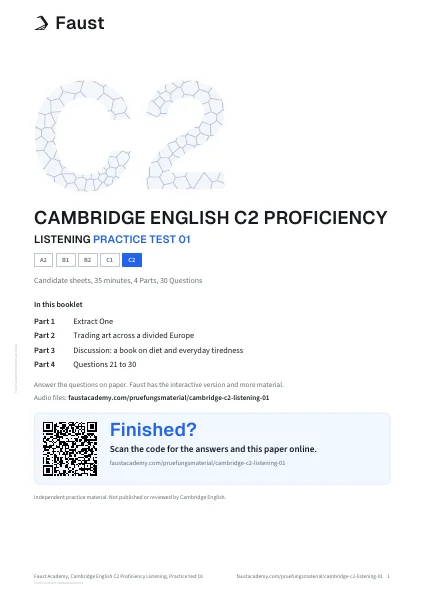
Cambridge C2 Proficiency Listening practice test 1 is a listening paper for the Cambridge C2 Proficiency exam. It takes 35 minutes. The PDF has 8 pages and 4 sections. The audio plays on this page. You can download the PDF for free, with no account.
Updated 4 November 2026, Faust Academy team
In this paper
- Trading art across a divided Europe
- Discussion: a book on diet and everyday tiredness
- Speaker 1
- Speaker 2
- Speaker 3
Exam material is in English.
Every PDF is free. How Faust marks
Independent Faust practice material. Not published or endorsed by the Cambridge University Press and Assessment.
Listening audio
Part 1
Part 2
Part 3
Part 4
Inside the paper
Part 1
You will hear three different extracts. For questions 1 to 6, choose the answer (A, B or C) which fits best according to what you hear. There are two questions for each extract.
1. Extract One You hear a woman talking on a radio programme about caring for her father while she was a university student. What does she say about the help her university offered her?
A) It presupposed that caring was something she could set aside
B) It came too late to make any real difference
C) It was generous but poorly communicated to students
2. What does the speaker suggest about her decision not to tell her friends about her caring role?
A) She regrets the strain it placed on those friendships
B) She was anxious to avoid being pitied
C) She wanted one part of her life to remain separate from it
3. Extract Two You hear two architects, Nadia and Owen, discussing a competition-winning design for a new public library in a town in the north of England. What is Owen's view of the decision to keep the old Edwardian facade?
A) It was imposed on the architects but handled ingeniously
B) It conceals what is genuinely new about the building
C) It reflects the town's reluctance to accept change
4. Nadia and Owen agree that the design
A) is likely to prove expensive to maintain
B) has been shaped too much by the tastes of the competition judges
C) treats the library as a place of silent study more than it now is
5. Extract Three You hear a man talking on the radio about the diaries he has kept for over forty years. How does he say he feels when he rereads his earliest diaries?
A) embarrassed
B) detached
C) wistful
6. He believes people who say private diaries should be destroyed are mistaken because
A) their value lies in what the writer failed to notice at the time
B) later readers tend to judge more generously than writers fear
C) genuine honesty in diaries is rarer than is generally assumed
Trading art across a divided Europe
You will hear {speaker_line}. For questions 7 to 15, complete the sentences with a word or short phrase.
7. Helen first found the dealer's records in a {{7}} belonging to his nephew.
8. In his ledgers, the dealer referred to each painter by means of {{8}}.
9. Larger canvases frequently crossed the border declared as {{9}}.
10. Helen believes the dealer is best described as {{10}} rather than idealistic.
11. Many artists asked to be paid in {{11}} instead of cash.
12. In the exhibition, the paintings are hung at {{12}} to recreate how buyers first saw them.
13. Helen was most surprised to discover that the buyers included two {{13}}.
14. Helen finds it absurd that the exhibition has been placed beside the {{14}}.
15. Helen hopes collectors will leave asking more questions about a work's {{15}}.
Part 3
You will hear a discussion in which a dietitian, Miriam Osei, and a food journalist, Callum Rafferty, talk about a book they wrote together on diet and everyday tiredness. For questions 16 to 20, choose the answer (A, B, C or D) which fits best according to what you hear.
16. Miriam's interest in the link between diet and tiredness began with
A) her own exhaustion during her early years of clinical training
B) patients whose fatigue could not be explained by medical tests
C) a remark made by a senior colleague about patients' eating habits
D) letters from readers of a column she used to write
17. How did Callum feel when Miriam first suggested writing the book?
A) doubtful that readers would trust advice from a journalist
B) anxious about having to understand the scientific research
C) wary that the book might become a list of rigid food rules
D) reluctant to go back to a subject he had already covered
18. What do Miriam and Callum both say about magazine articles that blame tiredness on particular foods?
A) They are mainly written to promote certain products
B) They make too little of the effects of poor sleep and stress
C) They give accurate information but explain it badly
D) They oversimplify a problem that depends on how and when people eat
19. What does Callum regret about the book?
A) The wording on its cover suggests a quick cure that the book does not offer
B) A chapter about breakfast habits had to be left out
C) There are too few accounts from readers' own experience
D) It was written more quickly than he would have liked
20. What is Miriam's main feeling about the letters readers have sent since the book came out?
A) delighted that the book has transformed readers' cooking habits
B) amused at how literally some readers have followed the recipes
C) frustrated that so few describe any long-term improvement
D) uneasy that some readers use the book instead of seeing a doctor
Part 4
You will hear five short extracts in which {extracts_line}. For questions 21 to 25, choose from the list (A to H) {task_one}. For questions 26 to 30, choose from the list (A to H) {task_two}. You will hear the recording twice. While you listen, you must complete both tasks.
21. Speaker 1
A) chaired a panel discussion
B) gave a public reading
C) ran a writing workshop
D) curated an exhibition of manuscripts
E) adapted a novel for the stage
F) worked as a volunteer steward
G) reviewed events for a newspaper
H) presented a series of podcasts
22. Speaker 2
A) chaired a panel discussion
B) gave a public reading
C) ran a writing workshop
D) curated an exhibition of manuscripts
E) adapted a novel for the stage
F) worked as a volunteer steward
G) reviewed events for a newspaper
H) presented a series of podcasts
23. Speaker 3
A) chaired a panel discussion
B) gave a public reading
C) ran a writing workshop
D) curated an exhibition of manuscripts
E) adapted a novel for the stage
F) worked as a volunteer steward
G) reviewed events for a newspaper
H) presented a series of podcasts
24. Speaker 4
A) chaired a panel discussion
B) gave a public reading
C) ran a writing workshop
D) curated an exhibition of manuscripts
E) adapted a novel for the stage
F) worked as a volunteer steward
G) reviewed events for a newspaper
H) presented a series of podcasts
25. Speaker 5
A) chaired a panel discussion
B) gave a public reading
C) ran a writing workshop
D) curated an exhibition of manuscripts
E) adapted a novel for the stage
F) worked as a volunteer steward
G) reviewed events for a newspaper
H) presented a series of podcasts
26. Speaker 1
A) that a character judged mad may simply be out of step with their community
B) that an author's illness is too readily treated as the key to their work
C) that humour can sit alongside depictions of mental distress
D) that some readers recognise their own experience in such books
E) that a disordered narrative style can be deliberate craft
F) that presenting suffering as romantic can do real harm
G) that younger audiences approach the subject with less prejudice
H) that surviving documents contradict the popular image of a writer
27. Speaker 2
A) that a character judged mad may simply be out of step with their community
B) that an author's illness is too readily treated as the key to their work
C) that humour can sit alongside depictions of mental distress
D) that some readers recognise their own experience in such books
E) that a disordered narrative style can be deliberate craft
F) that presenting suffering as romantic can do real harm
G) that younger audiences approach the subject with less prejudice
H) that surviving documents contradict the popular image of a writer
28. Speaker 3
A) that a character judged mad may simply be out of step with their community
B) that an author's illness is too readily treated as the key to their work
C) that humour can sit alongside depictions of mental distress
D) that some readers recognise their own experience in such books
E) that a disordered narrative style can be deliberate craft
F) that presenting suffering as romantic can do real harm
G) that younger audiences approach the subject with less prejudice
H) that surviving documents contradict the popular image of a writer
29. Speaker 4
A) that a character judged mad may simply be out of step with their community
B) that an author's illness is too readily treated as the key to their work
C) that humour can sit alongside depictions of mental distress
D) that some readers recognise their own experience in such books
E) that a disordered narrative style can be deliberate craft
F) that presenting suffering as romantic can do real harm
G) that younger audiences approach the subject with less prejudice
H) that surviving documents contradict the popular image of a writer
30. Speaker 5
A) that a character judged mad may simply be out of step with their community
B) that an author's illness is too readily treated as the key to their work
C) that humour can sit alongside depictions of mental distress
D) that some readers recognise their own experience in such books
E) that a disordered narrative style can be deliberate craft
F) that presenting suffering as romantic can do real harm
G) that younger audiences approach the subject with less prejudice
H) that surviving documents contradict the popular image of a writer
More papers
All 2 Cambridge C2 Proficiency Listening papers
Frequently asked questions
- How long is Cambridge C2 Proficiency Listening practice test 1?
- The paper takes 35 minutes. The PDF has 8 pages, and the answer key is a separate PDF. The audio for the paper plays on this page.
- Is Cambridge C2 Proficiency Listening practice test 1 free?
- Yes. You can download the PDF for free, with no account.