
Cambridge C2 Proficiency Listening practice test 3
- Engineered to the real Cambridge format
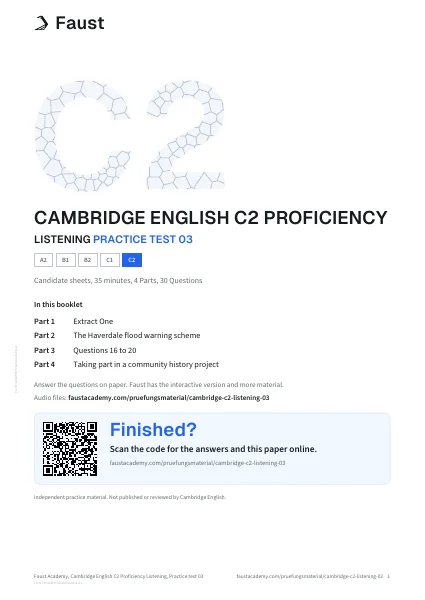
Cambridge C2 Proficiency Listening practice test 3 is a listening paper for the Cambridge C2 Proficiency exam. It takes 35 minutes. The PDF has 9 pages and 4 sections. The audio plays on this page. You can download the PDF for free, with no account. You can also practise it online.
Updated 17 November 2026, Faust Academy team
In this paper
- The Haverdale flood warning scheme
- A discussion about a reading app
- Speaker 1
- Speaker 2
- Speaker 3
Exam material is in English.
Every PDF is free. How Faust marks
Independent Faust practice material. Not published or endorsed by the Cambridge University Press and Assessment.
Listening audio
Part 1
Part 2
Part 3
Part 4
Inside the paper
Part 1
You will hear three different extracts. For questions 1 to 6, choose the answer (A, B or C) which fits best according to what you hear. There are two questions for each extract.
1. You hear a woman talking on the radio about a one-day cycle ride across a mountain range. What does she say motivated her to attempt the ride?
A) a wish to prove herself after a professional setback
B) a challenge issued by a cycling companion
C) curiosity about how she would behave under strain
2. What is her present attitude to the fear she felt on the descents?
A) She regards it as a sensible reaction that she would heed again
B) She regards it as an irrational response she has since overcome
C) She regards it as a weakness that other riders hid better than she did
3. You hear part of an interview with an architect about the restoration of a Victorian public swimming baths. How does the architect respond to the suggestion that the restoration is sentimental?
A) She concedes there is some truth in it but denies it is her main motive
B) She dismisses it as the view of people who do not know the building
C) She admits it troubles her when she considers the cost
4. Why does the architect mention the delays in funding?
A) to explain why the final costs rose so sharply
B) to suggest the scheme was improved by the wait
C) to criticise the council's handling of the project
5. You hear two critics, a man and a woman, discussing a new novel. What is the man's opinion of the middle section of the novel?
A) It is where the writer's ambition is most apparent
B) It is overcrowded with minor characters
C) It loses a momentum that it never fully regains
6. How does the woman react to the man's view?
A) She suspects his reaction is largely a matter of personal taste
B) She suggests that what he objects to was a deliberate choice by the writer
C) She shifts the discussion to a different complaint of her own
The Haverdale flood warning scheme
You will hear {speaker_line}. For questions 7 to 15, complete the sentences with a word or short phrase.
7. The flood nine years ago left the town without power because it swamped the {{7}}.
8. The radar dish that watches the hills upstream is mounted on top of the {{8}}.
9. The river level sensors are mounted on the {{9}} of the bridge.
10. Residents found the original alerts hard to act on because they were overly {{10}}.
11. Most residents now get their warnings through a free {{11}}.
12. The official title of each street's volunteer is {{12}}.
13. The top warning level is indicated by the colour {{13}}.
14. The speaker is most concerned about {{14}} among newer arrivals in the town.
15. Next year the team plans to trial {{15}} to improve forecasts of sudden storms.
Part 3
You will hear a discussion in which two software designers, Imogen Hartley and Rashid Okonkwo, talk about a reading app they created, which its owners have now decided to close. For questions 16 to 20, choose the answer (A, B, C or D) which fits best according to what you hear.
16. Imogen says the idea for the app first came from
A) her irritation at losing track of articles she had meant to read later
B) a wish to ease the financial pressure on struggling online publishers
C) a colleague's complaint about the way people read on their phones
D) her own research into how commuters make use of their journeys
17. Rashid says that when the app became popular, he was troubled by
A) the strain it placed on the small team's resources
B) the way users stockpiled articles without reading them
C) the lack of income from such a loyal body of users
D) the attention it attracted from much larger competitors
18. How does Imogen feel about the decision to close the app?
A) She accepts the reasoning, but regrets how little warning users were given
B) She is angry that the owners ignored the original team's advice
C) She is relieved that she no longer has to answer for its problems
D) She feels guilty for not having foreseen its decline
19. Rashid's view of the alternative apps now available is that they
A) are technically stronger but harder for ordinary people to use
B) cannot reproduce the feel of a quiet, personal collection
C) are likely to be shut down in their turn before long
D) will only appeal to users if they cost nothing
20. What does Imogen suggest users should do in response to the closure?
A) Keep a copy of their saved material in a format they control
B) Be wary of apps that promise to organise their reading for them
C) Favour services that are run by non-profit organisations
D) Be prepared to pay for software they have come to depend on
Taking part in a community history project
You will hear five short extracts in which {extracts_line}. For questions 21 to 25, choose from the list (A to H) {task_one}. For questions 26 to 30, choose from the list (A to H) {task_two}. You will hear the recording twice. While you listen, you must complete both tasks.
21. Speaker 1
A) transcribing handwritten letters
B) interviewing elderly residents
C) designing the exhibition displays
D) leading guided walks
E) digitising old photographs
F) raising money for the project
G) preparing materials for schools
H) tracing families through parish records
22. Speaker 2
A) transcribing handwritten letters
B) interviewing elderly residents
C) designing the exhibition displays
D) leading guided walks
E) digitising old photographs
F) raising money for the project
G) preparing materials for schools
H) tracing families through parish records
23. Speaker 3
A) transcribing handwritten letters
B) interviewing elderly residents
C) designing the exhibition displays
D) leading guided walks
E) digitising old photographs
F) raising money for the project
G) preparing materials for schools
H) tracing families through parish records
24. Speaker 4
A) transcribing handwritten letters
B) interviewing elderly residents
C) designing the exhibition displays
D) leading guided walks
E) digitising old photographs
F) raising money for the project
G) preparing materials for schools
H) tracing families through parish records
25. Speaker 5
A) transcribing handwritten letters
B) interviewing elderly residents
C) designing the exhibition displays
D) leading guided walks
E) digitising old photographs
F) raising money for the project
G) preparing materials for schools
H) tracing families through parish records
26. Speaker 1
A) unexpected links with my own family
B) proving a common belief about the town wrong
C) growing in confidence as a public speaker
D) working closely with people of other generations
E) learning to concentrate on small details
F) seeing local attitudes to the town change
G) finding a new career direction
H) feeling responsible for preserving the past
27. Speaker 2
A) unexpected links with my own family
B) proving a common belief about the town wrong
C) growing in confidence as a public speaker
D) working closely with people of other generations
E) learning to concentrate on small details
F) seeing local attitudes to the town change
G) finding a new career direction
H) feeling responsible for preserving the past
28. Speaker 3
A) unexpected links with my own family
B) proving a common belief about the town wrong
C) growing in confidence as a public speaker
D) working closely with people of other generations
E) learning to concentrate on small details
F) seeing local attitudes to the town change
G) finding a new career direction
H) feeling responsible for preserving the past
29. Speaker 4
A) unexpected links with my own family
B) proving a common belief about the town wrong
C) growing in confidence as a public speaker
D) working closely with people of other generations
E) learning to concentrate on small details
F) seeing local attitudes to the town change
G) finding a new career direction
H) feeling responsible for preserving the past
30. Speaker 5
A) unexpected links with my own family
B) proving a common belief about the town wrong
C) growing in confidence as a public speaker
D) working closely with people of other generations
E) learning to concentrate on small details
F) seeing local attitudes to the town change
G) finding a new career direction
H) feeling responsible for preserving the past
More papers
All 6 Cambridge C2 Proficiency Listening papers
Frequently asked questions
- How long is Cambridge C2 Proficiency Listening practice test 3?
- The paper takes 35 minutes. The PDF has 9 pages, and the answer key is a separate PDF. The audio for the paper plays on this page.
- Is Cambridge C2 Proficiency Listening practice test 3 free?
- Yes. You can download the PDF for free, with no account. Online, one scored paper per part is free.