
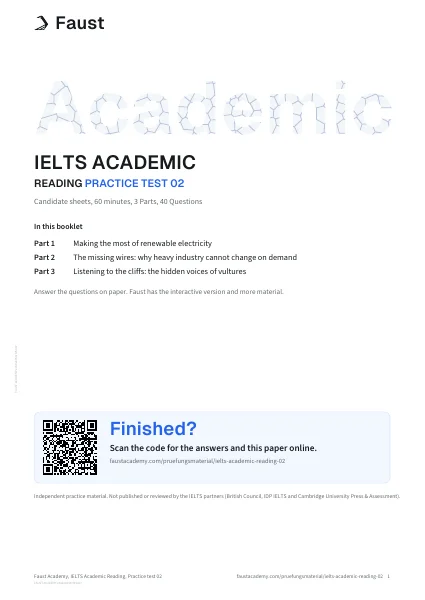
IELTS Academic Reading practice test 2 is a reading paper for the IELTS Academic exam. It takes 60 minutes. The PDF has 12 pages and 3 sections. You can download the PDF for free, with no account.
Updated 4 November 2026, Faust Academy team
In this paper
- Making the most of renewable electricity
- The missing wires: why heavy industry cannot change on demand
- Listening to the cliffs: the hidden voices of vultures
Exam material is in English.
Every PDF is free. How Faust marks
Independent Faust practice material. Not published or endorsed by the IELTS partners (British Council, IDP IELTS and Cambridge University Press and Assessment).
Inside the paper
Reading Passage 1
You should spend about 20 minutes on Questions 1 to 13, which are based on Reading Passage 1 below.
Making the most of renewable electricity
Over the past fifteen years, the price of building wind turbines and solar panels has fallen dramatically. In most countries, although not yet in all of them, a new wind or solar farm now produces electricity more cheaply than a newly built coal or gas power station. Yet household bills have not fallen nearly as far as these lower generation costs would suggest. Part of the explanation lies in a basic feature of electricity: unlike coal or oil, it cannot simply be piled up in a warehouse until somebody needs it. It must be used at the very moment it is produced, or else stored, and both of these things are harder and more expensive than they might appear. A power system built around the weather therefore needs more than turbines and panels; it also needs the means to move, keep and use energy at the right time. The first difficulty is geographical. The best sites for wind farms are frequently in places where few people live. In one northern region, dozens of turbines stand on exposed hills hundreds of kilometres from the large population centres. On windy days, the cables that carry power south to the cities are often already full. When this happens, the turbines are ordered to stop, and their owners receive compensation for switching them off, a cost that is eventually added to consumers' bills. Meanwhile, gas power stations nearer the cities are asked to increase their output to make up the shortfall. Building new transmission routes would solve the problem, but planning and constructing them can take a decade or more, and local residents often object to new pylons crossing the countryside. A second factor is less visible but, according to Dr Miriam Okafor, an energy economist at the Northmoor Institute for Energy Policy, at least as important. 'With a gas power station, a large share of the expense is the fuel, which you pay for gradually over thirty or forty years,' she explains. 'With wind and solar, the fuel is free, but almost all the money has to be spent before a single unit of power is sold.' As a result, the interest paid on borrowed money makes up a large part of the final cost of the electricity a project produces. This is why the way projects are paid for matters so much. Developers with a guaranteed price for fifteen or twenty years are far safer borrowers, and banks charge them considerably less interest. When governments replace such guarantees with schemes that leave developers exposed to unpredictable market prices, lenders ask for higher returns to cover the extra risk, and that additional expense is passed on, sooner or later, to the people who use the power. Storage is the third piece of the puzzle. The oldest form of large-scale storage is pumped hydro, in which surplus power is used to move water uphill to a higher reservoir; when demand rises, the water is released to flow back down through turbines. Suitable valleys, however, are rare. Grid batteries have spread quickly over the past decade, but most release their stored energy over a few hours at most. That is useful for shifting midday sunshine into the evening, but keeping summer sunshine until winter remains a problem that no technology has yet solved cheaply. A newer approach turns surplus electricity into heat and keeps it in large insulated silos filled with sand, which can stay hot for weeks. The heat can then be supplied to factories or to the hot water networks that warm some towns. Perhaps the cheapest solution of all is to change when electricity is used, rather than where or how it is stored. Consider the Calder Cold Store, a warehouse that keeps frozen fish for supermarkets. When power is plentiful and cheap, the warehouse lowers the temperature in its freezers by a few extra degrees, then allows it to rise slowly when prices go up. Because the goods are already deeply frozen, the building in effect acts as a large battery. 'At the beginning, I was worried that we would be putting our customers' stock at risk,' admits Owen Pritchard, the operations manager. 'In two years, not a single product has been spoiled.' Similar arrangements are now being offered to owners of electric vehicles. Drivers who plug in their cars in the evening can allow an app on their phone to choose when charging takes place, in exchange for a cheaper tariff. Most simply want a full battery by the morning and do not mind whether the car charges at ten o'clock or at three. Who owns the turbines can also make a difference. In the small town of Brackenridge, local wind turbines and solar panels on the roofs of schools and warehouses belong to Brackenridge Community Energy, a cooperative set up by residents. Anyone living in the area can buy shares, and whether they own one share or a hundred, every member has a single vote at the annual meeting. Part of the profit is paid out to members each year, and the rest is spent on insulating older homes in the town. Supporters argue that when people have a stake in a project, they are far less likely to oppose it, which may make it easier to find sites for the turbines and cables that a cleaner system needs. For Okafor, the lesson is clear. Some politicians have suggested that the expansion of renewables should be slowed to protect consumers from rising charges. She believes this misunderstands where the money goes. 'Slowing down wind and solar does not bring costs down,' Okafor says. 'Lowering the risk for investors and making better use of the power we already generate does.' In her view, the savings will come from stronger grids, more varied storage and customers who are willing to adapt, which together allow the cheap power that is already being produced to reach the people who need it.
1. Falling generation costs for wind and solar power have led to equally large reductions in household electricity bills.
TRUE) TRUE
FALSE) FALSE
NOT GIVEN) NOT GIVEN
2. Some wind farm owners are paid to stop generating electricity.
TRUE) TRUE
FALSE) FALSE
NOT GIVEN) NOT GIVEN
3. Projects with long-term fixed-price contracts are usually completed more quickly than other projects.
TRUE) TRUE
FALSE) FALSE
NOT GIVEN) NOT GIVEN
4. The use of grid batteries has grown only slowly in recent years.
TRUE) TRUE
FALSE) FALSE
NOT GIVEN) NOT GIVEN
5. Owen Pritchard was at first concerned that the scheme could damage the goods stored in the warehouse.
TRUE) TRUE
FALSE) FALSE
NOT GIVEN) NOT GIVEN
6. Members of the Brackenridge cooperative pay less for their electricity than other local households.
TRUE) TRUE
FALSE) FALSE
NOT GIVEN) NOT GIVEN
7. • Wind farms in remote areas are sometimes switched off because the {{7}} that carry power to the cities are full.
8. • Banks regard developers with long-term fixed-price contracts as safer {{8}}, so they charge them less interest.
9. • Electricity can be turned into heat and kept in insulated containers filled with {{9}}.
10. • The Calder Cold Store, which keeps frozen {{10}} for supermarkets, makes its freezers colder when electricity is cheap.
11. • Electric car drivers who let an app choose their charging time are offered a cheaper {{11}}.
12. • Profits that are not paid out to members are spent on insulating older {{12}} in the town.
13. • Okafor argues that holding back renewables does not lower {{13}}.
Reading Passage 2
You should spend about 20 minutes on Questions 14 to 26, which are based on Reading Passage 2 below.
The missing wires: why heavy industry cannot change on demand
A Across Europe, governments have spent the past few years arguing about deadlines. In more than one capital, ministers and industry associations are locked in a dispute over whether steelworks, cement kilns and chemical plants should become climate-neutral five or even ten years earlier than their counterparts in neighbouring countries. Supporters of an early date say that a clear and ambitious target concentrates minds and gives investors certainty. Business groups reply that a national deadline stricter than everyone else's would simply push production, and the jobs that go with it, across the border to places with looser rules. Both sides point to the rising price that companies already pay for each tonne of carbon dioxide they emit, though they draw opposite conclusions from it: one side sees it as proof that change is coming anyway, the other as a burden that should not be made heavier. Yet the question of the target year, however fiercely it is argued over, is not where the real difficulty lies. B Consider what it would actually take to make steel without coal. The methods are no longer experimental. Iron ore can be reduced using hydrogen instead of coke, and the resulting iron melted down in an electric arc furnace; scrap steel can be recycled in similar furnaces powered entirely by electricity. A few years ago, a mid-sized producer, Brenmark Steel, decided to test the approach for itself. With the help of a government innovation grant, it put up a small hydrogen-based unit beside its existing works. Steel from the unit was soon being sold to the company's regular customers, who treated it no differently from conventional material. By any reasonable measure the trial was a success. Yet anyone visiting the site today would find the unit doing much what it did in its first month: it has never grown beyond the modest size for which it was designed. When the company asked to expand it to full production, the regional grid operator replied that it could offer no additional capacity until the mid-2030s. Nor does any hydrogen pipeline come anywhere near the site, so the gas would have to be made locally, which in turn would require yet more electricity. The technology, in other words, is ready; the wires and pipes that would feed it are not. C Why has nobody built them? The answer lies less in engineering than in incentives. Network operators are businesses with obligations to their shareholders, and no operator wants to lay a pipeline that may never carry anything, and so they wait for signed contracts before committing. Their caution is reinforced by the way they are regulated: regulators generally allow them to recover the cost of new capacity only where demand for it has already been demonstrated. Manufacturers, meanwhile, cannot sensibly sign up to a new production process worth hundreds of millions without a guarantee that the power and hydrogen will be there when the plant opens. Each side, quite reasonably, is waiting for the other to move first. Time makes this stand-off costly. A blast furnace typically needs a major rebuild roughly every fifteen years, and a large number of Europe's furnaces are due for one within the next few years. Grid connections cannot be delivered on that timetable: from first proposal to final approval, a major high-voltage line can take a decade, much of it consumed by planning procedures and by objections from residents along the proposed route. A company facing a worn-out furnace and no firm date for a connection has little choice but to reinstall the old technology. Each such decision leaves a legacy of emissions stretching well into the 2050s. It is tempting to blame industry for its caution or operators for their conservatism, but both are behaving as the rules encourage them to. The real failure of policy, I would argue, has been a lack of foresight: the networks were never planned for the industry that governments said they wanted. D If the deadlock is to be broken, it is governments that will have to take the first step. Two measures would go a long way. First, governments should publish a binding plan, looking decades ahead, of where new power lines and pipelines will run, so that manufacturers can choose sites and operators can prepare routes with some confidence. Second, the state should be prepared to pay for capacity in advance, carrying the risk until private customers arrive; once they do, the cost can be recovered through ordinary network charges. Some will object that this is too expensive, and that each plant should simply be left to arrange its own connection. But that approach is precisely what has produced the present stalemate, because it keeps every party waiting. Nor is the answer more money for individual factories. Grants for pilot projects like Brenmark's are already common, and they have shown that the technology works; what they cannot do is build the networks those projects depend on. None of this requires governments to settle the argument about target years. A country could choose any deadline it likes, and it would still miss it if the cables were not in the ground. Debating the date is easier than laying the pipe, but only the second will cut emissions.
14. Section A
i) A circular wait between suppliers and their customers
Doubts over whether the new processes actually work
A political argument that overlooks the real obstacle
Rising carbon prices as the main driver of change
v) Proven methods held back by missing networks
Why companies are moving production abroad
Ways for governments to break the deadlock
15. Section B
i) A circular wait between suppliers and their customers
Doubts over whether the new processes actually work
A political argument that overlooks the real obstacle
Rising carbon prices as the main driver of change
v) Proven methods held back by missing networks
Why companies are moving production abroad
Ways for governments to break the deadlock
16. Section C
i) A circular wait between suppliers and their customers
Doubts over whether the new processes actually work
A political argument that overlooks the real obstacle
Rising carbon prices as the main driver of change
v) Proven methods held back by missing networks
Why companies are moving production abroad
Ways for governments to break the deadlock
17. Section D
i) A circular wait between suppliers and their customers
Doubts over whether the new processes actually work
A political argument that overlooks the real obstacle
Rising carbon prices as the main driver of change
v) Proven methods held back by missing networks
Why companies are moving production abroad
Ways for governments to break the deadlock
18. Which TWO statements does the writer make about the pilot plant described in Section B?
A) It was built to supply hydrogen to other plants in the region
B) Its construction relied partly on state support
C) Its steel failed to meet the standards that customers expect
D) It was the first plant of its kind in Europe
E) It continues to operate at its original size
19. Which TWO statements does the writer make about the pilot plant described in Section B?
A) It was built to supply hydrogen to other plants in the region
B) Its construction relied partly on state support
C) Its steel failed to meet the standards that customers expect
D) It was the first plant of its kind in Europe
E) It continues to operate at its original size
20. Which TWO reasons does the writer give for network operators' reluctance to build new capacity?
A) A shortage of qualified engineers
B) Uncertainty about whether enough customers will sign up
C) Objections from people living near planned routes
D) The high price of materials such as steel pipe
E) Rules that allow spending only on demand that already exists
21. Which TWO reasons does the writer give for network operators' reluctance to build new capacity?
A) A shortage of qualified engineers
B) Uncertainty about whether enough customers will sign up
C) Objections from people living near planned routes
D) The high price of materials such as steel pipe
E) Rules that allow spending only on demand that already exists
22. Which TWO actions does the writer recommend that governments take?
A) Offer long-term contracts guaranteeing a price for low-carbon steel
B) Publish a long-term plan showing where new networks will be built
C) Require each plant to secure its own grid connection before receiving approval
D) Commit public money to pay for network capacity before private demand arrives
E) Reduce the carbon charges paid by heavy industry
23. Which TWO actions does the writer recommend that governments take?
A) Offer long-term contracts guaranteeing a price for low-carbon steel
B) Publish a long-term plan showing where new networks will be built
C) Require each plant to secure its own grid connection before receiving approval
D) Commit public money to pay for network capacity before private demand arrives
E) Reduce the carbon charges paid by heavy industry
24. • Building a major new power line often takes about a {{24}}, largely because of planning and approval.
25. • A plant that cannot rely on a new connection may install another conventional furnace, leaving a {{25}} of emissions for decades.
26. • The writer believes the greatest failure of policy has been a lack of {{26}}, as networks were never designed for the industry that governments wanted.
Listening to the cliffs: the hidden voices of vultures
You should spend about 20 minutes on Questions 27 to 40, which are based on Reading Passage 3 below.
Listening to the cliffs: the hidden voices of vultures
For much of the twentieth century, vultures had a reputation as some of the quietest large birds in Africa. Visitors to the savannah see them circling high above the grassland, riding warm air for hours with barely a wingbeat, before dropping silently towards a carcass. Older field guides put this silence down to the birds' simple vocal anatomy, but that explanation came later: the reputation itself grew out of decades of watching vultures soar at a distance, where they rarely make a sound. Few observers had the opportunity, or the patience, to sit close to a breeding colony and simply listen. That is what Dr Lena Whitcombe of the Marlow Institute of Ornithology set out to do. Her team chose a colony of Rüppell's vultures nesting on a sandstone cliff in East Africa, where several hundred pairs raise their chicks on narrow ledges. Because human observers inevitably change the behaviour of the birds they watch, the researchers relied on small automatic sound recorders instead. Recorders were fixed beside nests on the cliff and at a feeding station on the plain below, and they ran through two full breeding seasons. Batteries were changed during brief visits timed to avoid the most sensitive weeks of nesting. What the recorders captured surprised even the team. Almost every call type was produced when birds were within a few metres of one another, whether at the nest or around a carcass. This, Whitcombe argues, is why generations of observers formed the wrong impression: the birds were communicating, but only to those standing close enough to hear. Some calls were soft hisses exchanged between partners on a ledge; others were harsh, squabbling cries as birds competed for food at the feeding station. The most distinctive sound, a rhythmic, rasping call given during mating, was heard only from males. Altogether, the team identified sixteen call types for the colony, a range comparable to that of macaque monkeys, which are often cited as notably vocal primates. Comparisons of this kind attract headlines, and the researchers are careful about how theirs is read. Whitcombe stresses that the comparison concerns the number of distinct call types, not what those calls mean or how they might be combined. 'Nobody is suggesting that vultures have a language,' she says. 'The point is that their range of sounds is far wider than anyone assumed.' Not everyone is convinced that the figure of sixteen will stand. Deciding where one call type ends and the next begins is among the oldest problems in the study of animal sound, because calls often shade into one another, varying in length or pitch with a bird's age or level of excitement. Professor Samuel Adeyemi takes a cautious view. Adeyemi praises the quality of the recordings, but points out that a generous approach to dividing similar sounds will always produce a longer list, and he suspects that several of the sixteen types are variations of a single call. His caution reflects long experience with many species. Adeyemi, who has listened to a sample of the team's recordings, studies bird song at the same institute's sound archive, where calls from several continents are catalogued. Another analyst working with the same material, he believes, could reasonably arrive at a shorter list. The disagreement might sound academic, but it has practical consequences, because many African vulture species have declined sharply in recent decades, threatened by poisoning, collisions with power lines and a shrinking food supply. Protecting them requires knowing how many birds remain and whether they are breeding. At present, conservation groups count vultures mainly through aerial surveys, which are expensive and can disturb birds sitting on their nests. Sound offers an alternative. Whitcombe suggests that the low nest-defence call, which is given only by birds incubating eggs, could show whether a ledge is being used for breeding. No one would need to climb the cliff to find out. The obstacle is the sheer quantity of data. Recorders cost far less than flights, yet listening through a single season of sound by hand would demand several months of a researcher's time. For this reason the team is training computer software to sort the recordings into call types without human help. Such software is only as good as the reference library of calls it learns from, and this is where the argument about how to divide similar sounds becomes practical. If the library splits one call into several types, the program will learn distinctions that may mean nothing to the birds; if it merges genuinely different calls, it may overlook the very signal that conservationists need. Adeyemi raises a further difficulty. He adds that a single recorder beside a busy ledge may capture one bird calling hundreds of times, so a rise in calls need not mean a rise in birds. Counting individuals from sound alone would require a way of telling one vulture's voice from another's, and no such method yet exists. On one point the two scientists agree: listening should complement, not replace, counts made from the air. Whitcombe imagines recorders monitoring colonies year-round, with flights reserved for sites where the sound record suggests that something has changed. It is a modest ambition, but for birds long dismissed as silent, simply being heard is a start.
27. The belief that vultures are quiet birds first arose from studies of their vocal anatomy.
TRUE) TRUE
FALSE) FALSE
NOT GIVEN) NOT GIVEN
28. More calls were recorded at the feeding station than beside the nests.
TRUE) TRUE
FALSE) FALSE
NOT GIVEN) NOT GIVEN
29. The majority of the call types were produced when the birds were close to each other.
TRUE) TRUE
FALSE) FALSE
NOT GIVEN) NOT GIVEN
30. Both male and female vultures produce the distinctive call associated with mating.
TRUE) TRUE
FALSE) FALSE
NOT GIVEN) NOT GIVEN
31. The comparison the researchers make with macaques refers only to how many different calls each animal has.
TRUE) TRUE
FALSE) FALSE
NOT GIVEN) NOT GIVEN
32. Professor Adeyemi suspects that the total number of call types may be too high.
TRUE) TRUE
FALSE) FALSE
NOT GIVEN) NOT GIVEN
33. Professor Adeyemi has made his own recordings at the same colony.
TRUE) TRUE
FALSE) FALSE
NOT GIVEN) NOT GIVEN
34. Population counts of vultures usually depend on {{34}}, which are costly and can disturb nesting birds.
35. Whitcombe proposes listening for a call given only by birds that are {{35}}, as this would show whether breeding is taking place.
36. Recorders are cheaper than flights, but checking the sound files by ear would take {{36}} of work for each season.
37. The team is therefore training {{37}} to recognise each call type automatically.
38. This approach depends on a reliable {{38}} of calls, which is why the debate over how to divide similar sounds matters.
39. Adeyemi also points out that a {{39}} may pick up the same bird many times, so the number of calls does not equal the number of birds.
40. Both researchers agree that sound recordings should {{40}} rather than replace observations from the air.
More papers

Paper 3
Made to measure: the long journey of a tunnel boring machine

Paper 4
Selling off the state's old equipment
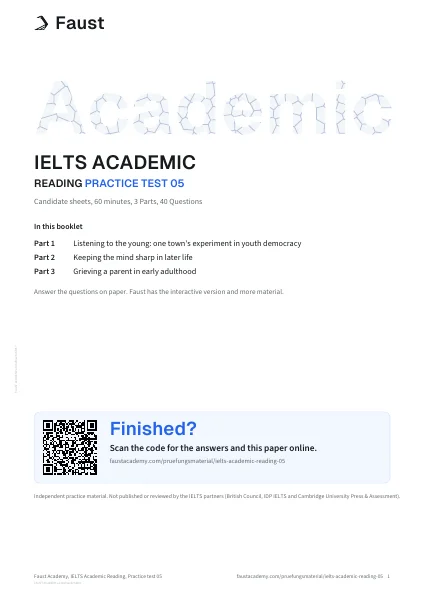
Paper 5
Listening to the young: one town's experiment in youth democracy
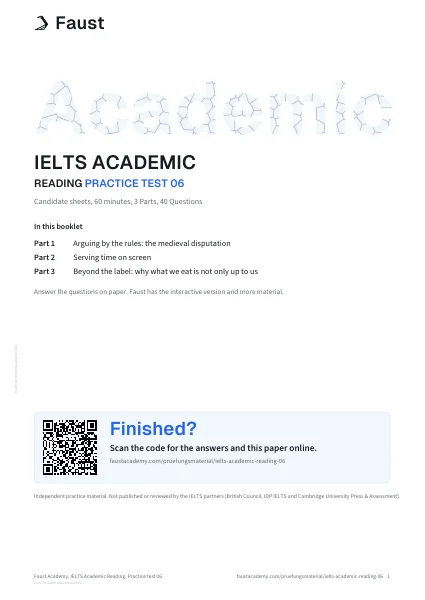
Paper 6
Arguing by the rules: the medieval disputation
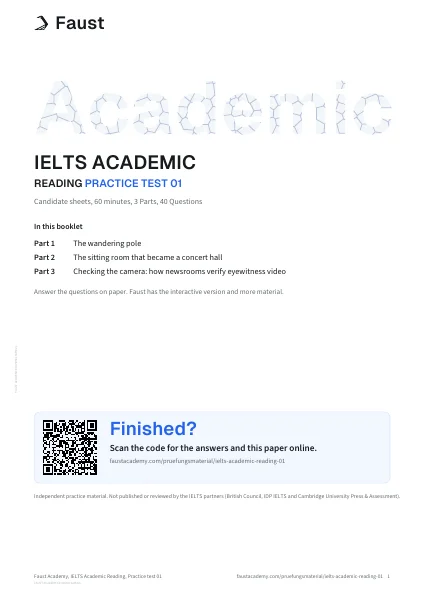
Paper 1
The wandering pole
Frequently asked questions
- How long is IELTS Academic Reading practice test 2?
- The paper takes 60 minutes. The PDF has 12 pages, and the answer key is a separate PDF.
- Is IELTS Academic Reading practice test 2 free?
- Yes. You can download the PDF for free, with no account.