
IELTS Academic Listening practice test 4
- Engineered to the real IELTS format
IELTS Academic Listening practice test 4 is a listening paper for the IELTS Academic exam. It takes 30 minutes. The PDF has 10 pages and 4 sections. The audio plays on this page. You can download the PDF for free, with no account.
Updated 4 November 2026, Faust Academy team
In this paper
- A phone call to a print shop
- Talk by the coordinator of the Harbour Room
- Two media studies students discuss their project on negative news
- Lecture: paying farmers to restore peatland
Exam material is in English.
Every PDF is free. How Faust marks
Independent Faust practice material. Not published or endorsed by the IELTS partners (British Council, IDP IELTS and Cambridge University Press and Assessment).
Listening audio
Part 1
Part 2
Part 3
Part 4
Inside the paper
Calendar order: Fernhill Birdwatching Club
Listen and answer questions 1 to 10.
1. • Contact name: Joanna {{1}}
2. • Number of calendars: {{2}}
3. • Monthly pictures: chosen from entries to the club's photo {{3}}
4. • Paper: heavy, with a {{4}} finish
5. • Dates of club {{5}} printed on each month
6. • Bird in the front cover drawing: {{6}}
7. • A proof will be sent by {{7}}
8. • Ready to collect: {{8}} November
9. • Price per calendar: £{{9}}
10. • Shop address: 27 {{10}} Street
The Harbour Room: an information evening for parents
Listen and answer questions 11 to 20.
11. The Harbour Room was originally set up by
A) a group of parents
B) the local council
C) a head teacher
12. During their first two weeks at the centre, new students
A) attend only in the mornings
B) work individually with a mentor
C) join lessons in small groups
13. What was the main reason the centre stopped offering online lessons for students at home?
A) Students became even more isolated
B) Families did not have suitable equipment
C) Staff found it hard to check progress
14. Parents who would like to see the centre before their child joins should
A) phone the office to book a visit
B) come to the Thursday open afternoon
C) ask their child's school to arrange a visit
15. Which TWO things does the speaker say helped a former student, Maya, to return to full-time school?
A) being allowed to arrive later than other pupils
B) having a named member of staff to go to
C) moving to a different school
D) joining an after-school club
E) keeping a diary about her feelings
16. Which TWO things does the speaker say helped a former student, Maya, to return to full-time school?
A) being allowed to arrive later than other pupils
B) having a named member of staff to go to
C) moving to a different school
D) joining an after-school club
E) keeping a diary about her feelings
17. Which TWO things are parents asked to do while their child attends the centre?
A) provide a packed lunch
B) attend a monthly parents' meeting
C) phone the centre if their child will be absent
D) help with homework each evening
E) arrange transport to the centre
18. Which TWO things are parents asked to do while their child attends the centre?
A) provide a packed lunch
B) attend a monthly parents' meeting
C) phone the centre if their child will be absent
D) help with homework each evening
E) arrange transport to the centre
19. Which TWO changes are planned for the centre next year?
A) longer opening hours
B) a gardening project
C) places for younger children
D) a second centre in another town
E) a new counselling room
20. Which TWO changes are planned for the centre next year?
A) longer opening hours
B) a gardening project
C) places for younger children
D) a second centre in another town
E) a new counselling room
Media studies project: how negative news affects audiences
Listen and answer questions 21 to 30.
21. Which TWO things did Maya find most revealing about keeping a news diary?
A) how often she looked at headlines without reading the articles
B) how her mood changed after reading certain kinds of story
C) how difficult it was to identify where some stories came from
D) how differently two outlets reported the same event
E) how many positive stories she was able to remember later
22. Which TWO things did Maya find most revealing about keeping a news diary?
A) how often she looked at headlines without reading the articles
B) how her mood changed after reading certain kinds of story
C) how difficult it was to identify where some stories came from
D) how differently two outlets reported the same event
E) how many positive stories she was able to remember later
23. Which TWO changes do the students agree to make to their questionnaire for the second round?
A) including people who are not at the university
B) asking participants about their sleep patterns
C) making the questions about feelings more specific
D) reducing the number of questions
E) adding a section on social media use
24. Which TWO changes do the students agree to make to their questionnaire for the second round?
A) including people who are not at the university
B) asking participants about their sleep patterns
C) making the questions about feelings more specific
D) reducing the number of questions
E) adding a section on social media use
25. deliberately looking for solutions-focused stories
A) This may leave people poorly informed
B) This is already more common than people assume
C) The research on this is still limited
D) This is mainly used by younger people
E) This is likely to make people feel more anxious
F) People rarely keep this up for long
G) Users should be given more control over this
H) This could be expensive to produce
26. avoiding the news completely
A) This may leave people poorly informed
B) This is already more common than people assume
C) The research on this is still limited
D) This is mainly used by younger people
E) This is likely to make people feel more anxious
F) People rarely keep this up for long
G) Users should be given more control over this
H) This could be expensive to produce
27. apps that let users filter out certain topics
A) This may leave people poorly informed
B) This is already more common than people assume
C) The research on this is still limited
D) This is mainly used by younger people
E) This is likely to make people feel more anxious
F) People rarely keep this up for long
G) Users should be given more control over this
H) This could be expensive to produce
28. push notifications for breaking news
A) This may leave people poorly informed
B) This is already more common than people assume
C) The research on this is still limited
D) This is mainly used by younger people
E) This is likely to make people feel more anxious
F) People rarely keep this up for long
G) Users should be given more control over this
H) This could be expensive to produce
29. weekly news summaries sent by email
A) This may leave people poorly informed
B) This is already more common than people assume
C) The research on this is still limited
D) This is mainly used by younger people
E) This is likely to make people feel more anxious
F) People rarely keep this up for long
G) Users should be given more control over this
H) This could be expensive to produce
30. reading the news just before going to sleep
A) This may leave people poorly informed
B) This is already more common than people assume
C) The research on this is still limited
D) This is mainly used by younger people
E) This is likely to make people feel more anxious
F) People rarely keep this up for long
G) Users should be given more control over this
H) This could be expensive to produce
Peatland, farming and carbon markets
Listen and answer questions 31 to 40.
31. According to the lecturer, peatland in Britain was mainly drained in the past
A) to make the land suitable for farming
B) to cut peat to sell as fuel
C) to protect nearby settlements from flooding
32. What does the lecturer see as the biggest obstacle to including peatland in carbon markets?
A) doubts about how reliably the carbon savings can be measured
B) payments that are too low to interest farmers
C) rules that only allow industry to trade carbon credits
33. Ditch blocking; small dams made of {{33}} are built across drainage channels; water level rises within a few months
34. Re-vegetating bare peat; fragments of {{34}} are spread by hand; the surface stops drying out and eroding
35. Paludiculture; wet-tolerant crops are grown, e.g. {{35}}, used to make insulation boards; gives farmers an income from wet land
36. Wet grazing; hardy breeds of {{36}} are kept at low numbers; animals stop scrub from spreading
37. Monitoring; water levels are checked using images from a {{37}}; cheaper than repeated site visits
38. • Payment is based on water levels measured on site each {{38}}, not on the amount of work done.
39. • Must run for decades, because stored carbon is lost quickly if land is drained and {{39}} again.
40. • Local {{40}} help small farms to apply together and share costs.
More papers
Paper 5
Phone call to an adult learning centre about an evening history course
Paper 6
Saltmere Marshes Guided Walks
Paper 1
Phone call to Brightwater Social Club
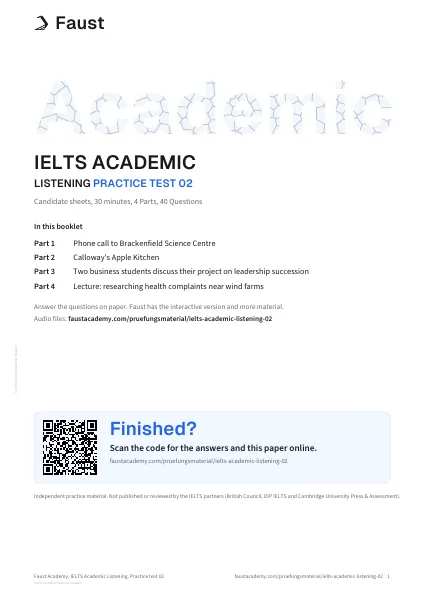
Paper 2
Phone call to Brackenfield Science Centre
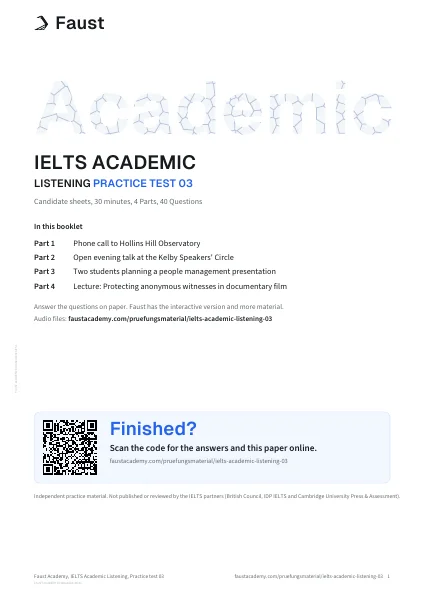
Paper 3
Phone call to Hollins Hill Observatory
Frequently asked questions
- How long is IELTS Academic Listening practice test 4?
- The paper takes 30 minutes. The PDF has 10 pages, and the answer key is a separate PDF. The audio for the paper plays on this page.
- Is IELTS Academic Listening practice test 4 free?
- Yes. You can download the PDF for free, with no account.