
OET Listening sample 2
- Engineered to the real OET format
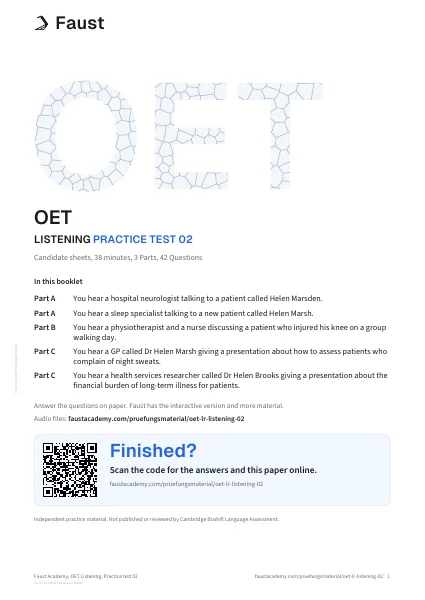
OET Listening sample 2 is a listening paper for the OET exam. It takes 38 minutes. The PDF has 12 pages and 5 sections. The audio plays on this page. You can download the PDF for free, with no account. You can also practise it online.
Updated 21 November 2026, Faust Academy team
In this paper
- You hear a hospital neurologist talking to a patient called Helen Marsden.
- You hear a sleep specialist talking to a new patient called Helen Marsh.
- You hear a physiotherapist and a nurse discussing a patient who injured his knee on a group walking day.
- You hear a ward pharmacist talking to a group of nurses about a change to the storage of insulin pens.
- You hear a male patient talking to a dietitian in a hospital outpatient clinic.
Exam material is in English.
Every PDF is free. How Faust marks
Independent Faust practice material. Not published or endorsed by the Cambridge Boxhill Language Assessment Unit Trust (CBLA).
Listening audio
Part 1
Part 2
Part 3
Part 4
Part 5
Inside the paper
You hear a hospital neurologist talking to a patient called Helen Marsden.
In this part of the test, you’ll hear two different extracts. In each extract, a health professional is talking to a patient. For questions 1-24, complete the notes with information that you hear. Now, look at the notes for extract one. Extract 1: Questions 1-12 You hear {professional} talking to {patient}. For questions 1-12, complete the notes with a word or short phrase that you hear. You now have thirty seconds to look at the notes.
1. • sudden {{1}} while gardening
2. • taken to hospital by {{2}}
3. • ruptured aneurysm sealed using {{3}}
4. • main problem is {{4}}
5. • works as a {{5}}
6. • has noticed difficulty with {{6}}
7. • not allowed to drive until after {{7}}
8. • mother died of a {{8}}
9. • history of {{9}}, untreated for years
10. • now takes {{10}}, dose to be reviewed by GP
11. • has accepted {{11}} for low mood
12. • advised that close relatives may need {{12}}
You hear a sleep specialist talking to a new patient called Helen Marsh.
Extract 2: Questions 13-24 You hear {professional} talking to {patient}. For questions 13-24, complete the notes with a word or short phrase that you hear. You now have thirty seconds to look at the notes.
13. • sleep difficulties began after {{13}}
14. • wakes around 3am most nights because of {{14}}
15. • tried {{15}}, no improvement
16. • feels {{16}} with colleagues
17. • makes mistakes when {{17}}
18. • partner has moved into the {{18}}
19. • uses {{19}} in bed until late
20. • main meal usually includes {{20}}
21. • has a glass of {{21}} most evenings
22. • keep a {{22}} for two weeks
23. • in the hour before bed, try {{23}}
24. • arrange {{24}} if no improvement
Part B
In this part of the test, you’ll hear six different extracts. In each extract, you’ll hear people talking in a different healthcare setting. For questions 25-30, choose the answer (A, B or C) which fits best according to what you hear. You’ll have time to read each question before you listen. Complete your answers as you listen. Now look at question 25.
25. You hear a physiotherapist and a nurse discussing a patient who injured his knee on a group walking day. They agree that the next step should be to
A) ask the doctor to review his pain relief
B) arrange a home visit to assess his stairs
C) book him into a strengthening class
26. You hear a ward pharmacist talking to a group of nurses about a change to the storage of insulin pens. What does she say has caused the most errors?
A) pens being left out of the fridge for too long
B) labels on the pens being hard to read
C) pens of different types being kept in the same drawer
27. You hear a male patient talking to a dietitian in a hospital outpatient clinic. What is the patient concerned about?
A) being unable to eat out with his friends
B) the cost of the special foods he has been advised to buy
C) feeling hungry between meals on the new plan
28. You hear a female nurse manager talking to a new healthcare assistant about patient falls on the ward. What does the nurse manager now believe about falls?
A) They are linked more to patients’ medication than to the ward layout
B) They mostly happen during the busy morning routine
C) They tend to happen when patients try to reach the toilet unaided
29. You hear a male doctor talking to a female patient who has just been told she needs a blood test before surgery. How does the patient feel about the test?
A) annoyed that she was not told about it earlier
B) anxious that it may delay her operation
C) unsure why it is necessary for her particular operation
30. You hear a clinic manager talking to colleagues about a new text message system for patients booked for procedures. What is the system intended to achieve?
A) early warning of cancellations so that slots can be offered to other patients
B) fewer phone calls for reception staff to deal with
C) better compliance with fasting instructions before procedures
You hear a GP called Dr Helen Marsh giving a presentation about how to assess patients who complain of night sweats.
In this part of the test, you’ll hear two different extracts. In each extract, you’ll hear health professionals talking about aspects of their work. For questions 31-42, choose the answer (A, B or C) which fits best according to what you hear. Complete your answers as you listen. Now look at extract one. Extract 1: Questions 31-36 You hear a GP called Dr Helen Marsh giving a presentation about how to assess patients who complain of night sweats. You now have 90 seconds to read questions 31-36.
31. Helen believes that the phrase ‘night sweats’ is unhelpful in consultations because
A) it makes patients assume that the cause must be serious
B) patients use it to describe very different experiences
C) it is not clearly defined in clinical guidelines
32. Helen criticises ordering a wide range of blood tests at the first appointment because
A) it often leads to patients being worried by minor abnormal results
B) the results usually arrive too late to affect the next decision
C) it can take attention away from the patient’s own account of the symptoms
33. What does Helen say she most wants to establish early in the first consultation?
A) whether other members of the patient’s family have had similar symptoms
B) whether a medicine the patient takes could be responsible
C) whether the sweats come with a fever
34. When Martin was asked about his recent weight loss, he
A) said that he had not realised he had lost any weight
B) was reluctant to discuss his eating habits
C) was pleased because he assumed his new exercise routine was responsible
35. How did Priya react when she was told her sweats were probably hormonal?
A) She was relieved that no further tests would be needed
B) She doubted it because her periods were still regular
C) She was anxious about the idea of starting treatment
36. Helen’s main concern about patients who manage night sweats on their own is that they may
A) hide a pattern that would point to an underlying illness
B) spend money on cooling products that do not help
C) use products that interact with their prescribed medicines
Extract 2: Questions 37-42
You hear a health services researcher called Dr Helen Brooks giving a presentation about the financial burden of long-term illness for patients. You now have 90 seconds to read questions 37-42. For questions 37-42, choose the answer (A, B or C) which fits best according to what you hear.
37. Dr Brooks says the main aim of her research is to
A) measure how much patients spend on prescriptions and travel to appointments
B) help patients claim the financial support they are entitled to
C) show clinicians what illness costs patients beyond the treatment itself
38. Dr Brooks thinks the main reason clinicians avoid raising the subject of cost is that they
A) worry that patients will find the question offensive
B) see it as outside their professional responsibility
C) believe they could not suggest any realistic solution
39. Dr Brooks refers to the case of a patient called Raymond to highlight
A) how indirect costs can make patients stop effective treatment
B) how illness can affect a patient’s ability to keep working
C) how confusing patients find the process of claiming financial help
40. Raymond did not tell his rheumatologist about his difficulties because
A) he did not want to appear uncommitted to his treatment
B) he assumed his physiotherapist already knew about his work situation
C) he believed the clinic could not change its appointment times
41. Dr Brooks believes that staff worries about the screening question in the pilot clinic were
A) justified, as some patients expected financial help
B) less important than the need to collect reliable data
C) unfounded, as patients mainly wanted practical changes to their care
42. Dr Brooks’s main concern about the future is that
A) more patients will refuse treatment because they cannot afford it
B) costs building up over many years will go unnoticed
C) health services will be unable to fund routine follow-up
More papers
All 2 OET Listening papers
Frequently asked questions
- How long is OET Listening sample 2?
- The paper takes 38 minutes. The PDF has 12 pages, and the answer key is a separate PDF. The audio for the paper plays on this page.
- Is OET Listening sample 2 free?
- Yes. You can download the PDF for free, with no account. Online, one scored paper per part is free.