
OET Listening practice test 1
- Engineered to the real OET format
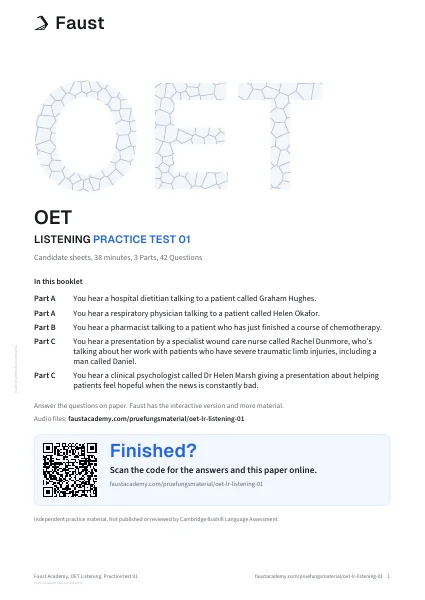
OET Listening practice test 1 is a listening paper for the OET exam. It takes 38 minutes. The PDF has 12 pages and 5 sections. The audio plays on this page. You can download the PDF for free, with no account. You can also practise it online.
Updated 17 November 2026, Faust Academy team
In this paper
- You hear a hospital dietitian talking to a patient called Graham Hughes.
- You hear a respiratory physician talking to a patient called Helen Okafor.
- You hear a pharmacist talking to a patient who has just finished a course of chemotherapy.
- You hear a ward nurse talking to a man whose wife has recently finished cancer treatment.
- You hear a radiographer talking to a colleague about a patient who is anxious before a scan.
Exam material is in English.
Every PDF is free. How Faust marks
Independent Faust practice material. Not published or endorsed by the Cambridge Boxhill Language Assessment Unit Trust (CBLA).
Listening audio
Part 1
Part 2
Part 3
Part 4
Part 5
Inside the paper
You hear a hospital dietitian talking to a patient called Graham Hughes.
In this part of the test, you’ll hear two different extracts. In each extract, a health professional is talking to a patient. For questions 1-24, complete the notes with information that you hear. Now, look at the notes for extract one. Extract 1: Questions 1-12 You hear {professional} talking to {patient}. For questions 1-12, complete the notes with a word or short phrase that you hear. You now have thirty seconds to look at the notes.
1. • first noticed that his {{1}} had become loose
2. • appetite poor since {{2}} in the spring
3. • tends to feel {{3}} after only a few mouthfuls
4. • reports frequent {{4}}, making eating painful
5. • finds {{5}} too exhausting
6. • has given up {{6}}, which he used to enjoy
7. • often feels {{7}} when standing up
8. • daughter has started {{8}}
9. • diet now consists mostly of {{9}}
10. • has tried adding {{10}} to meals, no real effect
11. • GP arranged {{11}}, nothing abnormal found
12. • advised to take {{12}} between meals
Extract 2: Questions 13-24
Extract 2: Questions 13-24 You hear {professional} talking to {patient}. For questions 13-24, complete the notes with a word or short phrase that you hear. You now have thirty seconds to look at the notes.
13. • dry cough began after a {{13}} last winter
14. • cough especially bad in the {{14}}
15. • also reports {{15}} after meals
16. • works as {{16}}
17. • struggles to {{17}} at work
18. • has stopped {{18}}
19. • {{19}} test: results normal
20. • allergy testing showed sensitivity to {{20}}
21. • referred for {{21}}
22. • tried over-the-counter {{22}}: no real benefit
23. • GP prescribed a {{23}} inhaler
24. • has started using a {{24}} at night
Part B
In this part of the test, you’ll hear six different extracts. In each extract, you’ll hear people talking in a different healthcare setting. For questions 25-30, choose the answer (A, B or C) which fits best according to what you hear. You’ll have time to read each question before you listen. Complete your answers as you listen. Now look at question 25.
25. You hear a pharmacist talking to a patient who has just finished a course of chemotherapy. What does the pharmacist say about the patient’s anti-sickness tablets?
A) They should be taken before meals rather than after
B) They can be stopped gradually over the next week
C) They must be kept in the fridge once opened
26. You hear a ward nurse talking to a man whose wife has recently finished cancer treatment. What is the man worried about?
A) being unable to spot signs that the illness has returned
B) managing his wife’s tiredness while he is at work
C) how to cope with the cost of regular check-ups
27. You hear a radiographer talking to a colleague about a patient who is anxious before a scan. What is the radiographer’s opinion about the patient?
A) She would cope better if she were given a sedative
B) She is likely to relax once she understands the process
C) She should be offered a later appointment time
28. You hear a ward manager speaking to her team at the start of a shift. Why is she talking about the new bedside chart?
A) to explain why some staff have been using it incorrectly
B) to ask for suggestions on how it could be improved
C) to make sure everyone knows it replaces the old form
29. You hear a physiotherapist talking to a patient who has had a knee replacement. What does the physiotherapist say about the exercises?
A) They are best done in several short sessions each day
B) They should be stopped if the knee aches afterwards
C) They will be reviewed after two weeks
30. You hear a hospital manager giving an update to clinical staff. What is the main point of her update?
A) Waiting times in the outpatient clinic have fallen
B) Staff are needed to join a working group on discharge
C) A new booking system will start next month
You hear a presentation by a specialist wound care nurse called Rachel Dunmore, who’s talking about her work with patients who have severe traumatic limb injuries, including a man called Daniel.
In this part of the test, you’ll hear two different extracts. In each extract, you’ll hear health professionals talking about aspects of their work. For questions 31-42, choose the answer (A, B or C) which fits best according to what you hear. Complete your answers as you listen. Now look at extract one. Extract 1: Questions 31-36 You hear a presentation by a specialist wound care nurse called Rachel Dunmore, who’s talking about her work with patients who have severe traumatic limb injuries, including a man called Daniel. You now have 90 seconds to read questions 31-36.
31. What does Rachel Dunmore see as the main aim of her work?
A) to shorten the time patients spend in hospital
B) to get the wound into a state where reconstruction can succeed
C) to limit the visible scarring left by the injury
32. Rachel’s main reason for believing that rebuilding a badly damaged limb in several operations is right is that it
A) gives the patient time to regain strength between operations
B) reduces the anaesthetic risk of one very long operation
C) lets the team see which tissue survives before deciding what to remove
33. How did Daniel react when he was told that reconstruction would take several months?
A) He was relieved that the leg could be saved
B) He was angry that he would be away from work for so long
C) He doubted that the surgeons could achieve it
34. Rachel mentions the first dressing change on Daniel’s leg to show that
A) dressing changes can be very distressing for patients
B) infection can develop without anyone noticing
C) a wound can look worse before it begins to improve
35. What does Rachel say patients typically feel about the negative pressure device?
A) embarrassed by how it looks
B) anxious about having it taken off
C) irritated by the noise it makes
36. When Daniel began rehabilitation, he
A) tried to do too much too soon
B) avoided putting weight on the leg because he was afraid
C) lost motivation after a series of setbacks
Extract 2: Questions 37-42
Extract 2: Questions 37-42 You hear a clinical psychologist called Dr Helen Marsh giving a presentation about helping patients feel hopeful when the news is constantly bad. You now have 90 seconds to read questions 37-42.
37. According to Dr Marsh, the main reason constant news coverage leaves some patients feeling helpless is that it
A) reports more distressing events than it did in the past
B) reaches people at times when they are unable to act on what they hear
C) gives people inaccurate information about risks to their health
38. Dr Marsh is critical of the advice to ‘think positively’ because it
A) leads people to feel they have failed when they cannot manage it
B) ignores evidence about how stress affects physical health
C) encourages people to avoid the news altogether
39. What does Dr Marsh say is the main aim of the approach she uses with patients?
A) to distract them from the news by keeping them physically busy
B) to rebuild their sense that their own actions can make a difference
C) to replace unhelpful habits with a fixed daily routine
40. Dr Marsh’s main concern about colleagues who adopt this approach is that they may
A) apply it rigidly without adapting it to each patient’s circumstances
B) stop following up once patients have started making progress
C) set patients too many ambitious goals at the same time
41. When Dr Marsh first explained her approach to her patient Raymond, he
A) dismissed it as too trivial to make any difference
B) was relieved to be given clear instructions
C) worried that the activity would be too tiring for him
42. When Raymond’s progress was interrupted by a chest infection, he
A) decided to stop the plan, convinced it had been unrealistic
B) restarted the plan with a shorter walk
C) replaced walking with exercises he could do indoors
More papers
All 1 OET Listening papersFrequently asked questions
- How long is OET Listening practice test 1?
- The paper takes 38 minutes. The PDF has 12 pages, and the answer key is a separate PDF. The audio for the paper plays on this page.
- Is OET Listening practice test 1 free?
- Yes. You can download the PDF for free, with no account. Online, one scored paper per part is free.