
Cambridge IGCSE 0510 Speaking Endorsement Reading practice test 1
- Engineered to the real Cambridge IGCSE format
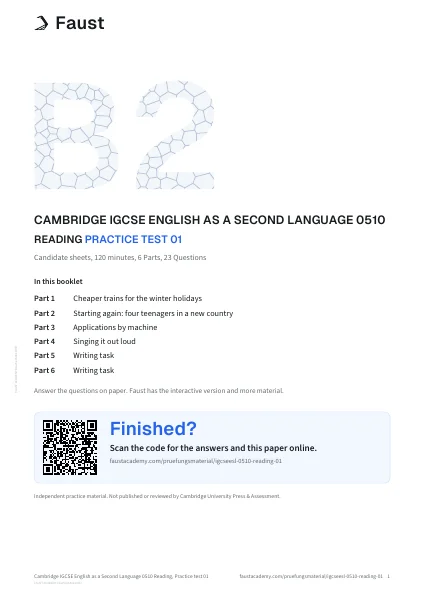 Reading 1 / 1
Cambridge IGCSE 0510 Speaking Endorsement Reading practice test 1 is a reading paper for the Cambridge IGCSE 0510 Speaking Endorsement exam. It takes 120 minutes. The PDF has 15 pages and 6 sections. You can download the PDF for free, with no account. You can also practise it online.
Updated 18 November 2026, Faust Academy team
In this paper
- Cheaper trains for the winter holidays
- Starting again: four teenagers in a new country
- Applications by machine
- Singing it out loud
Exam material is in English.
Every PDF is free. How Faust marks
Independent Faust practice material. Not published or endorsed by the Cambridge International Education.
Inside the paper
Cheaper trains for the winter holidays
Read the [text type] about [topic], and then answer the questions.
Cheaper trains for the winter holidays
Every winter, millions of people travel home for the holidays, and fares often seem to rise with demand. This year, however, there is some welcome news from Northline Rail. The new timetable begins on 14 December, and it brings extra services on several main routes as well as a brand new link to the coast. Tickets for the holiday period will go on sale on 28 October, so there is still plenty of time to plan carefully. Northline Rail now sells three main types of ticket. The cheapest option is the Early Saver, which is released in limited numbers and is valid only on the train printed on it. The Flexi Fare costs far more, but it can be changed right up to the moment of departure. The Standard ticket sits somewhere between the two. If your plans are fixed, the Early Saver is usually the smartest choice, and the best way to get one is to book as early as possible, because the cheapest tickets are always the first to disappear. Finding a cheap ticket is only half the story, however. A ticket alone does not guarantee a seat on busy days, and trains on popular routes can be full before they leave the first station. Arriving early at the station does not help much, because passengers already on board will have taken the best places. If you want to be sure of somewhere to sit, it is wise to reserve a seat, which costs only a small fee. The day you travel matters almost as much as the ticket you buy. Many commuters and holidaymakers choose Fridays, so prices rise sharply, and experts suggest you avoid travelling on Fridays if you can. Railway staff say the Friday before Christmas is the busiest day of the whole holiday period, while Christmas Eve is much quieter because so many people have already arrived. Time of day also makes a difference. It pays to be flexible about departure times, since trains at six in the morning or after eight in the evening are often much cheaper than those in the middle of the day. Finally, there is the new overnight service, which will interest anyone heading for the coast. It leaves in the late evening, and the overnight journey takes nine hours, so you can sleep for much of the trip and arrive in time for breakfast. The daytime service is shorter, but it usually costs more. If you are not ready to buy yet, set up price alerts in the app, and you will receive a message as soon as a cheaper fare appears.
1. On which date does the new timetable of Northline Rail begin?
2. What is the name of the cheapest type of ticket?
3. What does the writer say passengers should do to be sure of a place to sit on busy days?
4. Which day does the writer describe as the busiest of the holiday period?
5. How long does the new overnight journey to the coast take?
6. What advice does the writer give to people who want to find cheaper train tickets? Give three details.
Starting again: four teenagers in a new country
Read the article about four young people (A-D) who have recently moved to a new country. Then answer Questions 7-15. For each statement, write the correct letter A, B, C or D on the line. Which person gives the following information?
Starting again: four teenagers in a new country
A Imran When my family moved here last spring, I was dreading my first week at school. I walked in convinced that everybody would be judging me, my accent and even my shoes. Then, during a break, I noticed that the boy next to me kept checking his phone and straightening his bag, and it dawned on me that everyone else was just as worried about what I thought of them as I was about them. After that, I felt much calmer, and starting conversations became easier. Making real friends took a little longer. At home I had played football every weekend, so I asked about teams at school. Signing up for the local club, which trains twice a week, was the best thing I did. You spend ninety minutes passing a ball and shouting, and by the end of the first month I had people to sit with at lunch. On the bus to training I once heard a song from my old town, and I smiled and sang along quietly. If you play anything at all, find a team. B Lena I had studied the language for three years before we arrived, yet my first weeks felt like starting again. I mixed up words constantly. Once I asked a baker for a ‘window’ instead of a ‘loaf’, and I wanted to disappear. But she laughed kindly, corrected me and then asked where I was from. I never expected my mistakes to make people so friendly. Strangers slow down, smile and start chatting, which almost never happened when I stayed silent. Some moments are harder. Last month I was walking past a neighbour’s open kitchen window when the smell of baking bread drifted out. It was exactly what my grandmother’s house smells like on Sunday mornings, and I was suddenly homesick, so much that I had to sit on a wall for a while. I called her that evening. Strangely, I felt better afterwards, though I still think of that smell whenever I pass that house. C Tomás Before we moved, my parents were told that sorting out the paperwork would be quick. It was not. The residence forms needed several appointments, and a stamp from one office was refused by another. In the end the whole thing took months. If I could talk to newcomers, I would say: do not believe anyone who promises that official matters will be sorted out fast, and begin the process the day you arrive, not the week after. Mistakes happen anyway. On my first bus journey alone I took the wrong line and ended up at the far edge of the city, with a phone at two per cent. I was embarrassed, but a driver pointed me towards the right stop and I got home. Since then I have had a rule: if something goes wrong, use it to find out how to ask for help next time. I now carry a paper map and a charger, and I am not afraid to ask. A bad day can leave you better prepared than a good one. D Priya People here are generally welcoming, but I notice how often I am treated as a visitor. Shop assistants speak slowly to me before I have said anything. I would love to walk into a shop without anyone guessing I’m not from here, and order a coffee as though I had done it all my life. I am working on my accent and copying the way my classmates dress, although I know it takes years. Registering at my new school took one afternoon, which surprised my parents. Honestly, it wears me out a bit too. Because I look and sound different, I get the same questions every day: where am I really from, why did we leave, when are we going back? They are meant kindly, but sometimes I’d rather not answer them. That doesn’t mean I want to forget my background. I’ll keep our festivals going at home, and join in with local ones too. Last month I made sweets for my family’s lamp festival, and I plan to help at the town’s autumn fair as well.
7. advice not to trust promises that official matters will be dealt with quickly
A) Imran
B) Lena
C) Tomás
D) Priya
8. a recommendation for a good way of meeting people
A) Imran
B) Lena
C) Tomás
D) Priya
9. something unexpected that the writer discovered about making mistakes in the new language
A) Imran
B) Lena
C) Tomás
D) Priya
10. the wish to be seen as a local rather than as a newcomer
A) Imran
B) Lena
C) Tomás
D) Priya
11. a description of how something the writer noticed by chance brought on a sudden longing for home
A) Imran
B) Lena
C) Tomás
D) Priya
12. an understanding that made the writer feel less nervous
A) Imran
B) Lena
C) Tomás
D) Priya
13. some advice about how to gain something useful from a bad experience
A) Imran
B) Lena
C) Tomás
D) Priya
14. the idea that repeated questions about your origins can become exhausting
A) Imran
B) Lena
C) Tomás
D) Priya
15. the intention to keep family traditions alive while adapting to a new place
A) Imran
B) Lena
C) Tomás
D) Priya
Applications by machine
Read the article about [topic], and then complete the notes. / Imagine you are going to give a talk about [topic] to your classmates. Use words from the article to help you write some notes. Make short notes under each heading.
Applications by machine
Imagine you disagree with a decision made by a public office, for example one that refuses you a housing payment or a disability benefit. In many countries you can ask a local social court to look at your case. Until recently this meant forms, letters and a great deal of patience. Now a growing number of people simply open an AI tool on their phone and ask it to do the work. Users say that writing an application is quick, and a task that once took a whole evening can be finished over a cup of tea. The results are not always reliable, however: some applications sent to the court quote laws that do not exist. Speed is not the only attraction. In most places the tools are free to use, so nobody has to pay a fee before typing the first sentence. Official letters are often written in dense, technical language, so many people also report that legal terms are explained in plain language, which makes those letters much less frightening. Someone who once could not understand a rejection can now ask the tool what it means and receive an answer in everyday words. The effect is easy to see in court offices. Clerks say they now open far more cases than before, and because the software repeats the same arguments in slightly different words, judges spend hours reading long repeated texts. Applicants, meanwhile, rarely see this side of things. Supporters of the tools point out that people feel confident without a lawyer once the finished document sounds official, and that this confidence is exactly what many applicants were missing. Not every case is equally pressing. Some applicants need an emergency decision, for example when a family’s payments have stopped and the rent is due. Yet urgent cases wait longer when the queue fills with routine files. Many applicants have no other option, because lawyers are expensive to hire and a single meeting can cost more than a week’s food shopping. Court managers add that staff have too little time to check each claim, however carefully they work. Courts are now looking for practical answers. Some have introduced short standard forms, which ask applicants to describe their situation in a few plain sentences. Others are trying out software that sorts new files according to how quickly a decision is needed, so that a judge sees the most pressing papers first. Advice centres, which help people with benefit disputes, encourage applicants to treat an AI tool as a first draft only and to read every line before sending it. Nobody expects the technology to disappear, and few people want it to. Many officials believe that open access to the courts is worth protecting, whatever the tools may bring. Whether the new methods will ease the pressure or simply move it somewhere else remains to be seen.
Example
0. Problems for the courts:
Answer: some applications sent to the court quote laws that do not exist
16. Problems for the courts:
17. Reasons why more people use AI tools to make applications:
Exercise 4
Read the blog written by someone who researches protest songs and works with community choirs, and then answer the questions. For each question, choose the correct answer, A, B or C, and put a tick (✓) in the appropriate box.
Singing it out loud
by Mara Fenwick I research the songs that people sing at public protests, and I have learned what to expect when I say so. Eyebrows go up, and someone laughs, as if I had told them I study bus timetables. A song, they seem to think, is something to enjoy on the bus, not a subject for a university department and a pile of notebooks. A neighbour once asked if I spent my days with dusty records of old workers’ ballads, and a colleague’s brother wanted to tell me all about his favourite band. My own interest began years before I had a job in it. At seventeen I went to a march, expecting to be bored, and near the town hall several thousand people began singing the same short line. I joined in after about ten seconds. I walked home asking questions that I have never stopped asking. In the following years I sang in my school choir and borrowed my uncle’s records, and both of these filled in a good deal of the background. That line was the kind of chorus I now study most. It was only five words long and it repeated, so a stranger could join after hearing it once, without any rehearsal. Years later I stood in a different crowd and watched a woman who had never heard the song start singing within a minute. Afterwards I asked people what they remembered. Nearly all of them could recite the words, and several said the melody had run through their heads for days. Some professional songwriters look down on choruses like this, calling them lazy, but I find them clever, because they are built for a crowd rather than a stage. Some of the songs I study are more than a century old and are still sung today. Their words are plain and short, and later campaigners borrowed them freely. A verse about factory work became a verse about housing, and then one about climate, with only a few words swapped each time. Many of these songs came from singers whose names nobody recorded, although a handful were later made famous by well-known performers. Several mention a particular town or a famous strike, and new groups sang them anyway. A song that can be adjusted seems to belong to whoever needs it next. Songs can also suffer. Protests that drag on for months sometimes wear their singers out, and I have seen crowds roar through a chorus without knowing what the words mean. Then there is commercial use. When a song is taken up by companies for advertisements, it can lose its force. People hear the cheerful jingle first and the old anger later, if at all. I do not think the song is destroyed, but the crowd has to work harder to win it back. I do write about how songs are composed now and then, and I enjoy it. But when I ask myself why I keep returning to protest songs, I think of a frightened person with no microphone, no newspaper and no power. A chorus gives that person a voice that belongs to everyone around them, and it costs nothing. I have felt that myself, and I think it is worth understanding properly. My community choir meets at the library every Thursday evening and sings protest songs, old and new. Come along if you like. You do not need to read music.
18. How do people usually react when Mara explains that she researches songs sung at public protests?
A) They are surprised that songs can be studied seriously
B) They begin to suggest favourite songs of their own
C) They assume she is only interested in older music
19. What does Mara say first made her interested in protest songs?
A) singing in a school choir with her friends
B) hearing a crowd sing together at a march she attended
C) listening to the record collection of her uncle
20. In paragraph 2, Mara describes a simple chorus to show that
A) strangers can quickly join in without any rehearsal
B) simple choruses are often dismissed by professional songwriters
C) a catchy tune matters more than the words
21. What does ‘it’ refer to in paragraph 4: ‘it can lose its force’?
A) a song that companies use in advertisements
B) a protest that goes on for too long
C) a crowd that sings without understanding the words
22. Mara suggests that the most lasting protest songs
A) were usually launched by a well-known performer
B) have simple words that are easy to change for new causes
C) tend to avoid naming a particular place or event
23. What was Mara’s main reason for writing this blog?
A) to explain how protest songs are composed
B) to persuade readers to join a protest choir
C) to share why she values music as a way of speaking out
Exercise 5
Write about 120 to 160 words. You will receive up to 6 marks for the content of your email, and up to 9 marks for the language used.
24. Your school offered a week-long challenge to reduce the amount of energy used at home. You took part, but you found it harder than you expected. Write an email to a friend about the challenge. In your email you should:
explain why you decided to take part in the challenge
describe a part of the challenge that you found difficult
say what you are going to do now that the week is over.
Exercise 6
Write about 120 to 160 words. You will receive up to 6 marks for the content of your article and up to 9 marks for the language used.
25. Your school recently held a second-hand clothes fair in the sports hall, where students could swap, sell and buy jackets, shoes and other items. The school magazine wants students’ opinions about the fair, and you have been asked to write an article for its website. The article will be read by students and by staff who may help plan future fairs. In your article, say what was enjoyable about the second-hand clothes fair, and suggest how it could be improved. Here are some comments from students in your class: ‘I found a great leather jacket for a very low price.’ ‘There were only a few stalls with clothes in my size.’ ‘It made me think about how much clothing we throw away.’ ‘The hall was so crowded that it was hard to look properly.’ Now write an article for the school magazine. The comments above may give you some ideas, and you should also use some ideas of your own.
say what was enjoyable about the second-hand clothes fair
suggest how it could be improved
More papers
All 1 Cambridge IGCSE 0510 Speaking Endorsement Reading papersFrequently asked questions
- How long is Cambridge IGCSE 0510 Speaking Endorsement Reading practice test 1?
- The paper takes 120 minutes. The PDF has 15 pages, and the answer key is a separate PDF.
- Is Cambridge IGCSE 0510 Speaking Endorsement Reading practice test 1 free?
- Yes. You can download the PDF for free, with no account. Online, one scored paper per part is free.