
CELPIP-General Reading practice test 1
- Engineered to the real CELPIP format
 Reading 1 / 1
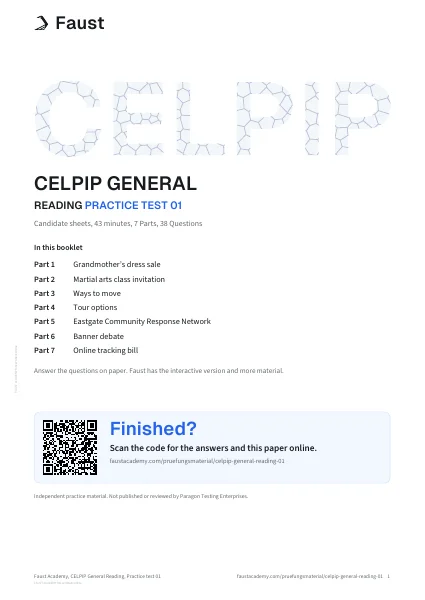
CELPIP-General Reading practice test 1 is a reading paper for the CELPIP-General exam. It takes 43 minutes. The PDF has 24 pages and 7 sections. You can download the PDF for free, with no account. You can also practise it online.
Updated 17 November 2026, Faust Academy team
In this paper
- Grandmother’s dress sale
- Martial arts class invitation
- Reply to Daniel
- Ways to move
- Email about moving
Exam material is in English.
Every PDF is free. How Faust marks
Independent Faust practice material. Not published or endorsed by the Paragon Testing Enterprises Inc..
Inside the paper
Grandmother’s dress sale
Read the following message. Using the drop-down menu (▾), choose the best option according to the information given in the message.
Grandmother’s dress sale
Hi Ravi, I hope you’re settling in well at your new place in Richmond. Can you believe it has been four months since you moved out? The hallway on our old floor is much quieter without your music, and I still miss our chats by the elevators. I’m writing because I need a favour, but let me explain first. You remember my grandmother Margaret, the dressmaker you always waved to when she came down for her mail? She turned 84 this month, and she still sews every day in her apartment on the 17th floor of the same high-rise in Burnaby where we used to be neighbours. She has decided to hold a sale of her handmade dresses at the Willow Park Community Centre on Saturday, November 28. She has been planning it since the summer. People sometimes ask her why she doesn’t simply retire. When I asked her last week, she laughed and said she would feel lost without her sewing and her regular clients, who still ride the elevator up to see her. For her, the work is the best part of every day. Honestly, though, I’m a little uneasy. She is so excited about showing her work that she keeps going late into the night. On Tuesday I found her at midnight, rubbing her sore hands, and she waved me off when I told her to stop. I’ll be at her place on Saturday, November 14, for her last dress fitting, and I’ll try once more to slow her down. Here is where you come in. Could you bring your van to the building on the morning of the sale and drive the dresses and the clothing racks over to the community centre? We will pack everything the evening before, on Friday, November 27, so all you would have to do is load up and go. My mother and my cousin Priya will be helping at the centre all day, and Margaret would be so happy to see you again. To say thank you, we are planning a dinner for you at Margaret’s on Sunday, November 29. She says she will make her famous lentil soup. Let me know if the van is free! Warm regards, Claire
1. Claire’s grandmother Margaret lives
A) in a seniors’ residence in Burnaby
B) in a high-rise apartment in Burnaby
C) in a house in Surrey
D) in a basement suite in Richmond
2. The community centre sale will take place
A) on Saturday, November 14
B) on Sunday, November 29
C) on Friday, November 27
D) on Saturday, November 28
3. Margaret keeps sewing mainly because she
A) loves the work and her regular clients
B) needs the extra income
C) wants to train a younger dressmaker
D) hopes to win a sewing prize
4. Claire is worried that Margaret
A) will not have enough dresses ready
B) will not sell many dresses at the sale
C) is wearing herself out before the sale
D) has been feeling lonely in her apartment
5. Claire hopes Ravi will
A) help pack the dresses the evening before
B) drive the dresses to the community centre
C) come to Margaret’s last dress fitting
D) help at the cash table during the sale
6. Claire and Ravi are
A) co-workers
B) cousins
C) classmates
D) former neighbours
Reading Part 1: Reading Correspondence
Here is a response to the message. Complete the response by filling in the blanks. Select the best choice for each blank from the drop-down menu (▾).
Martial arts class invitation
Hi Priya, Thanks for your message last week, and I’m glad your move to Kamloops is going well. You asked what I’ve been up to on weekends lately, so here is my news. I’ve started a martial arts and breathing class called Seonmudo, and I think you would enjoy it. I’d love for you to come with me on Saturday, November 28. The class is held at Maple Hill Community Centre on Alder Street. I joined the beginner session on Saturday mornings back in September, and that is the one I’d like you to try, since it’s slow and very gentle. The centre is busy all week. The teen class on Friday evenings is always packed, and when I walked past the Wednesday advanced group last month, they were doing amazing things with long wooden staffs. My sister Mina comes on Saturdays too, although she is already talking about moving up to the Sunday group, so you will know at least one person there. I’m happy to drive, since parking at the centre is limited. I’ll be at your door at 8:15 a.m. The doors open at 8:45, which gives us time to sign in and chat with people, and class begins at 9:00. We’re done at 10:30, and a group of us usually walk over to Birch Café for tea and a muffin afterwards. As for what to bring, everyone shows up with a yoga mat and a water bottle, and we do the movements barefoot, so your good gym shoes can stay at home. I keep a towel in the car for the damp walk to the café. You mentioned a sore knee when we chatted last month. Please don’t worry about it. Our instructor, Ms. Cho, is great at changing the movements for anyone who needs something different. Mr. Dube sits at the front desk and looks after registration, so you will meet him when you sign in. The drop-in fee is $15. The front desk only has a little cash box and no card machine, so I always carry a few bills. I’ll look after my own fee, and you can settle yours at the desk when we arrive. Let me know if Saturday works for you. Take care, Daniel
Reply to Daniel
Hi Daniel, Thank you for the invitation. It sounds like a great way to spend a weekend morning, and I would love to come to the ___7___ I’m glad you can drive, because I don’t know the buses in that part of town yet. Could you please confirm that you will pick me up at ___8___ I will bring ___9___ and a water bottle. Since my knee is still a little sore, I will talk to ___10___ before class starts. I’ll also bring cash, because ___11___ I’m looking forward to seeing Mina again as well. Talk soon, Priya
7. Blank 7
A) Sunday beginner class
B) Friday evening class
C) Saturday beginner class
D) Wednesday advanced class
8. Blank 8
A) 8:15 a.m.?
B) 8:45 a.m.?
C) 9:00 a.m.?
D) 10:30 a.m.?
9. Blank 9
A) a pair of gym shoes
B) a towel
C) a wooden staff
D) a yoga mat
10. Blank 10
A) Mr. Dube
B) Mina
C) Ms. Cho
D) the café owner
11. Blank 11
A) Daniel can’t pay for me this time
B) the centre doesn’t take cards
C) I plan to cover his fee too
D) the café charges a booking fee
Moving to Winnipeg
Read the following email message about the diagram on the left. Complete the email by filling in the blanks. Select the best choice for each blank from the drop-down menu.
Ways to move
Rental truck [a rental truck parked at a curb] You pack, load and drive Price: $1,150 Rental period: 3 days Full-service movers [two movers carrying a sofa] They pack, load and deliver Insured for damage Price: $3,400 Delivery: 2 days Shipping container [a container outside a front door] Left at your door for 7 days You load it yourself Price: $2,300 Delivery: 10 days Cargo van [a small cargo van] Small loads only Boxes and small furniture Price: $1,400 Delivery: 4 days
Email about moving
Subject: Moving to Winnipeg To: Priya Nair <pnair@northmail.ca> From: Dana Nair <dnair@northmail.ca> Hi Priya, Thanks for sending me the flyer about the four ways to move to Winnipeg. The cheapest choice is ___1___, but it means driving over 1,300 kilometres in January, and I really don’t want that. The movers would be easy, yet they cost ___2___ than the truck, which is too much for me. My job keeps me busy until six every day before the move, so I need something flexible. My apartment is full of furniture, including some fragile pieces I would rather handle myself, so a small van would not carry enough. One option stays at my door for ___3___, and I don’t mind that delivery takes ten days, because I won’t need the furniture right away. That is why I have decided on ___4___ Since I only have energy for an hour or so after work, I can ___5___ Let me know what you think. Thanks, Dana
1. Blank 1
A) full-service movers
B) the shipping container
C) the rental truck
D) the cargo van
2. Blank 2
A) $1,150 more
B) $1,100 more
C) $3,400 more
D) $2,250 more
3. Blank 3
A) 3 days
B) 7 days
C) 10 days
D) 2 days
4. Blank 4
A) the shipping container
B) the rental truck
C) full-service movers
D) the cargo van
5. Blank 5
A) load a bit each evening
B) leave loading to the movers
C) finish loading in one weekend
D) drive everything there myself
Reading Part 2: Reading to Apply a Diagram
Using the drop-down menu (▾), choose the best option.
Tour options
Foothills Carbon Learning Centre: Half-Day Tours Control Room Tour [A guide stands beside wall screens] Watch gas flow being monitored Price: $18 per person Duration: 2 hours Pipeline Walk [A group walks beside a long pipe] Follow the pipe to the storage well Safety boots provided Price: $25 per person Duration: 3 hours Partner Showcase [Visitors gather at a display table] Hear from industry partners Handle deep rock samples Price: $20 per person Duration: 2.5 hours Lab Workshop [Two people in lab coats study samples] Try simple gas tests Small groups only Price: $30 per person Duration: 3 hours
Learning day tour
Subject: Learning day tour To: Marcus Chen From: Dana Whitfield Hi Marcus, Thanks for sending the budget numbers. I’ve looked at the four tours for our learning day. Since our team is hosting colleagues from other departments, most of whom have never seen how carbon capture and storage works, I’d like a tour that explains the whole process in a way anyone can follow. The Pipeline Walk appeals to me most, since it follows the gas from capture to storage. Safety boots are provided, which helps. The Partner Showcase is also interesting because the centre works with several companies, but it may feel a little abstract. The Lab Workshop looks great, but $30 a person would take us over our $500 limit, so I’d rather skip it. You know our team’s interests better than I do, though, so tell me what you think. If you prefer another tour, I’ll happily go with your view. I may also write a short summary for the company newsletter afterwards. Thanks again, Dana
6. Dana and Marcus
A) are old university friends
B) are a client and a supplier
C) work on the same team
D) are neighbours in one building
7. The main purpose of the visit is
A) to help colleagues understand the process
B) to gather material for a report
C) to choose a partner for a project
D) to examine the pipeline route
8. Dana seems
A) ready to decide alone
B) open to Marcus’s opinion
C) annoyed about the budget
D) worried about safety
Eastgate Community Response Network
Read the following passage. Decide which paragraph, A to D, has the information given in each statement below. Select E if the information is not given in any of the paragraphs.
Eastgate Community Response Network
A. The Eastgate Community Response Network is a small service in Fairhaven that helps residents who have experienced hate or discrimination. It was founded in 2019 by a group of volunteers who kept hearing the same complaint from their neighbours: nobody was sure where to turn after an unpleasant or frightening incident. The first meetings took place in a church hall, with a borrowed telephone and a folding table. Today the network has a downtown office, a small team of staff, and more than sixty trained volunteers who answer questions and welcome visitors. Its work rests on a simple belief: every incident deserves to be taken seriously. B. People can contact the network in three ways: by telephone, through a form on its website, or by visiting the office in person. A report may describe what happened, where it took place and who was involved, but the writer’s name is written down only if he or she agrees. Staff explain this choice at the start of every conversation. Each report, whether long or short, is then entered in a secure database and assigned a reference number, which allows the person to ask about it later. C. Once a report has been received, a caseworker normally gets in touch within two business days. The caseworker listens, explains what options exist and helps the person decide what to do next. Many clients are put in touch with counselling services run by other organizations, or with a legal clinic that offers free advice. Reporting to the police is never required. A staff member will go along to the station if the person asks, but nobody is pressured to file a complaint. Follow-up calls continue for as long as the person finds them helpful. D. The network also studies the information it gathers. Every spring it publishes a summary showing the number and type of incidents recorded during the previous year, and the document is shared with city council. The authors caution that the figures are incomplete, since many people never tell anyone when something happens to them, whether from fear, embarrassment or doubt that anything will change. To keep its methods fair, the network asks an advisory panel of local residents to examine its procedures each year, and the panel’s suggestions are discussed openly at a public meeting. E. Not given in any of the above paragraphs.
1. The published figures probably understate how often incidents happen.
A) Paragraph A
B) Paragraph B
C) Paragraph C
D) Paragraph D
E) Not given in any of the above paragraphs
2. People can describe an incident without giving their names.
A) Paragraph A
B) Paragraph B
C) Paragraph C
D) Paragraph D
E) Not given in any of the above paragraphs
3. The network is paid for by provincial government grants.
A) Paragraph A
B) Paragraph B
C) Paragraph C
D) Paragraph D
E) Not given in any of the above paragraphs
4. A caseworker usually makes contact within two working days.
A) Paragraph A
B) Paragraph B
C) Paragraph C
D) Paragraph D
E) Not given in any of the above paragraphs
5. Volunteers started the service because residents lacked guidance.
A) Paragraph A
B) Paragraph B
C) Paragraph C
D) Paragraph D
E) Not given in any of the above paragraphs
6. Counsellors employed by the network treat clients on site.
A) Paragraph A
B) Paragraph B
C) Paragraph C
D) Paragraph D
E) Not given in any of the above paragraphs
7. Every report receives its own tracking number.
A) Paragraph A
B) Paragraph B
C) Paragraph C
D) Paragraph D
E) Not given in any of the above paragraphs
8. Going to the police is left to the individual.
A) Paragraph A
B) Paragraph B
C) Paragraph C
D) Paragraph D
E) Not given in any of the above paragraphs
9. Residents help review the network’s procedures every year.
A) Paragraph A
B) Paragraph B
C) Paragraph C
D) Paragraph D
E) Not given in any of the above paragraphs
Reading Part 4: Reading for Viewpoints
Read the following article from a website. Choose the best option to complete each sentence according to the information given on the website.
Banner debate
Visitors crossing the Mill Street Bridge in Harlow Falls, Ontario, may soon see something new above the river: a large banner carrying the words “Keep calm and carry on.” Town council is considering the proposal, and it has split opinion along the main street. Harlow Falls has hung banners before, but never one with a message from another country’s past. Reproductions of the famous poster are sold in gift shops across Canada, so the phrase is familiar even to people who know little about where it came from. Councillor Dana Whitfield, who put the idea forward, believes the words suit the community. “When the river flooded our downtown in 1954, people cleaned up and reopened their shops within weeks,” she says. “That sentence speaks to how this town has always got through difficult times, and I think we could use the reminder.” Others wonder what the slogan really stands for. Professor Samuel Okafor, a historian at Lakeshore University, says many residents hold the wrong picture. “People assume it hung on walls all over Britain during the Second World War,” he says. “In fact, the national government prepared it to support morale, but most of the printed copies were never put up in public. It became famous only decades later, when a copy turned up in a secondhand bookshop.” Asked whether the banner should go up, he is not opposed. “Hang it if the town wishes,” he says, “but present it as a symbol people chose, not as history.” Lena Petrov, who owns a gift shop near the bridge, welcomes the attention. “Anything that makes people stop and look around is good for downtown,” she says. She is more careful about the message, however. “I’d support it only if a short panel nearby tells people where the slogan actually came from. Otherwise we are simply repeating a myth.” Council is expected to vote next month. Each speaker, in a different way, comes back to the slogan’s history rather than to the banner’s design or cost. Whatever councillors decide, the words alone will not tell passers-by the whole story.
1. This article is about
A) the true wartime history of a famous British poster
B) a gift shop owner’s plan to attract visitors downtown
C) a proposal to display a historic slogan and the views it has prompted
D) how Harlow Falls recovered from a flood in 1954
2. According to Councillor Whitfield, the banner
A) would remind residents that the town has survived hard times
B) would bring in more visitors than any festival
C) should replace the town’s official motto
D) would mainly honour local veterans of the war
3. Professor Okafor explains that the original poster
A) was displayed in public places across the country
B) was designed by a local committee of residents
C) was meant as a private message to soldiers
D) was government material that was mostly never put up
4. Ms. Petrov’s support for the banner depends on
A) local businesses paying for the printing
B) a short history of the slogan appearing beside it
C) the banner replacing the current bridge decorations
D) historians approving the final wording
5. The writer’s conclusion suggests that the council
A) is likely to reject the banner because of its foreign origin
B) should leave explaining the slogan’s history to local shops
C) will need to think about how the slogan is explained, not only approved
D) has already agreed to add an information panel beside it
Shopper tracking law
The following is a comment by a visitor to the website page. Complete the comment by choosing the best option to fill in each blank.
Online tracking bill
A bill now before the New Brunswick legislature would, for the first time, set provincial limits on how online retailers follow shoppers across websites and apps. The government calls it the Online Shopper Privacy Act. Besides restricting tracking, it would create fines for companies that collect personal data without permission. Public hearings begin next month, and the proposal has already divided consumer groups, retailers and academics. Priya Natarajan, a consumer advocate with the Maritime Shoppers Alliance, says the bill does not go far enough. “Right now a shopper is followed from the first click, and the only way out is a maze of menus,” she says. “Nobody should be tracked until they have said yes. The default must be off, and the customer should be the one to turn it on. Anything else treats silence as consent.” She adds that few shoppers read privacy notices before pressing “accept,” so notices alone protect almost nobody. Daniel Whitford, president of the Atlantic Retail Association, favours a lighter approach. “A clear notice on every website would give customers the information they need,” he says. “Small shops depend on targeted advertising to find buyers at a price they can afford, because they cannot compete with national chains on billboards or television.” He predicts that the cost of new consent tools could leave many small sellers struggling to stay in business. Dr. Hélène Marchand, a privacy law professor at the Université de Fredericton, is more concerned about enforcement. “Companies that buy and sell personal profiles should have to erase what they hold at least once a year,” she says. She also warns that the bill’s proposed fines, capped at $10,000, are so low that large companies would simply book them as the ordinary price of doing business. In her view, a big platform could also absorb compliance costs far more easily than a corner shop. The bill’s sponsor, Minister Claire Doucet, says she is open to changes once the hearings end. Committee members have asked staff to compare tracking rules in other provinces and countries before the bill returns for a final vote. Written submissions from residents will be accepted until the end of next month.
Reader comment
I own a small online pottery shop in Moncton, so this bill matters a great deal to me. I agree with Priya Natarajan that ___6___ That is simply fair to the customer. Daniel Whitford says that ___7___ but I doubt it for my own business. I have never paid for a targeted ad, and ___8___ That is my own experience, and it is not unusual. Dr. Hélène Marchand is right to point out that ___9___ so the penalties must be serious enough to change behaviour. Looking ahead, I expect ___10___ Fair rules would be good for everyone.
6. Blank 6
A) data brokers should have to delete their stored records every year
B) tracking should be switched off unless a customer chooses to turn it on
C) shoppers should be taught to manage their own privacy settings
D) tracking should be allowed as long as stores post a clear notice
7. Blank 7
A) tracking helps shoppers find products they actually want,
B) large platforms will gain if the rules become stricter,
C) tracking has little effect on the prices customers pay,
D) small shops rely on targeted ads to reach buyers affordably,
8. Blank 8
A) my customers mostly find me through friends and craft fairs
B) my buyers mostly found me through sponsored posts
C) my ad costs went up after the platform changed its rules
D) my sales rise whenever I buy more targeted ads
9. Blank 9
A) most tracking firms operate outside the province’s reach,
B) privacy notices alone protect almost nobody,
C) small fines are treated as a routine cost of business,
D) voluntary labels have never been tested in Canada,
10. Blank 10
A) many small sellers to struggle with the cost of new consent tools
B) honest small sellers to gain as shoppers regain trust online
C) large platforms to pass compliance costs on to sellers
D) many customers to accept tracking without reading the settings
More papers
All 1 CELPIP-General Reading papersFrequently asked questions
- How long is CELPIP-General Reading practice test 1?
- The paper takes 43 minutes. The PDF has 24 pages, and the answer key is a separate PDF.
- Is CELPIP-General Reading practice test 1 free?
- Yes. You can download the PDF for free, with no account. Online, one scored paper per part is free.