
Aptis ESOL General Reading practice test 1
- Engineered to the real Aptis format
 Reading 1 / 1
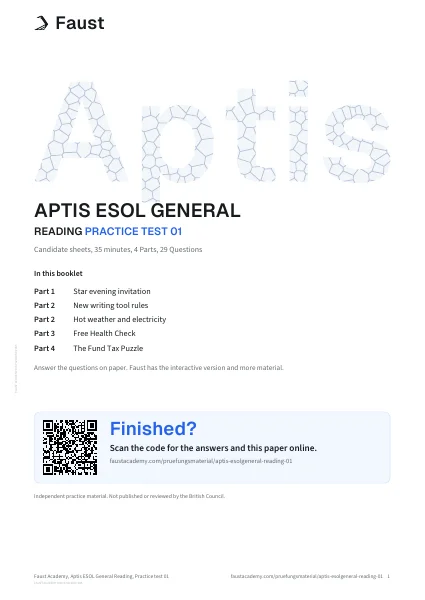
Aptis ESOL General Reading practice test 1 is a reading paper for the Aptis ESOL General exam. It takes 35 minutes. The PDF has 13 pages and 5 sections. You can download the PDF for free, with no account. You can also practise it online.
Updated 18 November 2026, Faust Academy team
In this paper
- Star evening invitation
- New writing tool rules
- Hot weather and electricity
- The Fund Tax Puzzle
Exam material is in English.
Every PDF is free. How Faust marks
Independent Faust practice material. Not published or endorsed by the British Council.
Inside the paper
Star evening invitation
Choose one word (A, B, or C) for each space and write the letter on the answer sheet. The first one (0) is done for you as an example with the answer A marked on your answer sheet.
Star evening invitation
Hi Tom, Please __(0)__ to my star evening on Friday. We can look at stars __(1)__ a telescope. My sister __(2)__ hot tea. Please __(3)__ a warm coat, as it is cold. The park is __(4)__ my house, so we can walk. The star evening starts at eight, so do not be __(5)__. Love, Anna
Example
0. Gap 0
A) come
B) eat
C) open
Answer: A
1. Gap 1
A) with
B) for
C) at
2. Gap 2
A) bring
B) brings
C) bringing
3. Gap 3
A) open
B) say
C) wear
4. Gap 4
A) near
B) next
C) nearly
5. Gap 5
A) later
B) lately
C) late
New writing tool rules
The sentences below give rules for office staff using a new writing tool at work. Put the sentences (B-F) in the right order. Write your answers on the answer sheet (Questions 6-10). The first sentence (A) is given for you on the answer sheet as an example.
New writing tool rules
A The office has a new writing tool, so all staff should follow these rules when they use it. (Example) B If you find a mistake, correct it yourself before you send anything. C It will then give you a new version in a few seconds. D Finally, ask a colleague to check any important email once more. E First, type your own short text into the tool and say what you need. F Please read this new version carefully, because the tool sometimes makes mistakes with names and dates.
6. Second sentence
B) If you find a mistake, correct it yourself before you send anything
C) It will then give you a new version in a few seconds
D) Finally, ask a colleague to check any important email once more
E) First, type your own short text into the tool and say what you need
F) Please read this new version carefully, because the tool sometimes makes mistakes with names and dates
7. Third sentence
B) If you find a mistake, correct it yourself before you send anything
C) It will then give you a new version in a few seconds
D) Finally, ask a colleague to check any important email once more
E) First, type your own short text into the tool and say what you need
F) Please read this new version carefully, because the tool sometimes makes mistakes with names and dates
8. Fourth sentence
B) If you find a mistake, correct it yourself before you send anything
C) It will then give you a new version in a few seconds
D) Finally, ask a colleague to check any important email once more
E) First, type your own short text into the tool and say what you need
F) Please read this new version carefully, because the tool sometimes makes mistakes with names and dates
9. Fifth sentence
B) If you find a mistake, correct it yourself before you send anything
C) It will then give you a new version in a few seconds
D) Finally, ask a colleague to check any important email once more
E) First, type your own short text into the tool and say what you need
F) Please read this new version carefully, because the tool sometimes makes mistakes with names and dates
10. Sixth sentence
B) If you find a mistake, correct it yourself before you send anything
C) It will then give you a new version in a few seconds
D) Finally, ask a colleague to check any important email once more
E) First, type your own short text into the tool and say what you need
F) Please read this new version carefully, because the tool sometimes makes mistakes with names and dates
Hot weather and electricity
The sentences below are from a book about how countries keep electricity working in hot weather. Put the sentences (B-F) in the right order. Write your answers on the answer sheet (Questions 11-15). The first sentence (A) is given for you on the answer sheet as an example.
Hot weather and electricity
A In very hot weather, many families use fans and fridges more than usual. (Example) B To help, power companies check the cables and wires before every summer. C Another way to help is to share electricity with nearby countries through special lines. D This means that the whole country needs much more electricity, especially in the afternoon. E If one country has a problem, a neighbour can quickly send power across the border. F They replace the old ones that could break when the weather is very hot.
11. Second sentence
B) To help, power companies check the cables and wires before every summer
C) Another way to help is to share electricity with nearby countries through special lines
D) This means that the whole country needs much more electricity, especially in the afternoon
E) If one country has a problem, a neighbour can quickly send power across the border
F) They replace the old ones that could break when the weather is very hot
12. Third sentence
B) To help, power companies check the cables and wires before every summer
C) Another way to help is to share electricity with nearby countries through special lines
D) This means that the whole country needs much more electricity, especially in the afternoon
E) If one country has a problem, a neighbour can quickly send power across the border
F) They replace the old ones that could break when the weather is very hot
13. Fourth sentence
B) To help, power companies check the cables and wires before every summer
C) Another way to help is to share electricity with nearby countries through special lines
D) This means that the whole country needs much more electricity, especially in the afternoon
E) If one country has a problem, a neighbour can quickly send power across the border
F) They replace the old ones that could break when the weather is very hot
14. Fifth sentence
B) To help, power companies check the cables and wires before every summer
C) Another way to help is to share electricity with nearby countries through special lines
D) This means that the whole country needs much more electricity, especially in the afternoon
E) If one country has a problem, a neighbour can quickly send power across the border
F) They replace the old ones that could break when the weather is very hot
15. Sixth sentence
B) To help, power companies check the cables and wires before every summer
C) Another way to help is to share electricity with nearby countries through special lines
D) This means that the whole country needs much more electricity, especially in the afternoon
E) If one country has a problem, a neighbour can quickly send power across the border
F) They replace the old ones that could break when the weather is very hot
Free Health Check
Four people were asked by a local newspaper about their opinions of the town’s free health check. Read the texts and answer Questions 16-22. Choose one answer (A, B, C or D) and mark it on your answer sheet.
Free Health Check
Person A ‘I am retired, so the morning appointments suit me very well. The woman next door told me about the check and kept telling me to go. I nearly stayed at home on the day, because I was afraid the doctor would find something wrong. Waiting for my results felt very long. In the end everything was fine, but I have not changed anything in my daily life. I think the age of fifty is about right.’ Person B ‘I work long hours in a warehouse, and that is my problem. The check is only open on weekday mornings, when I am always at work. At the warehouse it is the same for the men and the women: nobody has time to see a doctor. I only found out about it because I saw a poster by chance when I was shopping. I think the council should post the date and the place to every home in town.’ Person C ‘I am thirty-two, so I am too young to be invited, and I think that is a mistake. My father looked after himself, but he had heart trouble at forty-five. I run three times a week and eat well, so I am not worried about my own result. I read about the check on the town website, which was easy to find. I would like the council to invite people from thirty.’ Person D ‘My brothers and my friends never go to the doctor and live on fast food, but my sisters book a check-up every year without being told. The men I know think a doctor is only for people who are already ill. I was just like the men in my family, but my check showed a high risk. Since then I have stopped smoking, and now I cycle to work every day. I am sure the check saves lives.’
16. Who finds the opening times of the health check difficult?
A) Person A
B) Person B
C) Person C
D) Person D
17. Who believes men and women treat their health differently?
A) Person A
B) Person B
C) Person C
D) Person D
18. Who felt worried before getting the results?
A) Person A
B) Person B
C) Person C
D) Person D
19. Who thinks the check should start at an earlier age?
A) Person A
B) Person B
C) Person C
D) Person D
20. Who wants everyone in town to be told personally?
A) Person A
B) Person B
C) Person C
D) Person D
21. Who has changed daily habits since the check?
A) Person A
B) Person B
C) Person C
D) Person D
22. Who first heard about the health check from a neighbour?
A) Person A
B) Person B
C) Person C
D) Person D
Part 4
Read the text below. Match the headings A-H to the paragraphs 1-7 (Questions 23-29). Write your answers (A-H) on the answer sheet. There is one more heading than you need. The answer to Paragraph 0 is given on the answer sheet as an example (J).
The Fund Tax Puzzle
A surprise in the small print (Example) 0. For many years, millions of people have put a little money into investment funds, hoping to build up savings for retirement, a house or simply a rainy day. Most of them assume that the tax office takes a fair share of their profits and nothing more. Recently, however, a legal dispute has shown that the rules were more complicated, and sometimes less fair, than anyone had realised. 1. Marta Hollis, a nurse, spent several years putting small sums into three investment funds. In one year she sold part of a fund that had done well and made a gain of £900. Her other fund, however, lost £1,400 over the same twelve months. When her bank sent the annual statement, she was astonished to find that she had paid tax on a profit although her yearly result was a loss. Her neighbour Tomas, a retired driver, told almost the same story. Thousands of ordinary savers opened their statements and felt that something was wrong. 2. The reason lay in the way the old rules were built. Every investment was placed in a category, and each category had its own account. Under those rules, losses were kept in separate accounts and could not be combined with gains from another category. For example, a loss on shares in a single company could only be set against profits from other shares. It could not reduce the tax due on a gain from a fund, even when both belonged to the same person in the same year. The result was a confusing set of compartments, and savers often had no idea which one held their money. 3. The matter reached the Eastmarch Revenue Court after a group of savers challenged their tax bills. In its judgment, the court rejected the old practice, saying that the law gave no reason to treat the categories so differently. The judges ruled that losses should be set against gains when a person's tax for the year is calculated. Lawyers described the decision as a turning point, because tax offices had applied the earlier method for many years and had rarely been questioned. Several banks said they would study the judgment carefully before changing their systems. 4. Sadly, a court ruling does not mean that money arrives in every account. Banks will not correct old tax bills by themselves; savers must ask. The tax offices behave in the same way: they do not review earlier years unless someone sends in an application. Each person therefore has to write a request for repayment for every year in question, and nobody will remind them. A few banks have published short guides on their websites, but others have said nothing at all. Savers who wait for a letter may wait for ever. 5. A good claim begins with good records. Most savers will need their yearly statements from every fund and bank account involved, plus the purchase records showing when and at what price each holding was bought. The tax certificates that banks send each spring are also essential, because they show how much tax was actually paid. Banks usually supply copies on request, though some charge a small fee and need several weeks. Older papers may be harder to find, so it is worth asking early and keeping every reply in one folder. 6. Not everyone can benefit, however. Only savers who bought their funds before 1 January 2018 are covered by the ruling, because later purchases are taxed under a newer system. In addition, the tax bill for the year concerned must not yet be final; once the deadline for objections has passed, the case is closed. Finally, the saver must still have losses that have not been used up elsewhere. A person whose losses were already offset against other gains has nothing left to claim. Advisers suggest checking these three conditions before spending time on an application. 7. Looking ahead, the picture is brighter. Under the new approach, in future years, losses should be offset more simply, with the system combining results before the tax is calculated. Nobody expects the change to remove every difficulty at once, and the details may still be adjusted by the government. Savers are therefore advised to read their yearly statements carefully each spring and to ask questions when a figure looks odd. A small amount of attention now may prevent a much bigger problem later. Headings A Action is up to the investor B Limits on who can claim C A system built on separate pots D Banks that repay without being asked E Tax paid despite an overall loss F What to expect from now on G The court changes direction H Gathering the paperwork J A surprise in the small print (Example)
23. Paragraph 1
A) Action is up to the investor
B) Limits on who can claim
C) A system built on separate pots
D) Banks that repay without being asked
E) Tax paid despite an overall loss
F) What to expect from now on
G) The court changes direction
H) Gathering the paperwork
24. Paragraph 2
A) Action is up to the investor
B) Limits on who can claim
C) A system built on separate pots
D) Banks that repay without being asked
E) Tax paid despite an overall loss
F) What to expect from now on
G) The court changes direction
H) Gathering the paperwork
25. Paragraph 3
A) Action is up to the investor
B) Limits on who can claim
C) A system built on separate pots
D) Banks that repay without being asked
E) Tax paid despite an overall loss
F) What to expect from now on
G) The court changes direction
H) Gathering the paperwork
26. Paragraph 4
A) Action is up to the investor
B) Limits on who can claim
C) A system built on separate pots
D) Banks that repay without being asked
E) Tax paid despite an overall loss
F) What to expect from now on
G) The court changes direction
H) Gathering the paperwork
27. Paragraph 5
A) Action is up to the investor
B) Limits on who can claim
C) A system built on separate pots
D) Banks that repay without being asked
E) Tax paid despite an overall loss
F) What to expect from now on
G) The court changes direction
H) Gathering the paperwork
28. Paragraph 6
A) Action is up to the investor
B) Limits on who can claim
C) A system built on separate pots
D) Banks that repay without being asked
E) Tax paid despite an overall loss
F) What to expect from now on
G) The court changes direction
H) Gathering the paperwork
29. Paragraph 7
A) Action is up to the investor
B) Limits on who can claim
C) A system built on separate pots
D) Banks that repay without being asked
E) Tax paid despite an overall loss
F) What to expect from now on
G) The court changes direction
H) Gathering the paperwork
More papers
All 1 Aptis ESOL General Reading papersFrequently asked questions
- How long is Aptis ESOL General Reading practice test 1?
- The paper takes 35 minutes. The PDF has 13 pages, and the answer key is a separate PDF.
- Is Aptis ESOL General Reading practice test 1 free?
- Yes. You can download the PDF for free, with no account. Online, one scored paper per part is free.